Photo: Internet Since the end of November last year, news from the Gorno-Badakhshan Autonomous Region of Tajikistan has periodically made headlines in the media. According to numerous reports, the situation there is not entirely calm. We decided to analyze the current situation and provide you with a detailed account of what is happening. Trigger for […]
AZDA.TV· Send to others
Photo: Internet
Since the end of November last year, news from the Gorno-Badakhshan Autonomous Region of Tajikistan has periodically made headlines in the media. According to numerous reports, the situation there is not entirely calm. We decided to analyze the current situation and provide you with a detailed account of what is happening.
Trigger for the new escalation of the situation in Khorog
The escalation of the situation in eastern Tajikistan – in the Gorno-Badakhshan Autonomous Region occurred due to the death of 29-year-old Gulbidin Ziyobekov. The versions of the authorities and his relatives differ significantly. Official sources claim that Ziyobekov died from injuries sustained during his detention. Allegedly, he resisted the special forces of the Ministry of Internal Affairs. However, the relatives of the deceased assert that Gulbidin was unarmed and was killed after his detention while being taken to the police station.
Ziyobekov’s death sparked mass protests in Khorog and several clashes with security forces, resulting in the deaths of two more young men.
In November, a mass protest ended with an agreement between civil activists and the regional leadership to jointly investigate the circumstances surrounding Gulbidin Ziyobekov’s death. However, three months later, the investigation remains incomplete, and those responsible have not been held accountable. Against this backdrop, the authorities launched an information campaign against the so-called informal leaders of the region.
Background
The Gorno-Badakhshan Autonomous Region is the largest administrative unit of the Republic of Tajikistan. Its area accounts for almost 45 percent of the entire territory of the republic. Despite this, the region has a small population of about 220,000 people, most of whom are settled in ten large valleys. Due to the mountainous terrain, harsh climatic conditions, and underdeveloped communications, there has been an outflow of population from Gorno-Badakhshan to the central part of the republic – primarily to the capital and to regions of Russia. In the last decade, social and political instability in the region has added to these three factors.
Since 2012, the region has experienced periodic unrest, provoked by either local authorities or security forces dispatched from the center.
For example, in the summer of 2012, the situation in Gorno-Badakhshan sharply deteriorated due to the murder of the head of the regional department of the State National Security Committee of the republic, Abdullo Nazarov. According to various reports, the reason for his murder was a struggle over large smuggling flows, presumably of cigarettes from Afghanistan, which passed through the Ishkashim district and then headed to the central part of Tajikistan and southern Kyrgyzstan. At that time, the republican authorities accused informal leaders of Gorno-Badakhshan of the general’s murder and demanded that they hand over the culprits. However, negotiations soon stalled, leading to a large-scale special operation by government forces, resulting in the deaths of 41 people – 18 military personnel and 23 civilians. More extensive clashes were then prevented through the mediation of civil society and representatives of international organizations.
The outcome of the events of 2012 was an increase in the number of government forces in the region, the establishment of military posts within Khorog, and increased control over informal leaders in the area.
Who are the informal leaders of the region?
Informal leaders of Gorno-Badakhshan are primarily former field commanders of the United Tajik Opposition and newly emerged authorities among Badakhshan youth in the region and Russia.
After the signing of the peace agreement between the government of Rahmon and the Tajik opposition, some of the informal leaders of Badakhshan were integrated into the republic’s security agencies under a thirty percent quota. However, as the Tajik opposition weakened, almost all former field commanders of the United Tajik Opposition were pushed out of government structures.
After unsuccessful attempts to neutralize former field commanders, the government of Emomali Rahmon forced them to sign a document in which the informal leaders of the region took on a number of obligations in exchange for the authorities’ promise to cease their persecution.
Currently, the known informal authorities of Gorno-Badakhshan include:
– Tolib Aymbekov
– Mamadbokir Mamadbokirov
– Yodgor Mamadaslamov
– Khursand Mazarov
– Munavvar Shanbiyev
– Zoir Rajabov
and Amriddin Alovatshoeyev.
Systematic elimination of former field commanders of the United Tajik Opposition
The struggle of Emomali Rahmon against the informal leaders that emerged during the civil war began immediately after the signing of the peace agreement. Initially, the president, pursuing good intentions, namely strengthening republican power, only fought against those former “warlords” who refused to obey the law. However, over the years, under the banner of “strengthening legitimate power,” Emomali Rahmon focused on eliminating all regional authorities that could pose a threat to his power.
Since the mid-2000s, special operations to eliminate former field commanders of the United Tajik Opposition have been conducted in regions opposed to Emomali Rahmon.
Furthermore, as he strengthened his family-clan power, the current president also eliminated former associates whom Rahmon saw as a threat.
Why does the government want to minimize the influence of informal leaders in the region?
The current crisis in the Gorno-Badakhshan Autonomous Region is also linked to Emomali Rahmon’s plans to eliminate former field commanders of the United Tajik Opposition. Informal leaders, according to experts, while not posing a direct threat to Rahmon’s power on a national scale, exert certain pressure on representatives of the central authority in the region.
Former field commanders, along with their supporters, partly prevent corrupt officials from acting freely, demand that the authorities adhere to the laws of the republic, and sometimes participate in resolving certain socio-economic issues, thereby somewhat duplicating the function of the authorities.
And here it is worth recalling the reason for the current crisis. According to the authorities, Gulbidin Ziyobekov took a prosecutor’s assistant from the Roshtkala district of the Gorno-Badakhshan Autonomous Region hostage and beat him in 2018. The corresponding video with the prosecutor’s assistant can be found on the internet. In the video, young men accuse Abdusalom Abirzoda of harassing a local girl, allegedly because the prosecutor’s assistant had been calling her on the phone.
In that case, the regional prosecutor’s office opened a criminal case against Ziyobekov and demanded that he appear for questioning. The attempt to forcibly bring Ziyobekov to the police station at the end of November last year ended tragically.
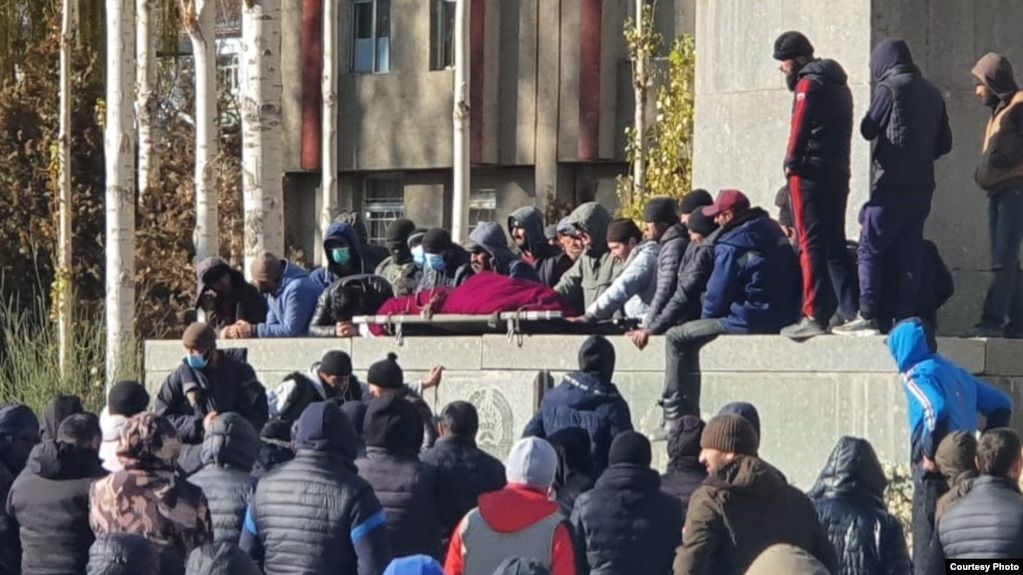 Photo: Internet