News
HUMAN RIGHTS
The European Union expressed concern over human rights violations in Tajikistan
Representatives of the European Union have called for accountability for all those responsible for human rights violations in the Gorno-Badakhshan Autonomous Region. On November 27, the tenth annual meeting of the Cooperation Committee between the European Union and the Republic of Tajikistan took place in Brussels (Belgium). The meeting was chaired by the Minister of […]
Representatives of the European Union have called for accountability for all those responsible for human rights violations in the Gorno-Badakhshan Autonomous Region.
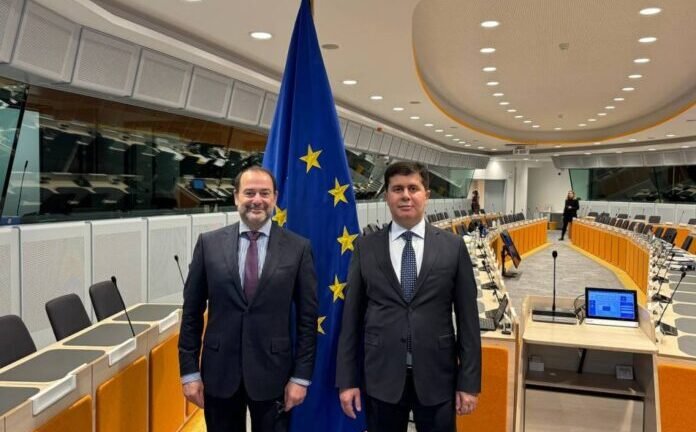
On November 27, the tenth annual meeting of the Cooperation Committee between the European Union and the Republic of Tajikistan took place in Brussels (Belgium).
The meeting was chaired by the Minister of Economic Development and Trade, Zavki Zavkizoda, and the head of the European Commission’s Department, Luka Devine.
The Cooperation Committee reviewed the state of bilateral relations and addressed issues of political and socio-economic development, water resources, the environment, energy, trade and investment cooperation, as well as regional and international matters, according to the statement.
According to the press service of the European Union’s Diplomatic Service, the parties exchanged views on ongoing negotiations for the conclusion of the Agreement on Enhanced Partnership and Cooperation (EPCA), which began earlier this year, and on Tajikistan’s application for participation in the unilateral duty-free regime under the EU’s Generalized Scheme of Preferences (GSP+).
The Generalized Scheme of Preferences (GSP+) exempts the country from paying taxes for the export of more than 6,000 types of goods to the European market.
Experts believe that if the country obtains this status, Tajik exporters could save tens of millions of dollars.
However, to achieve this status, the Tajik authorities must fulfill their commitments under 27 signed declarations, including those related to human rights, labor law, environmental protection, and climate.
However, in international human rights rankings, Tajikistan occupies one of the worst positions.
At this meeting, the European Union urged for human rights to be aligned with the recommendations of the UN and OSCE, particularly regarding freedom of association, peaceful assembly, freedom of expression, freedom of the media, as well as freedom of religion and belief.
In this regard, the European Union welcomed the adoption of the first Strategy and Action Plan on Human Rights in Tajikistan for 2023-2025 and called for its full implementation and further engagement of civil society in political processes.
At the same time, the European Union expressed its concern regarding the detention of human rights defenders, independent journalists, and bloggers, and urged the Tajik authorities to ensure accountability and bring to justice all those responsible for human rights violations in the Gorno-Badakhshan Autonomous Region (GBAO).
It is still unknown how the Tajik authorities reacted to these demands.
Earlier in 2022, the authorities of the country brutally suppressed protests in GBAO. As a result, dozens of residents were killed or injured. Later, under the pretext of combating organized crime, the authorities detained and imprisoned dozens of residents, civil society activists, and prominent figures in the region, including from the city of Khorog and the Rushan district.
International and local human rights organizations have repeatedly called on the authorities of Tajikistan to release imprisoned journalists, civil society activists, and other political prisoners, but the authorities always ignore these calls from human rights organizations.