News
POLITICS
Rahmon dismissed a number of leaders of the Ministry of Internal Affairs and the State National Security Committee
On January 19, 2024, under the leadership of the head of the Security Council, President Emomali Rahmon, a meeting of the Security Council of Tajikistan was held. It was reported that the meeting discussed “the state of security and stability, the rule of law, public order, and the fight against crime in the country, including […]
On January 19, 2024, under the leadership of the head of the Security Council, President Emomali Rahmon, a meeting of the Security Council of Tajikistan was held.
It was reported that the meeting discussed “the state of security and stability, the rule of law, public order, and the fight against crime in the country, including in the Khatlon region.”
Emomali Rahmon expressed dissatisfaction with the prevention and fight against terrorist and extremist crimes, drug trafficking and smuggling, transnational organized crime, and corruption-related economic crimes, and instructed to intensify these processes.
According to some experts, if the government of Emomali truly wanted to, it could eradicate corruption at the highest levels of power; however, instead, they overlook the corruption of officials and, under the pretext of fighting extremism, imprison dissenters and representatives of the intelligentsia for criticizing the government.
Earlier, on January 17 of this year, the European Parliament strongly condemned the repressions and criticized the Tajik authorities for using laws against extremism and terrorism as a basis for persecuting employees of independent Tajik media.
However, at the Security Council meeting, Emomali Rahmon acknowledged that, in addition to the rise of corruption and bribery among law enforcement officials and civil servants, there has been an increase in extremist and terrorist crimes, drug smuggling, and the involvement of some law enforcement, supervisory, and security personnel in illegal drug trafficking, which indicates a “low professional level, incompetence in the performance of official duties, hiring random and unprofessional individuals into the ranks of the agencies, and the selection and improper placement of personnel by the heads of the agencies.”
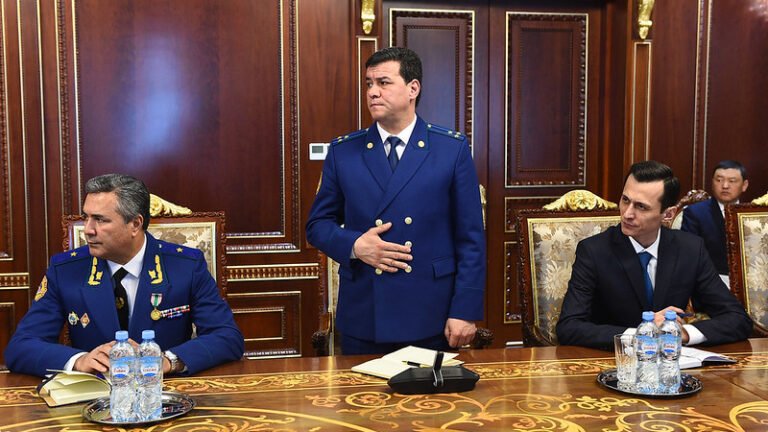
At this meeting, Emomali Rahmon dismissed several high-ranking officials from the Ministry of Internal Affairs, including the head of the Ministry’s Department for the Khatlon region and his deputies, the head of the Ministry’s Department in the city of Kulob, the head of the Ministry’s Department in the city of Bokhtar and the Kushoniyon district, the head of the Ministry’s Department for the Khatlon region in the Kulob zone, and the heads of several departments of the central apparatus of the Ministry of Internal Affairs.
He also dismissed the prosecutor of the Khatlon region and his deputies, the heads of several prosecutor’s offices across the country, and prosecutors from several cities and districts.
Additionally, the head of the operational group of the State Committee for National Security in the Khatlon region, the head of the operational group of the Kulob zone, and the heads of several departments of the central apparatus of the State Committee for National Security were also dismissed.
Rahmon also ordered the dismissal of the head of the Agency for State Financial Control and the Fight Against Corruption in the Khatlon region and his deputies, the head of the Agency’s department for state financial control in the cities and districts of the Kulyab zone, and others.
The President of the country instructed to reduce the staff of the State Automobile Inspectorate of the Ministry of Internal Affairs by 30 percent.
The reason for the dismissal of the heads of disciplinary and law enforcement agencies in the Khatlon region and other regions of the country is due to “numerous cases of violations and non-compliance with the requirements of legislation and military regulations.”
The unexpected mass dismissal of key leaders of law enforcement agencies, especially in the Khatlon region, raises a number of questions among experts. In particular, while Tajikistan constantly warns of the dangers from the neighboring country – Taliban Afghanistan, what is the message behind the mass removal from office of a large number of key leaders of law enforcement agencies?
Some experts also believe that there are two possible explanations in this case: first, perhaps these officials of law enforcement agencies indeed committed serious crimes, the scale of which is personally known to Emomali Rahmon, and he has no choice but to dismiss them, or, possibly, Rustam Emomali will come to power in the near future, so Emomali Rahmon is clearing the way for his son to the presidential chair.