News
RELIGION SOCIETY
Instructions from President Rahmon before the month of Ramadan
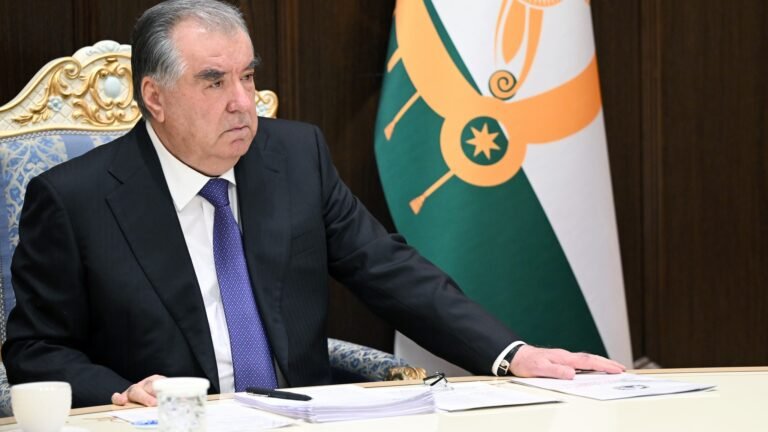
On March 9, President Emomali Rahmon met with representatives of the public, religious figures, and the scientific intelligentsia of Tajikistan. He congratulated everyone on the upcoming holy month of Ramadan. He reminded all listeners of the laws “On the Regulation of Traditions, Celebrations, and Rituals in the Republic of Tajikistan” and “On the Responsibility of […]
On March 9, President Emomali Rahmon met with representatives of the public, religious figures, and the scientific intelligentsia of Tajikistan. He congratulated everyone on the upcoming holy month of Ramadan. He reminded all listeners of the laws “On the Regulation of Traditions, Celebrations, and Rituals in the Republic of Tajikistan” and “On the Responsibility of Parents for the Education and Upbringing of Children,” demanding strict adherence to the provisions of these laws from the country’s public. He lamented the cases of law violations, stating that “some Tajik citizens still indulge in extravagance during events.” The President also referred to the commandments of the Quran and the hadiths of the Prophet, noting the “displeasure of the Almighty” towards the extravagant.
The head of the Tajik state drew attention to the multiple trips of Tajik citizens for Hajj and Umrah, emphasizing the singular nature of pilgrimage, again citing the Prophet Muhammad, who performed pilgrimage only once. President Rahmon mentioned the figure of 29 individuals who were able to worship Islamic relics during the Soviet era and indicated the “large” number of Tajik citizens who undertook pilgrimage during the years of Independence, with a total expenditure of 12 billion somoni. He admonished everyone for such large expenses on pilgrimage and suggested that “if this money had been spent on building housing, improving living conditions and children’s education, providing quality food, clothing, and school supplies, as well as supporting the needy or for beautification, it would have improved the living conditions of Tajik families.” For those wishing to go to Mecca a second and third time, Rahmon proposed acting according to the commandments of Sharia, “spending resources on a decent life for their family, the education of children and grandchildren, the beautification of the country, the construction of enterprises and schools, roads and bridges, as well as donating money to help and support orphans, street children, the disabled, the sick, and low-income families.”
Touching on the share of practicing Muslim believers, Rahmon reported that in Tajikistan, there is one mosque for every 1800-2000 citizens, while “in other CIS member states, this figure is 3-3.5 thousand, and in other developed countries of the world, it is 5-5.5 thousand per mosque.” He emphasized the advantages of the Independence period, the secular system of the state in creating “conditions for the realization of religious rights and freedoms for the citizens of the country, and ensuring their freedom of conscience is at an appropriate level.” Rahmon once again compared the current times with the history of the Soviet era, when “there were 34 mosques operating in Tajikistan, including 17 central mosques, 15 churches, and 2 synagogues; that the “strict restrictive measures of that time did not lead to religious extremism and terrorism, or inter-religious conflicts.”
Rahmon provided statistics, noting that “there are about 4 thousand mosques operating in Tajikistan, an Islamic institute, religious studies research institutions, more than 250 thousand people who have made pilgrimages, and over 4 thousand who have performed the minor pilgrimage – Umrah, thousands of religious figures, who are graduates of domestic and foreign institutions, operate in a free atmosphere.” He did not forget to remind about “the great son of the Tajik nation Abu Hanifa Numon ibn Sabit, also known as Imam Azam, who is the founder of ‘the greatest tolerant school of thought in the world of Islam,’ whose followers make up almost 60% of the world’s Muslims, that is, more than half of the believers in the religion of Islam.” Rahmon praised the Sunnis, stating that “the Hanafi school has many followers because it prioritizes tolerance above all, being favorable for every time, considering man as the highest creation of the deity.”
Rahmon criticized the followers of the Islamic trend “Salafism,” as they “bring radical and hostile ideas into the religious atmosphere of Tajikistan, have a negative attitude towards the Hanafi school and its founder Imam Abu Hanifa, and also express hostility towards the Ismaili school, which has historically been and remains a part of the faith of some segments of the indigenous population of the country.”
Rahmon spoke out against illegal religious education and the numerous cases of preventing “the active process of brainwashing children, adolescents, and youth.” The President of Tajikistan believes that “illegal religious education in many cases leads to the formation of religious fanaticism in the consciousness of the learner and subsequently to the commission of extremist and terrorist acts.” Additionally, Rahmon noted that “illegal religious education leads to demagoguery, engaging in fortune-telling, witchcraft, other undesirable activities, illegal private medical practice, as well as causing material and physical harm to citizens on this basis.” He reminded that “the Prophet of Islam categorically prohibited going to fortune-tellers and magicians and instructed: ‘Anyone who goes to a fortune-teller, his prayers will not be accepted for 40 days; if he believes in the fortune-teller, he will be expelled from faith…’
Rahmon particularly highlighted cases of Tajik citizens being involved in acts of international terrorism, whose actions damage the reputation of the Tajik state and the Tajik nation on the world stage. He emphasized that in the country, the Supreme Court has banned the activities of 28 extremist and terrorist organizations, but there are still cases of joining such parties and movements. Rahmon could not avoid the issue of political Islam and stated that “the politicization of religion is an artificial process and has nothing to do with the religion of Islam.”
Rahmon mentioned the civil war of 1992-1997, stating that “the people will never forget the 150,000 killed, one million forced refugees, over 50,000 orphans, millions of people who lost their relatives and loved ones, billions of somoni in economic losses from those days, which still affect our economy and life today.” Thus, President Rahmon urged citizens to “fight against any manifestation of extremism and terrorism and to ensure the rule of law in the country.”
Concluding his festive speech, the leader of the nation Rahmon called on “the heads of regions, cities, and districts, local structures of the ministries of education and science, culture, labor, migration and employment, committees for youth and sports, women and family, and religious affairs” to strengthen ideological work, organize national traditions, celebrations, and rituals, and urged law enforcement agencies and courts to pay necessary attention to the aforementioned issues.”