News
POLITICS
Moscow accused Kyiv, while ISIS claimed responsibility for the attack
The Kremlin accuses Ukraine, despite the lack of evidence linking Kyiv to the attack, meanwhile, ISIS-Khorasan poses a clear threat to Russia (according to The Diplomat). The devastating terrorist attack on March 22 at the Crocus City Hall hotel in Krasnogorsk on the outskirts of Moscow, allegedly carried out by four citizens of Tajikistan, vividly […]
The Kremlin accuses Ukraine, despite the lack of evidence linking Kyiv to the attack, meanwhile, ISIS-Khorasan poses a clear threat to Russia (according to The Diplomat).
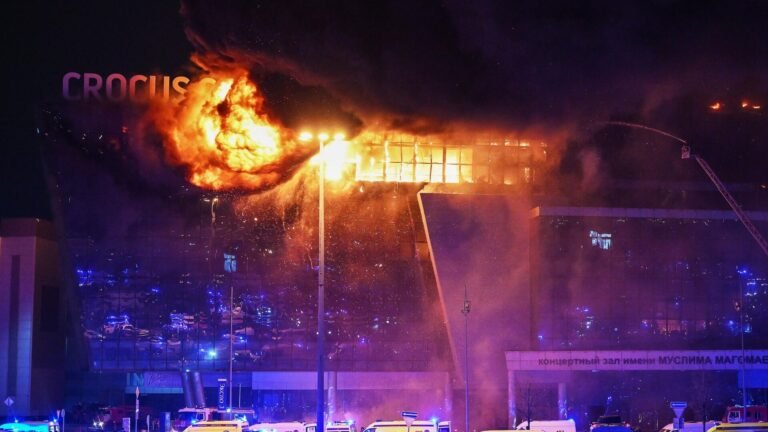
The devastating terrorist attack on March 22 at the Crocus City Hall hotel in Krasnogorsk on the outskirts of Moscow, allegedly carried out by four citizens of Tajikistan, vividly demonstrates the threats posed by Central Asian jihadist terrorism and extremism. The shooting in the concert hall unfortunately confirmed the U.S. Embassy’s security warning in Russia in early March about a terrorist threat, as well as the testimony of U.S. Central Command Commander General Michael Kurilla on March 16, 2023, during hearings in the Senate Armed Services Committee about the rapid development of the Islamic State Khorasan (ISIS-Khorasan) group and the increase in its capabilities to conduct “external operations” in Europe and Asia.
Unfortunately, at a meeting of the Federal Security Service (FSB) on March 19 – ten days after two alleged members of ISIS-Khorasan, citizens of Kazakhstan, were killed in an FSB operation in the Kaluga region – Russian President Vladimir Putin dismissed numerous terrorist warnings from Washington, describing them as “outright blackmail” and an “attempt to intimidate and destabilize” Russian society against the backdrop of the euphoria following Putin’s victory in the presidential elections from March 15-17 with a “historic” 88 percent of the vote.
On the evening of March 22, a coordinated attack occurred at the Crocus City Hall concert venue in Krasnogorsk, a Russian city on the western outskirts of Moscow. Four militants opened fire on the gathered crowd and used explosive incendiary devices, resulting in a horrifying death toll: at least 137 people were killed and 144 were injured. This attack is considered the deadliest terrorist act in Russia since the Beslan school siege in 2004 and the deadliest in Moscow since the apartment bombings in 1999.
When special rapid response police units (SOBR) and mobile special purpose units (OMON) arrived at the scene more than an hour after the attack began, the attackers took advantage of the chaos and thick smoke from the burning building to escape. Shortly after the incident, when the National Guard began searching for the attackers, “Islamic State” claimed responsibility for the attack through its Amaq News agency, the official media of the terrorist group. “Amaq” reported: “Islamic State militants attacked a large gathering of Christians in Krasnogorsk on the outskirts of Moscow. As a result, they killed and wounded hundreds of people and caused enormous damage to this place before successfully retreating to their bases.”
The Kremlin seems to have taken Amaq News’s statement lightly, unfoundedly hinting at Ukraine’s involvement in the terrorist act. From the very beginning, the FSB deliberately attempted to blame Ukraine – again, without evidence and even in the face of contrary evidence.
The day after the attack, the FSB announced the detention of 11 suspects, including four who were “directly” involved in the attack, in the Bryansk region, located 385 km (239 miles) from Moscow, and stated that they were attempting to cross into Ukraine. In his statement on March 23, Putin did not mention the involvement of the Islamic State, instead hinting at Ukraine’s involvement. Kyiv categorically rejected Russia’s accusations of its involvement in the terrorist act. After pro-Russian military Telegram channels circulated a video capturing the detention and initial interrogations of the suspects, it became clear that all four alleged attackers were citizens of Tajikistan. They were Dalerjon Mirzoev, Saidakrami Rachabalizod, Muhammadsobir Faizov, and Fariduni Shamsidin.
In a disturbing video showing the torture of subjects, including the severing of an ear from one detainee, the suspects themselves do not indicate that they were connected to IS-Khorasan. However, one of the detainees mentioned that he received instructions to carry out the attack and obtained weapons from a “preacher’s assistant” via Telegram. This suggests that a religious factor played a role in this terrorist act. When the alleged attackers appeared in court on March 25 to face charges, all showed visible signs of abuse.
Experts on religious extremism and counter-terrorism agree that the leaders of the Islamic State closely monitored the international community’s reaction after the attacks and sought to use the “glory of the holy jihad against crusading Russia” to expand their influence and strengthen recruitment campaigns. Noticing potential attempts to “steal” the “victory” of the Islamic State, Amaq News agency published three additional official statements following its initial announcement. These included photographs of the four Tajik attackers against the backdrop of the Islamic State flag, a two-minute first-person video titled “Exclusive Scenes from ‘Amak’,” and a detailed report on the attack.
In its official statement, in a characteristic jihadist style, Amaq News stated that “four inghimasi fighters of the Caliphate attacked Christians using automatic weapons and knives, throwing incendiary bombs into the hall, resulting in at least 300 infidels killed and injured.” (An inghimasi fighter is defined by the U.S. Center for Combating Terrorism as a “suicide fighter” or “individuals who infiltrate enemy positions with no intention of returning alive.”) In conclusion, the Islamic State sent a message to Russia: “And let the crusaders Russia and its allies know that the mujahideen do not forget to take revenge.” The latest official statement from the Amaq news agency maintains consistency in terms of writing style, branding, and jihad language, aligning with previous Islamic State statements regarding other attacks.
It is noteworthy that “Al-Qaeda” and Central Asian Salafi-jihadist groups associated with the “Islamic State” view Russia as one of the main enemies of Islam, accusing it of conducting repressive policies against Muslim migrants from Central Asia. ISIS-Khorasan, Katibat al-Tawhid wal-Jihad, the Islamic Jihad Union, and Katibat Imam al-Bukhari in their recent propaganda materials have called on their supporters to wage a holy jihad against the “infidel” regime of Putin. The anti-Russian ideology of Central Asian Salafi-jihadist terrorist groups linked to the “Islamic State,” “Al-Qaeda,” and “Hayat Tahrir al-Sham” is not new.
While the main ideological doctrine of the Turkestan Islamic Party focuses on anti-Chinese propaganda and holy jihad against the Communist Party of China, Salafi terrorist groups in Central Asia are turning their attention to “infidel” Russia and “taghuts” (idolaters). The Central Asian states serve as additional sources of ideological inspiration. It is well documented that Central Asian jihadist groups, using their supporters and sleeper cells within Russia, have carried out numerous terrorist attacks targeting the civilian population. Among the most high-profile incidents is the suicide bombing in the St. Petersburg metro in 2017, carried out by supporters of Katibat al-Tawhid wal-Jihad from Kyrgyzstan.
In February 2024, following a calculated attack on a Catholic church in Istanbul carried out by a Tajik ISIS-Khorasan militant, The Diplomat magazine published an analysis titled “Brother-Killing Jihad: Assessing ISIS-Khorasan’s Attacks in Central Asia on Turkey,” which detailed the main factors behind the anti-Russian actions, the ideology of Central Asian terrorist groups, and their forced hijra (migration) to Afghanistan and the Middle East, where they participate in holy jihad against perceived enemies of Islam.
The report emphasizes that a significant number of labor migrants from Uzbekistan, Tajikistan, and Kyrgyzstan have previously faced difficult conditions while working in Russia, often finding themselves unable to resist religious pressure distortedly linked to Russian chauvinism and nationalism. The Kremlin’s persistent demand to use marginalized migrants from Central Asia as participants in the war in Ukraine, along with economic stagnation and the rise of pro-war Russian nationalism, is forcing Central Asian Islamists to move from Russia to the Middle East. Long-term research on Central Asian jihadism has shown that many Uzbek, Tajik, and Kyrgyz jihadists linked to the Islamic State, Taliban, Al-Qaeda, and Hayat Tahrir al-Sham previously engaged in labor migration to Russia, where many underwent radicalization.
The latest report from the UN Security Council indicates that the operational and financial capabilities of the Tajik and Uzbek branches of ISIS-Khorasan are steadily expanding, posing an increased threat not only to the post-Soviet countries of Central Asia and Russia but also to the United States and European countries. According to the 33rd report of the Analytical Support and Sanctions Monitoring Team of the UN Security Council, in 2023, a Tajik member of ISIS-Khorasan named Khukumatov Shamil Dodikhudoevich (alias Abu Miskin) managed to raise $2 million in donations from more than 20 Western countries through the Tron blockchain to finance terrorist activities.
It is quite possible that the funding for the attack on “Krokus City Hall” came from one of these financial channels of ISIS-Khorasan. However, it is unlikely that the detained foot soldiers – four Tajik suspects in the terrorist act – were aware of the funding sources, as ordinary members typically do not have access to the decisions of the Shura Council of the Islamic State. Important decisions regarding financial and military operations are usually made at this council.
After the incident, the Kremlin made coordinated efforts to blame Ukraine, despite the lack of evidence linking Kyiv to the incident. Russian ultra-nationalists are promoting various conspiracy theories, claiming that Ukraine and the West orchestrated the attack by Tajik migrants on “Krokus City Hall” to incite ethnic conflict within Russia. These objectively implausible conspiracy theories are gaining traction: some pro-government television channels and Kremlin-affiliated political experts even suggest that the Tajik attackers on “Krokus City Hall” carried out a bloody attack under the direction of Ukrainian intelligence services, organized by the United States and the United Kingdom.
It is noteworthy that at the beginning of the Russo-Ukrainian war, the Islamic State took a firm stance, declaring the conflict “foreign” and unrelated to Islamic jihad. It urged its supporters not to participate in the war, stating that it is not a holy war, but rather a conflict between two “infidel” states. Al-Naba from the Islamic State called on its followers not to engage in the “Crusader against Crusader” war, praising it as “divine punishment” for the Crusaders. Al-Naba expressed hope that the war would destroy “the enemies of Islam.” If the four alleged Tajiks who attacked “Krokus City Hall” were indeed ideological followers of ISIS-Khorasan, they would not have carried out the attack at the behest of “infidel” states.
In conclusion, it is important to emphasize that instead of downplaying the involvement of the “Islamic State” in the attack on “Krokus City Hall” and shifting the blame onto the West, the counter-terrorism forces of Russia and its Central Asian allies would benefit from thoroughly analyzing the real ideological situation, motives, and religious beliefs of the alleged Tajik attackers. This approach is crucial for effectively countering the growing threat posed by Central Asian Salafist jihadism on a global scale in the future.