News
HUMAN RIGHTS MIGRATION
Official Dushanbe concerned about the return of migrants home after the attack in “Krokus”
(Based on materials from Radio Ozodi) The influx of money from Tajik migrant workers in Russia is not just a means of survival and salvation for Tajik families, but also a source of political stability for the country’s authoritarian regime, experts believe. A wave of xenophobia following the terrorist attack at the Crocus City Hall […]
(Based on materials from Radio Ozodi)
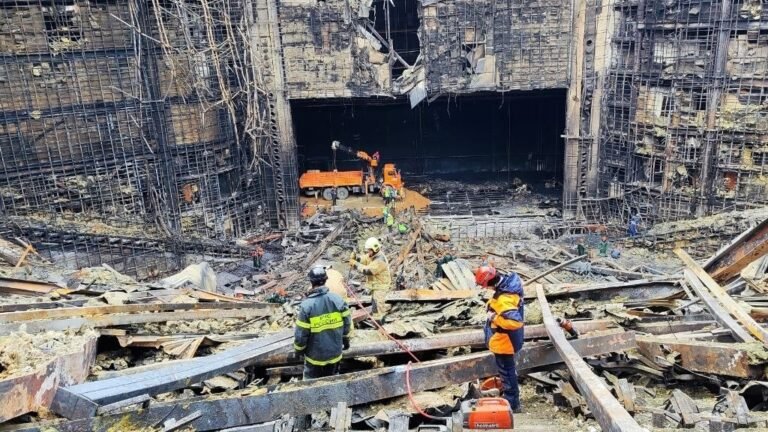
The influx of money from Tajik migrant workers in Russia is not just a means of survival and salvation for Tajik families, but also a source of political stability for the country’s authoritarian regime, experts believe. A wave of xenophobia following the terrorist attack at the Crocus City Hall concert venue in Russia last month is driving migrants back to their homeland.
For the author of this article, the realization of this fact came 10 years ago — after two taxi rides during a business trip to Tajikistan.
The first driver who picked me up for an interview at a café was an elegantly dressed man in his 60s, who shared that he had returned home to Dushanbe after nearly 20 years of working in Russia. He had recently married off his youngest son without taking out loans for the wedding (a rare occurrence in Tajikistan). The man added that he works as a taxi driver mainly to avoid sitting at home. His trips around the city, which he left during the height of the brutal civil war in Tajikistan, must have felt to him like a victory lap. For the driver who took me back, these trips felt more like a descent into hell. He had just graduated from school but looked much older than the average recent graduate. Thin, with sunken eyes, the young man desperately wanted to leave the country where the monthly salary hovered around 100 dollars. At that time, he dreamed of working at a factory in the Moscow region, where a friend promised to help him get a job.
Typically, mass migration separates Tajik families, sometimes for a season and sometimes for years. But for the Tajik system — authoritarian, corrupt, and unable to create jobs — the money that about one million people working abroad send home each month is a lifeline. However, from time to time, the usual course of things is interrupted when migrants, mostly men, return to their country, which they help keep afloat, only to find little work and no social protection to support them.
The latest shock is the xenophobic fallout from the deadliest terrorist attack in Russia since 2024, which occurred on March 22, when armed terrorists stormed the Crocus City Hall concert venue near Moscow. The attack claimed 145 lives. In connection with the attack, for which the Islamic State group claimed responsibility, 10 Tajiks were arrested in Russia, four of whom were charged with shooting at people. They appeared in court with visible signs of beatings and torture. In the following weeks, there was an increase in intimidation, discrimination, detentions, and migration bureaucracy in Russia, worsening the lives of all Central Asian migrants, especially Tajiks.
STABILITY IS OUR MANTRA
Another side effect of the terrorist attack, combined with other recent reports of Tajik recruitment by the “Islamic State” group, may be that the world as a whole becomes more closed to citizens of the poorest country in the region, which in turn will make them even more dependent on Russia. This new reality became evident earlier this month when Turkey implemented a “temporary” (according to its embassy in Tajikistan) cancellation of the 90-day visa-free regime for Tajik citizens. The visa-free regime was introduced in 2018. The Tajik government stated that Ankara did not notify Dushanbe about the cancellation, which takes effect on April 20. Currently, there are no indications that Russia is considering something similar, despite calls from many to introduce a visa regime with Tajikistan.
Temur Umarov, a researcher at the Carnegie Moscow Center for Russian and Eurasian Studies, believes this is explained by the status of both countries as allies, as well as the desperate labor shortage in the Russian economy. “There is a structural dependence in terms of migration on both sides,” Umarov said in an interview with Radio Free Europe/Radio Liberty. “Russia also knows that migration is necessary not only for economic but also for political stability in Tajikistan and other Central Asian countries. Therefore, after the ‘Krokus City Hall’ incident, remittances may decrease, but most likely this will only be a temporary phenomenon.”
Currently, it is unknown how many Tajiks have returned home, not waiting for the end of the wave of xenophobia that is raging in the Russian Federation: clients are refusing the services of Tajik taxi drivers, and other citizens of this country are being beaten by Russian police and local residents. The Tajik service of Radio Free Europe/Radio Liberty interviewed several Tajiks who reported that they cannot enter Russia: some are being deported from the country, while others are not being allowed back when they travel home for a visit.
The Deputy Minister of Labor of Tajikistan, Shahnosa Nodiri, acknowledged on March 30 that her ministry is receiving “many calls” from Tajiks wishing to leave Russia. “We are currently monitoring the situation; more are arriving [in Tajikistan] than are leaving [for Russia],” she said in an interview with the Russian news agency TASS. On April 9, the Ministry of Labor of Tajikistan published a list in local media of eight Russian companies that have a total of three thousand vacancies open for Tajik citizens — the latest sign that officials may be concerned about the outflow of their citizens from Russia. The ministry added that the “rights and interests” of Tajik citizens will be protected throughout the duration of the employment contract through the state agency “Agency for Employment Abroad” and the representation of the Ministry of Labor, Migration, and Employment of the Population of the Republic of Tajikistan.
Authoritarian President Emomali Rahmon, meanwhile, was thinking about peace and stability, repeatedly mentioning these words in his address on April 9, when he congratulated citizens on the end of the holy month for Muslims. Rahmon urged Tajiks to be “politically vigilant” amid the “escalation of the situation in the modern world, where the process of world redistribution is intensifying.” “In these extremely complex and dangerous conditions, we must not allow our citizens, our children to become pawns in the hands of interested groups and forces,” Rahmon warned.
NATION OF MIGRANTS
For Tajikistan, mass migration to Russia began even earlier than for neighboring Kyrgyzstan and Uzbekistan — due to the civil war that broke out in the poorest country in the region in 1992, just a year after gaining independence. However, a real turning point occurred at the turn of the century, when rising energy prices led to economic revival and a construction boom in Russia. According to the Ministry of Internal Affairs of Russia, in 2021, a record three million Tajiks entered the Russian Federation, although many of them were repeat arrivals. According to the ministry, about 2.4 million of the arrivals indicated “work” as the purpose of their visit.
Tajikistan has not published data on remittances this year, but it can be confidently said that it remains one of the most remittance-dependent countries in the world in terms of the money supply relative to GDP, and in the past it has competed with Kyrgyzstan and Nepal for this title. Economists warn that when remittances exceed exports in monetary terms, an effect similar to the “Dutch disease” arises — when dependence on a dominant sector makes the economy vulnerable to external circumstances. For Tajikistan, this dependence is exacerbated by the fact that remittances overwhelmingly come from Russia, whose economy has experienced shocks due to falling commodity prices and sanctions imposed by Western countries in connection with Moscow’s invasion of Ukraine, which, in turn, has led to a sharp reduction in monthly remittances to Tajikistan. And it is the potential economic downturns in Russia, Umarov claims, that remain the biggest long-term concern for the sustainability of the remittance system in Tajikistan.
The worst of all the shocks was likely the coronavirus pandemic, which left hundreds of thousands of migrants from Central Asia stranded in Russia, without money even for food and rent. Data from the Russian Central Bank for the first nine months of 2020 indicates that remittances to Tajikistan decreased by 37 percent, although the National Bank of Tajikistan claimed that the decline was only nine percent. Tajiks who are now considering a trip to Russia may find comfort in the fact that the worst reaction following the terrorist attack may already be behind them. Monitoring and interviews conducted by the Tajik service of Azattyk revealed fewer instances of violence and intimidation against Tajiks in the past week, and support for hardworking Tajik migrants has grown on social media in Russia. Officials may also be softening their tone. Shortly after the attack, one member of the State Duma called for the introduction of a visa regime for Tajiks, while influential head of the Russian Security Council Nikolai Patrushev stated last week that Ukraine is recruiting mercenaries in Tajikistan to fight against Russia. The Ministry of Foreign Affairs of Tajikistan denied these comments.
However, this week there were no notable anti-Tajik statements from high-ranking Russian politicians, and Irina Panaistova, a representative of the Orsk city emergency management agency, expressed gratitude to the local Tajik diaspora on April 10 for their extensive aid efforts in response to the severe flooding that occurred in the region. Panaistova’s words did not receive significant coverage in Russian media. Chris RIKLTON