News
HUMAN RIGHTS MIGRATION
“Headscarves are not allowed in Russia!” Nationalists target Central Asian residents in Siberia
Nationalists conducted “raids” against small businesses owned by Central Asian entrepreneurs in several Siberian regions, as reports of xenophobic incidents continue to rise following the deadly terrorist attack at Crocus City Hall near Moscow last month. During one incident that occurred on April 8, members of the “Russian National Squad” (RND) entered a pharmacy in […]
Nationalists conducted “raids” against small businesses owned by Central Asian entrepreneurs in several Siberian regions, as reports of xenophobic incidents continue to rise following the deadly terrorist attack at Crocus City Hall near Moscow last month.
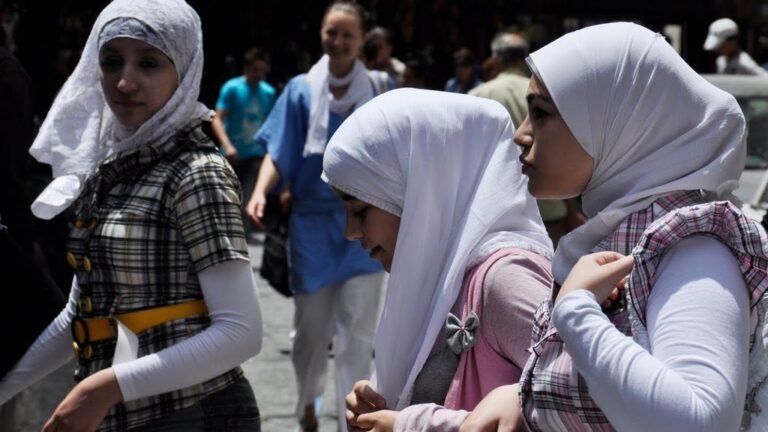
During one incident that occurred on April 8, members of the “Russian National Squad” (RND) entered a pharmacy in Novosibirsk and demanded the dismissal of a female pharmacist wearing a headscarf if she refused to remove it. “In Russia, hijabs are worn [only] by radical Islamists,” they said. The participants then left a series of negative reviews about the pharmacy on the digital map 2GIS and the local review service Flamp. “Russia is not a kishlak (a rural Central Asian settlement)! This is a secular state! You can wear a hijab in the village, but not in Russia!” wrote one user. Another linked the pharmacist’s wearing of a hijab to the terrorist attack on March 22. “Either she takes off the hijab and continues to work in a civilized country, or she has no job and place in our society! Or is what happened at Crocus City Hall not enough?”
In an interview with a correspondent from Radio Free Europe “Siberia. Realities,” migrants from Central Asia in Russia detailed how nationalist groups are targeting business owners and migrant employees at their workplaces. On March 22, the most horrific terrorist attack in Russia in the last two decades occurred at a concert venue in the Moscow region. Russian investigators stated that the attack was carried out by four men—all citizens of Tajikistan—as a branch of the extremist group “Islamic State” claimed responsibility for the attack, which resulted in the deaths of 144 people.
Numerous reports across Russia indicate a rise in xenophobic sentiments and attacks on migrants from Central Asia, who are also attracting increased attention from the police and security forces following the attack. In related incidents on April 8, the “Russian National Squad” also attacked shawarma vendors in Novosibirsk, demanding the dismissal of all female employees wearing headscarves. The organization “Army of Defenders of the Fatherland,” RND describes its goal as “mutual assistance and joint protection,” working to “counter possible diversions, provocations, lawlessness of ethnic criminal groups, as well as the connivance and incompetence of the authorities.” “The authorities did not respond to attempts by some affected businesses to report the incidents. Human rights defenders from the Center for Civil Initiative Support also appealed to the police for intervention based on freedom of religion.
Extortion and Vandalism
The owner of a local café, Sasha Shodmonbek, told a correspondent from Radio Free Europe “Siberia. Realities” that for the first time in seven years of living in Novosibirsk, he is experiencing such a level of aggression. “The horror began in March,” he said. Although fights and ethnic tension are not new to his part of the city, according to Shodmonbek, he has only felt compelled to leave in recent weeks.
“My fellow countrymen predicted that after the detention of Tajiks for the attack on ‘Krokus’ [City Hall], violence would begin,” he said. “I didn’t believe it. But when I was detained three to five times a day for several hours, and after being released I was beaten by those who were not in uniform, I started to think about leaving.”
Shodmonbek decided to stay after his compatriots convinced him that “everything would work out.” But he sympathizes with the Tajiks who have lived legally in Siberia for a long time and are now “simply refusing” to live in Russia. At the end of March, Shodmonbek’s café was vandalized from the outside. He decided to close the business before any further incidents occurred.
“My neighbor — an Uzbek — was less fortunate. The same people, it seems, from the ‘raid’ [RND] came in and broke everything — dishes, tables. He filed a report with the police, but they still did not visit him.” Shodmonbek’s neighbor refused to speak with journalists, explaining that “at least [the place] didn’t burn down.” Local residents and human rights defenders report not only attacks on foreign businesses and labor migrants; the authorities themselves admit that they are conducting raids. The regional Ministry of Internal Affairs reported that officials entered a café in the Siberian city of Krasnoyarsk after “discovering a violation of migration legislation.”
“50 foreign citizens were brought to the police station, their fingerprints and DNA samples were taken, and 16 vehicles in their possession were checked,” the agency’s press release noted. As a result of the intervention, seven out of the 50 foreign citizens were detained and are apparently going to be deported from Russia.
According to one human rights defender from Krasnoyarsk, the press release omits “how [the labor migrants] were beaten, shoved in like sardines in a barrel, and held without food and water for more than a day.” The raid in Krasnoyarsk is one of thousands of criminal and administrative cases initiated across Russia since March 22. Legislative initiatives limiting the labor of migrants have also been adopted in the Siberian regions of Novosibirsk and Tyumen.
Written by Katherine Chapanionek based on a report by RFE/RL’s Siberia.Realities