News
ECONOMY MIGRATION
Can Tajikistan reduce its dependence on remittances from migrants?
The authorities of Tajikistan speak of the need to reduce economic dependence on remittances from migrants. Experts believe that radical economic and political reforms are necessary for this, which the authorities have not yet undertaken. As reported by Radio Ozodi, after the terrorist attack at the Moscow region’s “Krokus” and the subsequent pressure on migrants […]
The authorities of Tajikistan speak of the need to reduce economic dependence on remittances from migrants. Experts believe that radical economic and political reforms are necessary for this, which the authorities have not yet undertaken.
As reported by Radio Ozodi, after the terrorist attack at the Moscow region’s “Krokus” and the subsequent pressure on migrants in Russia, the public in Tajikistan and the authorities have once again begun to discuss the economic dependence of Dushanbe on Moscow. In addition to expert opinions and media materials, the issue was also raised by the President of Tajikistan Emomali Rahmon during his visit to the Sughd region. “In today’s conditions, we must work as hard as possible. Build, create, further improve our homeland, increase production, create jobs, enterprises, and, as much as we can, reduce the level of labor migration,” said Emomali Rahmon while speaking at the opening ceremony of the Khujand Fortress. The question of how far the desired outcomes diverge from reality and whether Tajikistan can overcome its dependence on the financial flows of labor migrants is one that is often raised among experts and lacks a clear solution.
“There is no one-time solution…”
Political analyst Nur Safarov states that the issue of dependence on migrant money can only be discussed in the political context of the situation that arose after March 22 (the terrorist attack at “Krokus” – ed.). “In my opinion, Tajikistan and Russia are interested in sending and receiving labor. The rules of the market economy have not been canceled; when there is high demand for labor, there will also be supply. This has been working between Russia and Tajikistan for over 25 years. Tajikistan is also working on labor migration with countries such as the United Kingdom, South Korea, Qatar, and Kazakhstan. Tajikistan will not be able to create 1-3 million new jobs in any sector of the economy in the coming years,” notes Nur Safarov. The expert points out that there is little arable land in the republic, and about 70% of the population lives in rural areas. Meanwhile, over the past 35 years, there has been a significant demographic increase in the population from 5 to 10 million people, which continues to this day.
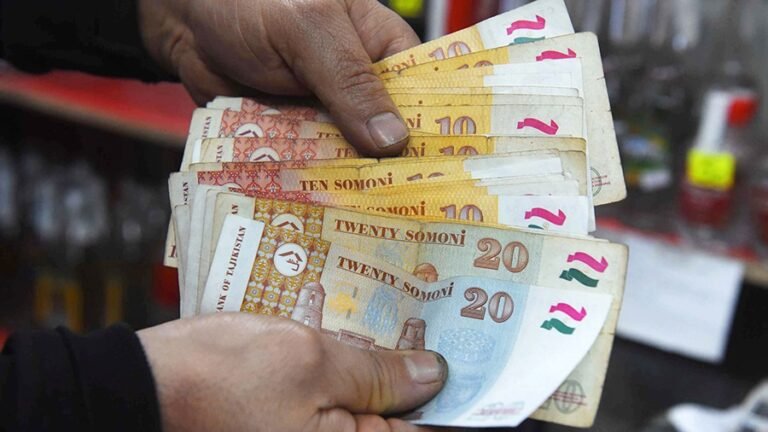
Remittances from migrants have accounted for more than 40% of Tajikistan’s GDP in various years. In 2022, this figure reached an unprecedented volume of $3.2 billion. According to economists, remittances from labor migrants ensure the solvency of most families in Tajikistan, contribute to the development of businesses, the banking and tax systems, and save the population from extreme poverty.
Is there an alternative to labor export?
After the terrorist attack in the Moscow region’s “Krokus” and pressure from Russian law enforcement agencies, thousands of migrants left Russia and arrived in Tajikistan. According to the Ministry of Labor, Migration and Employment, the number of returning migrants in the last three months is 60% higher than last year’s figures.
Economic observer Abdullo Ashurov noted in a conversation with Radio Ozodi that the Tajik authorities need to establish a dialogue with other countries that could accept labor migrants from Tajikistan. “On the other hand, it is necessary to support business within the country to attract more investment in production and create jobs,” Ashurov said. By 2030, the Tajik authorities plan to increase the share of industry in the overall GDP from 17% to 22%, transforming the republic into an industrial-agrarian one, thereby creating additional jobs. However, the problem, according to independent experts, is that there are many obstacles to attracting investments in the country.
“If we talk about the problems, first of all, it is an unhealthy business climate, where the state does not create comfortable conditions for business and views the investor as a cash cow, the lack of necessary qualifications among the population, a weak banking sector, the monopoly of key sectors by close-to-power circles, etc.,” notes economist Nuriddin Murodov. According to the interviewee of Radio Ozodi, similar problems exist in the agricultural sector, which could create additional jobs. “Over the years of independence, we have not been able to reform the agricultural sector. There are still no sources of financing for this sector, no tax reform has been carried out, which creates an additional burden on farmers, and large companies supplying products from abroad have completely suffocated the farmers,” Murodov believes. According to official statistics, the share of agriculture in the GDP structure is 17.4%, while employment in this sector accounts for 70%. In fact, the sector does not even provide for those who work in it daily.
The Question of Political Will
An expert in macroeconomics from Dushanbe notes that the problems of economic development in today’s Tajikistan should be sought in the political sphere. “To reduce dependence on remittances, it is necessary to create an economy based on free market principles. For this, the authorities must be interested in building a transparent tax system, independent courts, eliminating all existing monopolies in the market, investing in and nurturing human capital, and minimizing state intervention in the economy. This requires a fight against corruption, and essentially declaring war on all those close to power who have access to resources,” the expert notes. The leadership of Tajikistan rarely addresses the issue in the migration sphere at the level of official rhetoric, which often leads to criticism and accusations of ignoring this important category of citizens. However, recently Emomali Rahmon has mentioned Tajik migrants more than ever before.