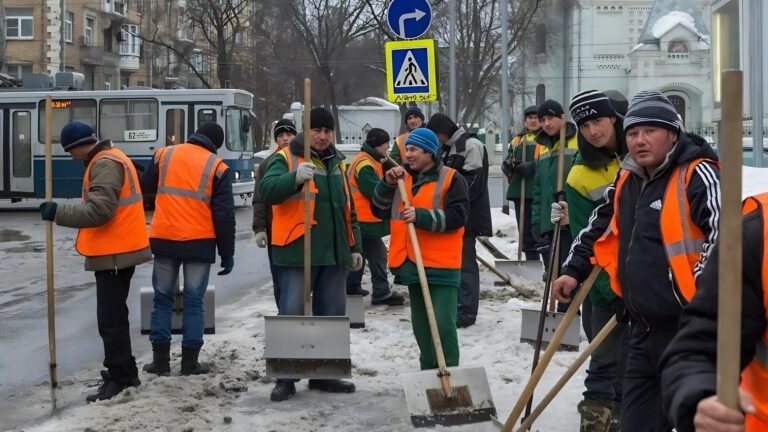
On March 22, as a Russian group was preparing to take the stage at the Crocus City Hall concert venue on the outskirts of Moscow in front of a full house, four armed individuals entered the hall. They opened fire and set the concert hall on fire. More than 500 people were injured, and ultimately 145 people died. Almost immediately, the media reported that the attackers were ethnic Tajiks. Two days after the attack, four suspects appeared in a Moscow court, each showing visible signs of torture – bruises around their eyes and a severed ear. Their court appearance was preceded by videos of their brutal interrogations circulating on social media.
The exact number fluctuates, but estimates suggest that around 1 million citizens of Tajikistan are in Russia at any given time; in 2022, the share of remittances in Tajikistan’s GDP reached 51 percent. Despite media reports of increased pressure on Tajik migrant workers and other Central Asian nationals in Russia following the attack on Crocus City Hall, “racial violence has always been an inherent part of mobility to Russia,” said political anthropologist Malika Bakhoidinova to The Diplomat.
In her interview with The Diplomat, Bakhoidinova, a researcher at the University of Amsterdam studying migration from Central Asia to Russia, explains the role of Tajik migrants in the economies of Russia and Tajikistan, delves into the constantly evolving migration system in Russia, and helps analyze some of the complexities that are often overlooked in reports on migration from Central Asia to Russia.
After the attack on Crocus City Hall, we witnessed an increase in media reports of discrimination and abuse against migrants from Central Asia, especially Tajiks. How have the living conditions of this community changed since the attack? Is the current moment a continuation of existing conditions or a deviation?
Last month, of course, there were more reports of violence and abuse against migrant workers, but in many ways, the situation was deteriorating even before that. Indeed, 2023 has also become a year of rising violence against foreign workers in Russia. In May 2023, it all began when 100 students from Tajikistan were detained in a dormitory and brutally beaten by law enforcement officers in Russia. According to eyewitnesses, law enforcement officers entered the dormitory, locked the entrance and exit doors, blocked the surveillance cameras, and began to beat all the students. It is unclear why students were targeted in this incident; reports indicate that if anyone dared to ask about the reason for the attack, they were beaten even more severely.
Racial violence has always been an inherent part of migration to Russia, with citizens of Tajikistan often bearing the brunt of such violence simply because they belong to the least protected group. However, such open displays of torture, as we have seen following the recent attack, have been quite shocking.
Citizens of Tajikistan are generally the most marginalized minority group in Russia, particularly in terms of their treatment by law enforcement agencies. As a result, unfortunately, the collective punishment of migrant workers following the tragic attack was not a great surprise. Suddenly, the pace of deportations increased, people with darker phenotypes were stopped by the police in cities, and raids and checks intensified.
It should also be noted that this is not a specifically “Russian” response. The sadistic revenge from Russian law enforcement, which we have all seen in the traces of torture and videos circulated after the terrorist attack, has been made possible by the broader legacy of the American “war on terror.” Regarding the attack on “Krokus,” we can also observe how Western media and experts quickly picked up this story, mistakenly labeling ISIS-Khorasan as a “Tajik” organization and searching for specific characteristics of Tajik citizens in an attempt to understand their alleged radicalization. This narrative was wholeheartedly embraced in the West because it all “makes sense” when we consider the legacy of the war on terror. Russia’s reaction to the attack has become a continuation of the Western and global trajectory of Islamophobic violence, rather than an exception.
Can you explain the many ways in which migrant workers fit (or do not fit) into Russian society? How important is this contingent of workers to the Russian economy?
The Russian construction, services, and (increasingly) manufacturing sectors heavily rely on the labor of foreign workers. This reliance is driven by various factors, including, in particular, the demographic decline in Russia. Russia needs workers; the experience of rapid marketization and privatization in the 1990s, which plunged many Russian citizens into poverty, led to a decrease in birth rates. According to demographers, millions of people were not born—people who would now be part of the workforce. As a result, Russia needs labor to maintain its existing infrastructure, and it also needs to attract about 1 million new residents each year to stabilize the ongoing demographic decline. Of course, this is unlikely to happen, as migration corridors to Russia are currently being reshaped.
Moreover, many sectors of the Russian labor market rely on legally unprotected non-citizens to increase their profits and benefit from their labor. Labor outsourcing is not uncommon in industries where non-citizens work. This involves contracting not with individuals but with subcontractors, who then hire vulnerable workers, such as non-citizens, and pay them less. This further exacerbates the instability of those who are “hired” under such contracts.
Again, this is not unique to Russia; rather, it is a sign of global neoliberalization and the ongoing spread of capitalist forms of making money through brokerage activities. We also need to remember that the labor of non-citizens is a cheaper and more submissive form of labor, especially if such labor can be disciplined through strict migration rules and violence from the police. Labor migrants represent a particularly vulnerable layer of society in Russia, as most migration control measures and disciplinary actions are carried out within Russia. Visa-free mobility means that it is migration law and violence in migration that are intended to “discipline” foreign workers. Both are also mobilized during crisis moments, as we saw in the response to the attack in Crocus.
What role do labor migrants play for Tajikistan – for those who remain in Tajikistan and in the Tajik economy as a whole?
In answering this question, many people will likely immediately note the high volumes of remittances to Tajikistan, equivalent to a significant share of the country’s GDP. The economy of Tajikistan is extremely dependent on remittances and the foreign currency they bring. However, this ignores the broader and long-term consequences of the mass exodus of the local population in search of migration.
The Soviet myth of “labor surplus” has persisted in Tajikistan, and local officials readily refer to this myth when explaining the need for labor migration to Russia. According to this discourse, Tajikistan produces 100,000 workers each year, and the local economy is unable to provide them with jobs; there is no other option but to “export” them to Russia.
This says more about the local economy and its organization than about a real surplus of labor. Why, for example, is there no similar “labor surplus” problem in the Czech Republic? The Czech Republic also does not have large reserves of natural resources and has a similar population size as Tajikistan. The answer is that they started with a highly educated population, and their leaders focused on other priorities. Instead of trying to realize dreams of diversifying migration, the economy of Tajikistan should instead incorporate more of its workforce.
Schools in Tajikistan are extremely overcrowded: local teachers sometimes teach three full shifts a day; remote schools lack the infrastructure to transport students to schools. Education is just one example where we can observe a shortage of qualified people and infrastructure – and where a large number of people could be employed as teachers, builders, bus drivers, and in many other positions. But this will require political will and funding, as well as a rethinking of the role of the workforce in the economy of Tajikistan. Instead, more and more teachers are emigrating to Russia.
Labor migration is not the only way to achieve mobility to Russia, and increasingly, entire families are moving to Russia, seeing more educational and economic opportunities there. Such educational and economic opportunities should be accessible to many in Tajikistan. Migration and this vast scale of mobility deplete human capital. Moreover, dependence on remittances from migrants further reduces the need for radical economic reforms in the country and the necessity to address the problem of rampant corruption.
Some Central Asian states, such as Kyrgyzstan, are currently warning their citizens against migrating to Russia. As far as I know, this has not happened in Tajikistan. How should we interpret this decision? To what extent does the Tajik government care about the safety and living conditions of its citizens working abroad?
Unfortunately, the brief answer is: not much. Only four weeks after the attacks did the Minister of Foreign Affairs of Tajikistan finally criticize the use of torture and cruel treatment of suspects, which were publicly displayed in Russia to demonstrate the power of revenge. This was too little and too late; much of the damage, so to speak, has already been done. The fundamental principle of the presumption of innocence was not even mentioned initially.
This speaks to the deep-rooted relationship between the state and society in Tajikistan: the state has not developed effective mechanisms to promote and protect the rights of labor migrants in Russia. The Tajik embassy in Russia is often simply inaccessible to Tajik citizens. Many citizens stand in long lines outside the embassy all day, and as soon as they get inside, they are sent to make a copy of a document or correct some minor error. Then they have to return to the queue and wait again.
Scenes of mistreatment and the initial refusal of Tajik authorities to comment on the obvious use of torture will only further exacerbate the vulnerable position of Tajik citizens in Russia. The lack of protection that we have observed in recent decades from racist insults eloquently speaks to the absence of any “social contract” between the Tajik state and labor migrants. If there is a contract, it is only one that feeds off the labor of migrants and their remittances, but does not provide any accountability or protection.
Of course, there are geopolitical hierarchies and asymmetrical relations between Tajikistan and Russia. This is indeed the case, and there are objective limitations in terms of protecting citizens’ rights in the migration sphere. Nevertheless, within the context of migration, there are many opportunities to ease the lives of citizens. For example, a good start would be to ensure the accessibility of consular services for the majority of the migrant population or to regulate exorbitant ticket prices to Russia.
Can you briefly describe the rules and legal framework governing labor migration between Tajikistan and Russia? Do you see any signs that this system will change?
This is the most complex question that any researcher working on migration to Russia faces. Russia’s migration legislation is complicated and constantly changing. Ultimately, it is a replacement for the visa regime, and a wide range of laws and mechanisms are required to support its infrastructure.
In general, Russian migration legislation does two things simultaneously: it criminalizes violations of migration law (which is not unique to Russia) and makes it financially beneficial for the state (which is more unique, as it relies on direct payments made by migrant workers).
In 2013 and 2014, a new package of amendments and changes was introduced into the existing migration legislation of Russia. For example, in 2013, two articles were added to the Code of Administrative Offenses. These legislative changes included the introduction of Article 18.8 (part 3 on violations of entry and stay rules in Russia) and Article 18.10 (part 2 on illegal work in Russia). Additionally, one of the main changes was the expansion of the grounds for entry bans to Russia, which now include legal, administrative, and epidemiological criteria. For instance, having HIV now grants a permanent entry ban to Russia. Three unpaid fines – for example, for late payment of even phone bills or minor traffic violations – can also lead to a re-entry ban. Living in a place different from the legal residence is another ground for a ban.
Regarding the monetization of migrant labor, Russian legislation currently requires all foreign workers to obtain a “work permit” (patent), which entails significant monthly payments to the state. To obtain a work permit, a person must pass tests in the Russian language, history, and migration law. Additionally, they must obtain a medical certificate. These are just some of the changes adopted over the last decade, and the law continues to evolve. Overall, trying to navigate Russian migration legislation is like chasing a speeding train. You are always falling behind.
In general, these constant changes in legislation mean that being a migrant in Russia is not only extremely expensive and legally complicated, but also that migrating individuals are always subject to deportation and expulsion from Russia. In conversations with people who have worked in the migration field, I often heard that it is often impossible to know whether your stay was completely legal or not. For example, you not only need to pay a monthly fee for the work permit, but you also need to send confirmation of that payment to another agency for that agency to register the payment. It’s some kind of paperwork circus.
What do you think is lacking in the current discourse about migrants from Central Asia in Russia?
Yes, undoubtedly, one of the missing elements is the perpetual debt cycle that forces people to migrate as a lifelong strategy. In the notion of “migration and development,” there is a myth that workers go into migration, acquire skills, and return to “develop” their countries. This ignores the high costs associated with mobility. Becoming a “migrant” is practically expensive everywhere.
To go to Russia and start working, a huge amount of money is required, which people often borrow from their friends and extended network of relatives. You have to pay for expensive passports (thanks to Western propaganda about “readability” and border control) and exorbitant tickets to Russia (in Tajikistan, they are the highest in the region). Travelers need to buy warm clothes and leave money for their families.
When many arrive in Russia, a whole range of new expenses arises: costs associated with work permits, rent, food, monthly fees for work permits – and all this must be paid regardless of whether you found a job or not. Migrants are ruthlessly monetized by the entire infrastructure of movement from Tajikistan to Russia. They take out loans to earn relatively little. When many return home and new needs arise, they have nowhere to turn except migration. You borrow money again and leave again.