News
RUSSIA TAJIKISTAN
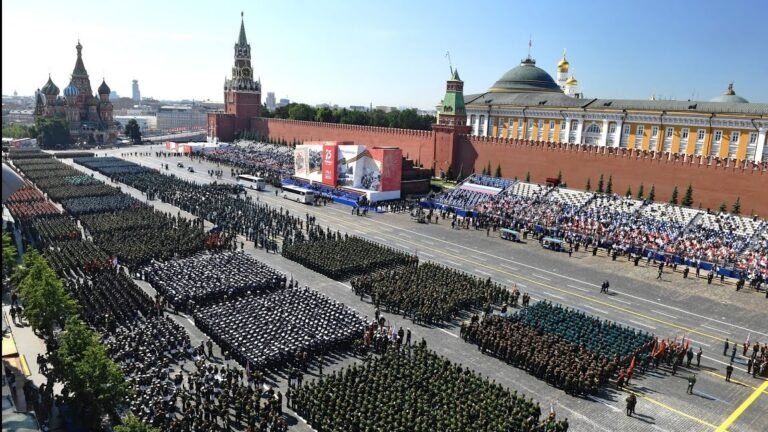
The President of Tajikistan will attend the Victory Parade in Moscow
The President of Tajikistan, Emomali Rahmon, will attend the Victory Day parade in Moscow. According to Russian media, Rahmon will arrive at the invitation of the President of Russia, Vladimir Putin. Rahmon received the invitation during a phone conversation with Putin, during which issues of bilateral cooperation between Tajikistan and Russia were discussed. An informal […]
The President of Tajikistan, Emomali Rahmon, will attend the Victory Day parade in Moscow. According to Russian media, Rahmon will arrive at the invitation of the President of Russia, Vladimir Putin.
Rahmon received the invitation during a phone conversation with Putin, during which issues of bilateral cooperation between Tajikistan and Russia were discussed.
An informal meeting of the heads of the CIS will also take place in Moscow, the report notes.
According to media reports, the President of Kyrgyzstan, Sadyr Japarov, will also attend the Victory Day parade in Moscow among the leaders of Central Asian countries.
Emomali Rahmon plans to visit Moscow against the backdrop of the deteriorating situation of Tajik labor migrants following a violent incident at “Krokus City Hall” in Russia.
After hundreds of migrants and students were stranded at Russian airports and border zones, the foreign ministers of Tajikistan and Russia, Sirojiddin Muhriddin and Sergey Lavrov, exchanged views on the matter by phone. During the conversation, Lavrov informed Sirojiddin Muhriddin that “the tragic events at ‘Krokus City Hall’ were the main reason for more thorough checks of incoming foreign citizens.” Lavrov also emphasized the “temporary nature of the measures taken, their non-targeted nature against any specific nation or religion,” as well as the gradual normalization of the situation at the checkpoints.
The Tajik Foreign Minister emphasized to his colleague that “such actions are applied exclusively to citizens of Tajikistan, which is fundamentally incompatible with the spirit and traditions of Tajik-Russian relations.”
In light of these events, the Tajik Foreign Ministry summoned the Russian ambassador, Semen Grigoryev, and handed him a note of protest. The Tajik Foreign Ministry expressed serious concern over “mass cases of pronounced negative attitudes” towards Tajiks in Russia and violations of their rights and freedoms.
The press service of the President of Tajikistan only noted that “in this context, issues of cooperation in the field of labor migration were discussed in detail” and “an agreement was reached to instruct the relevant agencies of both sides to intensify work in this direction.” No further details were provided.
At the same time, the Kremlin described this as “an attempt by certain forces to artificially escalate the situation around incoming labor migrants to Russia, including from Tajikistan,” emphasizing that such attempts “will be jointly suppressed,” and that they “will not harm the relations between the peoples.”
According to some reports, about 2 million Tajik migrants live and work in Russia. Many migrants claim that among other nationals from Central Asian countries, Tajiks face the most scrutiny, pressure, and deportation.