News
AFGHANISTAN RUSSIA
Will the Kremlin exclude the Taliban from the list of terrorists and accept labor migrants from Afghanistan?
In Russia, the Ministry of Justice and the Ministry of Foreign Affairs insist on excluding the Islamist group “Taliban” from the list of terrorist organizations in the Russian Federation. Authorities are even considering the possibility of allowing the Taliban into the Russian labor market. The “Taliban” has been recognized as a terrorist organization in Russia […]
In Russia, the Ministry of Justice and the Ministry of Foreign Affairs insist on excluding the Islamist group “Taliban” from the list of terrorist organizations in the Russian Federation. Authorities are even considering the possibility of allowing the Taliban into the Russian labor market.
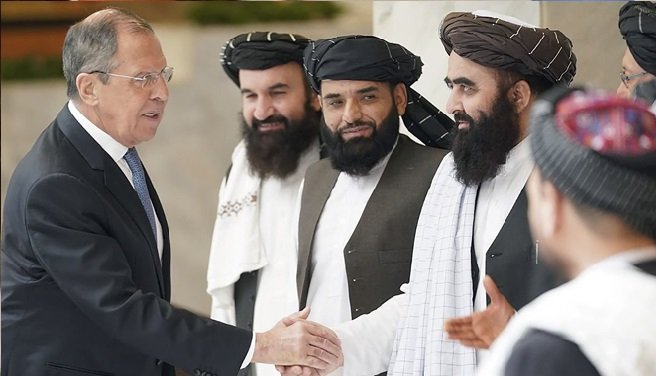
The “Taliban” has been recognized as a terrorist organization in Russia since 2003. However, this does not prevent the Kremlin from engaging with militants at the highest level. Another round of negotiations took place at the international economic forum in St. Petersburg.
In the list of terrorist organizations on the FSB website, the “Taliban” is listed alongside “Al-Qaeda,” “Islamic State,” as well as the “Columbine” community and the “Freedom Legion of Russia,” which is fighting on the side of the Armed Forces of Ukraine. In May 2024, the Ministry of Justice and the Ministry of Foreign Affairs of the Russian Federation appealed to Putin with a proposal to exclude the “Taliban” from the unified list of terrorist organizations. “These are people who control the country, its territory. And today they are in power in Afghanistan; we need to proceed from reality and, accordingly, build relationships,” Putin stated.
His rhetoric was quickly picked up by representatives of Russian regions, at least according to the Taliban themselves. “Chechnya and Tatarstan, as well as other republics [within the Russian Federation], have offered us to implement opportunities [for the employment of migrants from] Afghanistan, especially in the agricultural sector,” said Abdul Umari, acting Minister of Labor and Social Affairs in the interim government of Afghanistan formed by the “Taliban.”
It seems that the Kremlin has given the green light for an image gift to the Taliban. Orientalist Ruslan Suleymanov notes that, in reality, the statements remain just statements: “We know that representatives of Chechnya and Tatarstan travel to Afghanistan, where they meet with officials of the interim government formed by the Taliban. We know that when the Taliban visit Russia, they separately meet with representatives of Chechnya and Tatarstan. They have special, warm relations. In particular, it is known that there is a Tatar community in Afghanistan, and during one of the meetings, the Taliban promised to treat the Tatar minority with care, but this is all at the level of rhetoric.”
High-ranking Russian officials, such as former Defense Minister Sergey Shoigu, stated in the spring of 2023 about the threat posed by radical groups in Afghanistan. In Kazan, the Taliban responded by stating that they are conducting a “policy of strengthening security” and are ready to engage in this dialogue with Russia. “The former defense minister openly criticized the Taliban. He said that a terrorist threat emanates from the territory of Afghanistan. Why take on additional risks now? These statements simply sounded like a beautiful gesture, giving hope to the Taliban that they would soon be excluded from the list and even recognized as their interim government. But for now, there is nothing behind these words; I do not think the Russian state is ready to deal with these migrants, as this is a huge risk and a threat. As became clear after the terrorist attack in ‘Krokus City Hall,’ there is indeed a terrorist threat coming from Afghanistan,” says Ruslan Suleymanov.
Control over migrants, including labor migrants, in Russia has been tightened following the terrorist attack at “Krokus City Hall,” which claimed the lives of more than 140 people. At that time, the international scope of the activities of the “Vilayat Khorasan” group, an Afghan cell of the “Islamic State,” became clear, although Moscow formally blamed Ukraine for the attack.
When discussing the involvement of labor migrants, Putin carefully emphasizes that “arrivals should not create any problems.” However, the Taliban themselves deny the presence of any terrorist cells on the territory of Afghanistan. The Turkish publication Hurriyet reported that Turkish intelligence helped Russian authorities prevent a second “Vilayat Khorasan” terrorist attack in Moscow: allegedly, the terrorists were preparing an attack on a shopping center. Russian intelligence has not commented on this information so far.