News
POLITICS
What is the secret of the political longevity of the “unsinkable” ministers of Tajikistan?
Personnel changes among high-ranking officials in Tajikistan occur frequently. However, there are a number of officials who have not been affected for more than ten years. How do some heads of ministries and departments manage to keep their positions for so long? Ongoing personnel reshuffles in Tajikistan since the beginning of this year, as in […]
Personnel changes among high-ranking officials in Tajikistan occur frequently. However, there are a number of officials who have not been affected for more than ten years. How do some heads of ministries and departments manage to keep their positions for so long? Ongoing personnel reshuffles in Tajikistan since the beginning of this year, as in previous periods, have bypassed five high-ranking officials of the republic, who have held their positions for 11 to 14 years.
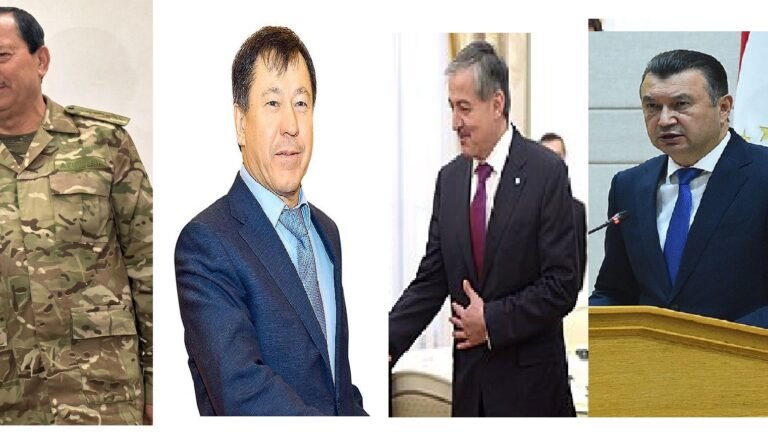
At the top of the list among the long-serving state officials is the chairman of the State National Security Committee of Tajikistan, 69-year-old Saymumin Yatimov, who has held this position since 2010. He is followed by the Minister of Internal Affairs of Tajikistan, Ramazon Rahimzoda, who was appointed to this position in 2012 – 12 years ago. The Ministers of Defense Sherali Mirzo, Foreign Affairs Sirojiddin Mukhriddin, and the Prime Minister of Tajikistan Kohir Rasulzoda have been in their positions for 11 years.
During this time, Tajikistan has experienced a series of socio-economic upheavals: the Khorog events of 2012-2014, the “mutiny” of Deputy Minister of Defense Abduhalim Nazarzoda in 2015, riots in the prisons of Khujand and Vahdat in 2019-2020, the coronavirus pandemic in 2020, large-scale military clashes with Kyrgyzstan in 2021-2022, events in GBAO in 2022, and ongoing pressure on labor migrants from Tajikistan in Russia in 2022-2023. All these events have caused outrage within the republic and criticism from abroad, directly affecting the image of the authorities and the state. However, none of the mentioned ministers have lost their positions or have even been subjected to open criticism from the president.
What is the secret to the political longevity of these individuals?
“The longer in power, the more concerns”
The deputy chairman of the banned National Alliance in Tajikistan, Alim Sherzamonav, links this to the strengthening of authoritarian tendencies in the country. “From 1999 to 2010, personnel changes affected all ministers, at that time the legitimacy and popularity of the sitting president were at a fairly high level, he was confident in himself,” says Sherzamonav. “Over time, this legitimacy decreased, the regime became increasingly authoritarian, consequently, trust in those around him diminished, and loyalty and devotion to the top leader became valued above all,” says Sherzamonav. According to him, a similar practice can be observed in many authoritarian countries where leaders hold the presidential seat for a long time and see threats in their subordinates.
Over the past ten years, the president of Tajikistan has often emphasized the need to attract young specialists to public service, including women. Critics of the head of state often link this rhetoric to the promotion of family members of the top leader to high positions. One way or another, there have been no young candidates for the five important ministerial positions in the last 10 years, especially women.
“Unconditional loyalty”
“The authoritarian style is always characterized by a strong focus on administrative levers of influence over subordinates, unconditional adherence to hierarchy, and the making of quick, unnegotiated decisions that are generally ineffective. To meet the demands of such a system, it is not necessary to be a high-level professional; it is enough to demonstrate not just loyalty but unconditional devotion to the president. I would not like to name names, but I personally know leaders who have spent their entire lives in high executive bodies and have never said the word ‘no’ or attempted to explain that a particular state decision project is unpromising or simply lacks the necessary potential. Therefore, the longevity of officials in high government bodies, especially in law enforcement and security, is explained solely by banal loyalty,” says former Deputy Minister of Economy of Tajikistan Karimjon Akhmedov. According to him, government meetings that are broadcast on television lack discussions, explanations, arguments, and demonstrate complete lack of initiative.
“But the problems of authoritarian governance do not end here; they are scaling up. And if we go down the management ladder, we will see hundreds of small autocratic bosses who prefer their fellow countrymen and simply loyal people over professionals. As a result, Tajikistan is the poorest and most corrupt state in the CIS…,” notes Akhmedov.
The internal political scene of Tajikistan has virtually lost discussions at all levels over time. Engaging in debate, defending one’s own viewpoint, or alternative visions has been replaced by constant quoting of the president, clarifications of his speeches and messages. The five mentioned ministers seem to remain among the most successful in this regard and beyond.
Bound by Responsibility
A political analyst from Dushanbe, wishing to remain unnamed, notes that loyalty is not the only main factor for political longevity in Tajikistan. “The mentioned ministers are involved in many visible and invisible actions and processes that have taken place in recent years. These are precisely the leaders who are members of the Security Council, an organ where, as practice shows, various projects aimed at preserving the current regime and minimizing threats are planned and implemented. This is often associated with violations of human rights and laws. Therefore, such individuals stay close. They either retire quietly from their positions, die under strange circumstances, or completely disappear from the information field,” says the source to Radio Ozodi.
Expert circles also do not rule out that the preferences of strategic allies may play a significant role in the political fate of key ministers in the government.