News
MIGRATION RUSSIA
Russia has developed an adaptation course for labor migrants from Central Asia
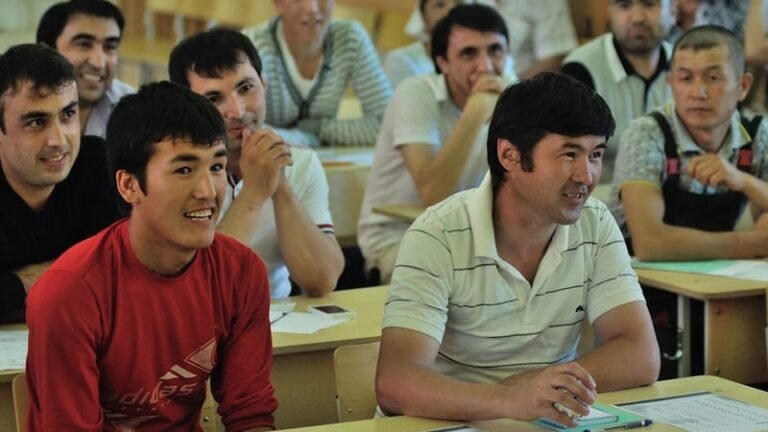
The Federal Nationalities Agency (FADN) of Russia has developed an adaptation course for labor migrants from Central Asia. The course consists of a 70-minute lecture, which was reviewed by Kommersant. FADN announced the completion of this course’s development in September 2023. The course is set to be tested in the Kaliningrad and Moscow regions, as […]
The Federal Nationalities Agency (FADN) of Russia has developed an adaptation course for labor migrants from Central Asia. The course consists of a 70-minute lecture, which was reviewed by Kommersant.
FADN announced the completion of this course’s development in September 2023. The course is set to be tested in the Kaliningrad and Moscow regions, as well as in Perm and Krasnodar Krais, and in Yakutia. Last week, the agency’s deputy head, Stanislav Bedkin, reported that the course successfully passed testing in their territory. After the testing, the agency made adjustments to the program and then sent the updated course to all regions. “To date, most subjects of the Russian Federation have developed their regional component, that is, the features of their culture and the traditions of each subject,” Mr. Bedkin added.
According to Kommersant, the course is divided into four blocks: “Basics of Migration and Labor Legislation,” “Basics of Informal Behavior in Russia,” “Responsibility for Non-Compliance with Legislation,” and “History of Relations between Russia and Central Asian Countries.”
Remember: you are not in your homeland
In the first section, migrants are provided with detailed information about the procedures for entry and stay of foreigners in the Russian Federation, as well as the rules for obtaining a patent and concluding an employment contract. The lecturer is also expected to mention the possibility of “obtaining Russian citizenship through a simplified process after serving under contract in the armed forces.” At this stage, all possible situations are discussed, such as what to do if a migration card is torn or soiled.
“Some things that are familiar to Russians may be new and unusual for you, and vice versa, familiar things for you may be unacceptable in Russia. However, remember: you are not in your homeland, so you should behave as is customary in Russia,” it is stated in the block “Basics of Informal Behavior in Russia.”
The authors emphasize the importance of knowing the Russian language: “Russians are a multinational people, but everyone speaks Russian.”
It also addresses cultural nuances: “Addressing someone as ‘brother’ or ‘sister’ is not appropriate when speaking to people who are not your relatives or close acquaintances.” Foreigners are also advised “not to discuss passersby in their native language, or to whisper in their native language in the presence of others.”
“It is important to remember that Russia is a secular state,” the lecture states. “In Russia, it is not customary to publicly demonstrate attitudes toward any religion, to perform religious rituals in the street, to conduct prayers in public places, and so on. Animal sacrifices are also unacceptable.”
It is also mentioned that “in Russia there is always a special attitude towards the memory of the Great Patriotic War,” therefore “one should behave appropriately and with respect at the monuments of the Great Patriotic War, including at the Eternal Flame, and their desecration is strictly punished.”
In this section, there is also a discussion about “the basics of behavior with the opposite sex.”
“Women in Russia traditionally wear bright, revealing clothing, which is not disapproving and corresponds to the norm, rather than a readiness for dating,” the authors of the lecture report. “The attitude towards women in Russia is very caring, and they have as many rights as men, so they should be treated accordingly. It is not permissible to physically touch unfamiliar women and men (to touch, pinch, hug, grab by the hands or clothing). Such actions can be regarded as harassment.”
It is also stated that “one should not make sounds, whistle, or click their tongue in an attempt to attract the attention of a woman or man they like.” Finally, “physical violence is unacceptable, especially towards women.”
On extremism and the bonds of friendship
The third part is about punishments for violating the laws of the Russian Federation, primarily migration legislation. Migrants are also warned against “participating in extremist and terrorist activities” or assisting such activities: “Be aware that sometimes this danger comes from a well-known person who politely asks you to pass something to another person.”
The Federal National-Cultural Autonomy (FADN) also urges foreigners: “Do not attend rallies or demonstrations – usually their organizers just want to use you for their purposes. Rallies and demonstrations without the permission of the authorities are prohibited in Russia. Participants are detained and fined, and foreign citizens may be deported from Russia.” This section also provides positive examples of migrant behavior, such as “the heroic act performed by a foreign citizen to prevent a terrorist act.”
The concluding part is dedicated to “the history of relations between Russia and the Central Asian countries.” It states that “the bonds of friendship that connect Russia and Central Asia have a centuries-old history.” The authors of the materials emphasize that “fortresses founded by Russians later became major cities in Central Asia,” and that “the incorporation of Central Asian lands into the Russian Empire in the 19th century positively influenced the development of the economy of Central Asia.”
“During the Soviet Union, the connection between our regions only strengthened, as large sums from the USSR budget allowed the Central Asian republics to develop successfully,” the FADN lecture asserts. “One of the main transformations of Soviet power was the unification of numerous tribes into the Soviet nations of Kazakhs, Kyrgyz, Karakalpaks, Uzbeks, Turkmen, and Tajiks, which allowed the peoples in the USSR to develop as state nations. Later, this made it possible for new separate states to emerge in the region on the cultural and economic basis of the former union republics.”
Eleven animated videos accompany the text materials. Their main character, Timur, talks about the rules of life in Russia. Each video begins with the phrase “As-salamu alaykum, dear brothers and sisters! My name is Timur, and I have been a Muscovite for about ten years.” The content of the videos largely corresponds to the content of the lecture materials.
Representatives of the Federal Agency for Nationalities Affairs informed Kommersant that regional authorities, “responsible for implementing measures in the field of social and cultural adaptation of foreign citizens,” will take over the further implementation of the course. It is planned that the regions will begin to implement the course by September 10, 2024. However, there is currently no requirement in the legislation for migrants to complete such a course.