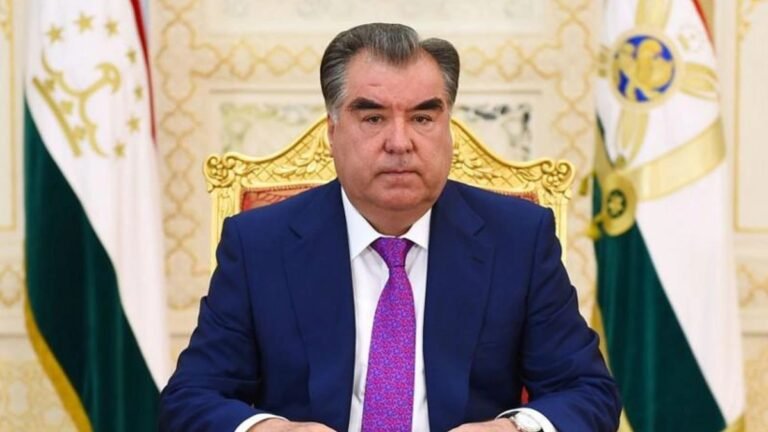
The season of personnel changes, or “rotations,” continues in Tajikistan. On January 9, the President of Tajikistan, Emomali Rahmon, held a meeting with personnel appointed to the leadership of the General Prosecutor’s Office, the Ministry of Defense, the National Guard, and the Committee for Emergency Situations and Civil Defense. According to the press service of […]
AZDA.TV· Send to others
Photo: Internet
The season of personnel changes, or “rotations,” continues in Tajikistan.
On January 9, the President of Tajikistan, Emomali Rahmon, held a meeting with personnel appointed to the leadership of the General Prosecutor’s Office, the Ministry of Defense, the National Guard, and the Committee for Emergency Situations and Civil Defense.
According to the press service of the President of Tajikistan, new appointments were made for heads of several departments of the General Prosecutor’s Office, prosecutors of the cities and districts of Khorog, Kanibadam, Tursunzade, Rasht, Farhor, Nosiri Khusrav, and Baljuvon, as well as military prosecutors of the Bokhtar and Sughd garrisons.
In his conversation with the “new personnel,” President Emomali Rahmon emphasized the importance of ensuring the security and stability of the state, protecting the country’s borders, and safeguarding the achievements of the period of independence, stating that they should remain vigilant and fulfill their duties based on military regulations and instructions.
The authoritarian President of Tajikistan, in his speeches or when appointing new officials, always speaks about statutory relations during military service and the fight against corruption. However, the rise of corruption in the country has reached unprecedented levels, and the country now ranks among the twenty most corrupt countries in the world. Unofficial relations, known as “dedovshchina,” also thrive in the armed forces, and young people do everything possible to avoid military service due to harsh treatment.
Traditionally, personnel reshuffles in Tajikistan are conducted annually in January. Most experts believe that these changes are merely a façade of activity. They argue that when appointing individuals to government positions, Emomali Rahmon typically does not consider qualifications, knowledge, or skills. The criteria for selecting personnel in most cases are nepotism and proximity to the president’s family.
Experts refer to personnel changes in Tajikistan’s ministries and agencies as merely “rotations,” as most officials are relieved of one position and appointed to another without regard to personal achievements, knowledge, or skills.
We use cookies to improve your experience and to understand how the site is used. You can accept or decline. Declining may limit some features.
Functional
Always active
The technical storage or access is strictly necessary for the legitimate purpose of enabling the use of a specific service explicitly requested by the subscriber or user, or for the sole purpose of carrying out the transmission of a communication over an electronic communications network.
Preferences
The technical storage or access is necessary for the legitimate purpose of storing preferences that are not requested by the subscriber or user.
Statistics
The technical storage or access that is used exclusively for statistical purposes.The technical storage or access that is used exclusively for anonymous statistical purposes. Without a subpoena, voluntary compliance on the part of your Internet Service Provider, or additional records from a third party, information stored or retrieved for this purpose alone cannot usually be used to identify you.
Marketing
The technical storage or access is required to create user profiles to send advertising, or to track the user on a website or across several websites for similar marketing purposes.