The Jogorku Kenesh ratified agreements on the Tajik-Kyrgyz border.
On March 19, during a session of the Kyrgyz parliament, deputies adopted draft laws regarding the Tajik-Kyrgyz border in three readings.
Out of 85 deputies, only 1 voted against.
The Jogorku Kenesh ratified agreements on the Tajik-Kyrgyz border. On March 19, during a session of the Kyrgyz parliament, deputies adopted draft laws regarding the Tajik-Kyrgyz border in three readings. Out of 85 deputies, only 1 voted against. At the parliamentary session, Deputy Prime Minister and head of the State National Security Committee of Kyrgyzstan […]
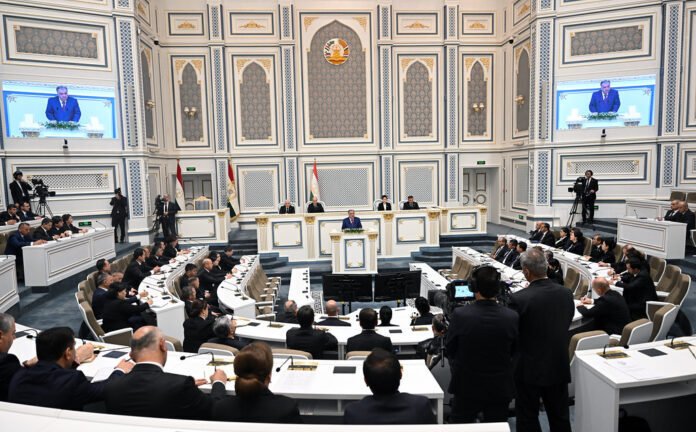
The Jogorku Kenesh ratified agreements on the Tajik-Kyrgyz border.
On March 19, during a session of the Kyrgyz parliament, deputies adopted draft laws regarding the Tajik-Kyrgyz border in three readings.
Out of 85 deputies, only 1 voted against.
At the parliamentary session, Deputy Prime Minister and head of the State National Security Committee of Kyrgyzstan Kamchybek Tashiev informed the deputies about the details of the territory exchange under the Agreement on the Tajik-Kyrgyz border.
According to him, negotiations began in 2002 and lasted almost until 2024, during which the government delegations of Kyrgyzstan and Tajikistan signed 45 protocols, topographic working groups signed 86 protocols, and legal working groups signed 25 protocols.
He stated that since the beginning of bilateral negotiations, the Tajik side adhered to materials from 1924 and 1927 when describing the border. The Kyrgyz side relied on the 1991 CIS creation agreement, the 1991 Almaty Declaration, and the Moscow Declaration. Thus, the two countries proposed different documents for clarification.
“They claimed the land. I spoke then. I said that if you claim our lands, we will also claim Murghab. We have enough rights, strength, and opportunities to take it. There were various methods. Later we signed protocol No. 44, which clearly states that from now on, border clarification will proceed according to the CIS creation agreement. After that, the work progressed,” he explained.
He reported that from 2010 to 2021, the parties could not agree on any land parcel.
“Kyrgyzstan forced Tajikistan to work on borders from 1991,” Tashiev said.
After the vote, Chairman Turgunbek uulu called this decision “historic” and expressed hope that it would further strengthen the centuries-old friendship between the two nations, putting an end to disagreements and conflicts between them. “This is the desire of both peoples,” the speaker said.
Additionally, on March 18, the Tajik parliament also ratified this agreement. Unlike the Kyrgyz parliament, the process of approving the agreement in the Tajik parliament was not covered by the media and remains classified.
Moreover, Kyrgyz colleague Saymumin Yatimov — Kamchybek Tashiev — spoke before Kyrgyz deputies before the vote and explained several points of the agreement, including the reasons for transferring the village of Dostuk in the Batken region to Tajikistan.
According to Tashiev, this decision was made due to water supply issues and the village’s remoteness from Kyrgyz settlements. It is reported that the water supply for the village of Dostuk is provided from Tajikistan.
The government of Kyrgyzstan will build new houses for the residents of this village who will be relocated and allocate 30 hundredths of land in another region of the country.
Tashiev also emphasized that rumors about the transfer of the Altyn-Mazar area to Tajikistan are not true.
According to him, earlier Tajikistan claimed 210,000 hectares of Kyrgyz territory, including 70% of the Laylak district and half of the Batken region. Kyrgyzstan insisted that negotiations be based on the 1991 treaty, rather than the maps from 1924-1927.
“I said that if they continue to claim our lands, we will also start making our demands, for example, regarding the Murghab issue, as we have rights to these territories and possess sufficient strength to reclaim them. Only after that did the Tajik side agree to a compromise, and we signed Protocol No. 44, which establishes the borders based on the 1991 declaration,” Tashiev stated before the deputies.
It is reported that the total length of the border between Kyrgyzstan and Tajikistan is 1,006.84 kilometers, and the process of defining and demarcating it began in 2002. By 2011, only 519.9 kilometers had been defined, but after concessions from Tajikistan in the last three years, an additional 486.94 kilometers of the border have been established.
In some disputed points, armed clashes and killings of citizens from both countries have occurred in recent years.
The last major conflict on the border between Tajikistan and Kyrgyzstan occurred on September 16, 2022, resulting in, according to authorities, over 250 citizens of Tajikistan being killed and wounded.
After many years of conflicts, on December 4, 2024, a meeting of the Intergovernmental Commission of Kyrgyzstan and Tajikistan on the definition and demarcation of the state border of the two countries took place in the city of Batken (Kyrgyzstan). After this, the chairmen of the State Committee for National Security of both countries, Saymumin Yatimov and Kamchybek Tashiev, stated in the media that the border issue between the countries has been fully resolved.
Later, on February 21 of this year, the heads of the State Committees for National Security of Tajikistan and Kyrgyzstan — Saymumin Yatimov and Kamchybek Tashiev — signed a final agreement on the agreed sections of the common border in Bishkek.
Thus, on March 13, Emomali Rahmon signed in Bishkek with the President of Kyrgyzstan Sadyr Japarov the final stage of the border agreement.