News
WORLD
The head of the Tajik Ministry of Foreign Affairs met with the President of Iran
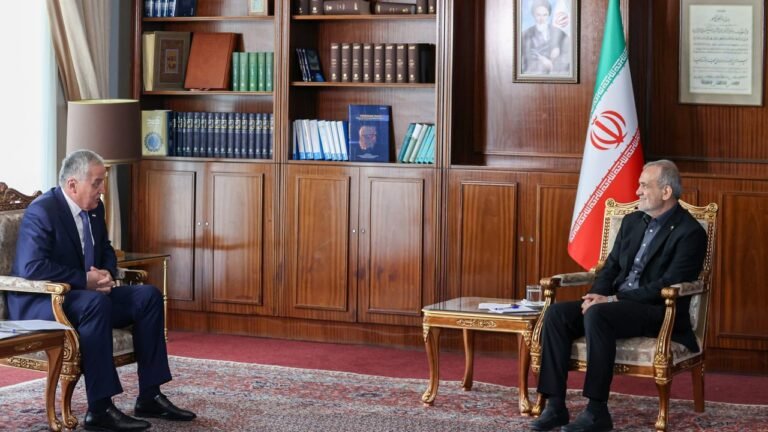
On May 18, 2025, in Tehran, Tajikistan’s Foreign Minister Sirojiddin Mukhriddin met with Iranian President Masoud Pezeshkian. According to the Iranian agency IRNA, during the meeting, representatives of the two countries discussed the high level of current bilateral relations and noted the favorable conditions for further expanding cooperation in the fields of trade, economy, science, […]
On May 18, 2025, in Tehran, Tajikistan’s Foreign Minister Sirojiddin Mukhriddin met with Iranian President Masoud Pezeshkian.
According to the Iranian agency IRNA, during the meeting, representatives of the two countries discussed the high level of current bilateral relations and noted the favorable conditions for further expanding cooperation in the fields of trade, economy, science, politics, and security.
Iranian President Pezeshkian called for the expansion of bilateral cooperation, the activation of efforts, and a broader use of existing opportunities to deepen bilateral ties. He emphasized that creating favorable conditions for active interaction between entrepreneurs and scientific circles of Iran and Tajikistan would contribute to the overall development and progress of the peoples.
For his part, the head of Tajikistan’s foreign ministry expressed the Tajik side’s readiness for even more sustainable strengthening of mutually beneficial cooperation with Iran.
Sirojiddin Mukhriddin noted the cancellation of the visa regime between the countries as an important factor and incentive for increasing the flow of tourists between the countries and strengthening ties between citizens.
The visit of Tajikistan’s Foreign Minister Sirojiddin Mukhriddin to Iran and his meeting with Iranian President Masoud Pezeshkian takes place against the backdrop of the resumption of bilateral ties after a long period of tension between Tajikistan and Iran.
The escalation began with the arrest of Iranian billionaire Babak Zanjani in Iran and the debts of “Barki Tojik” to the Sangtuda-2 hydroelectric power station, as well as after the ban on the Islamic Revival Party of Tajikistan in 2015.
However, with the coming to power of Ebrahim Raisi in 2019, relations between the two countries began to warm. During his tenure, a law on a visa-free regime between Tajikistan and Iran was adopted.
Additionally, in January of this year, an official visit by the new Iranian President Masoud Pezeshkian took place in Tajikistan. During the visit, 23 bilateral agreements were signed, a trade forum was held, and agreements worth over 450 million dollars were concluded.
Experts note that after this, bilateral relations between Iran and Tajikistan reached a new, higher level. The parties have intensified the implementation of joint trade, economic, and logistical projects. In particular, recent agreements have been reached on the construction of a Logistics Center for Tajikistan in the Iranian port of Chabahar.
Official channels report that Tajikistan intends to create an important logistics hub in the port of Chabahar. The goal of this step is to establish terminals and warehouse facilities with the involvement of Tajik investors and entrepreneurs.
Earlier in May 2025, at the 17th meeting of the Joint Commission on Economic, Trade, and Scientific-Technical Cooperation between the two countries, which took place in Shiraz, the Ministry of Transport of Tajikistan proposed the implementation of this project.
It was reported that during the first half of 2025, the Tajik side will develop and send a project for the construction of a logistics center to the Iranian side.
After the adoption of this document, the Iranian side will review it within one month and present the Tajik side with a draft cooperation agreement, which will include state benefits (preferences) with a precise definition of the investment amount.
According to experts, Tajikistan is striving for integration into international logistics corridors, and this step is the next move for Tajikistan in this direction. One of these corridors connects China with Europe through the countries of Central Asia, Iran, and Turkey.
For Tajikistan, which has no access to the sea, this opens up the possibility of direct access to the Indian Ocean, which could significantly expand the country’s trade and economic potential.