News
MIGRATION
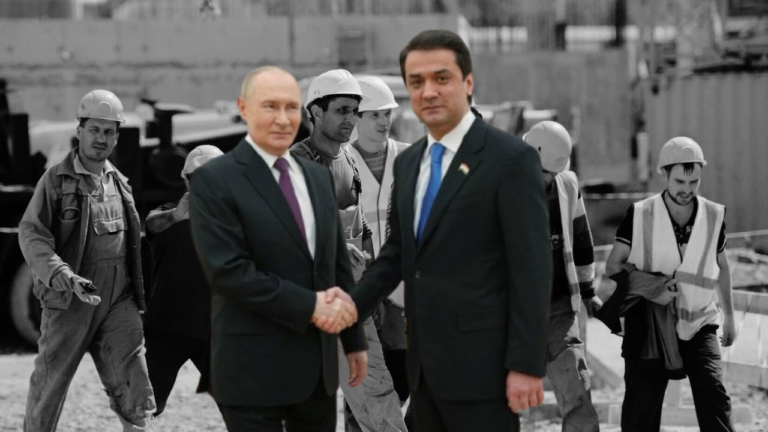
How will Rustam’s meeting with Putin affect the lives of Tajik migrants?
During meetings with Russian politicians, Rustam Emomali raised the issue of the situation of migrants in Russia. However, the specific issues he and others discussed are unknown. The meetings of the Mayor of Dushanbe and Chairman of the Majlisi Milli of the Majlisi Oli of Tajikistan (the upper house of parliament) Rustam Emomali with Russian […]
During meetings with Russian politicians, Rustam Emomali raised the issue of the situation of migrants in Russia. However, the specific issues he and others discussed are unknown.
The meetings of the Mayor of Dushanbe and Chairman of the Majlisi Milli of the Majlisi Oli of Tajikistan (the upper house of parliament) Rustam Emomali with Russian officials took place during his official visit to the Russian Federation on May 28–29.
According to state media, on May 28, during his official visit to Russia, Rustam Emomali met with the President of the Russian Federation Vladimir Putin. During the negotiations, a wide range of issues related to bilateral cooperation was discussed, including the development of strategic partnership and alliance, trade and economic issues, and they positively assessed the state of inter-parliamentary interaction, noting its progressive development and stable dynamics of strengthening.
Rustam Emomali also expressed gratitude to Vladimir Putin for supporting two significant social initiatives in Dushanbe — the construction of the building of the Russian State Theater named after V. Mayakovsky and the Center for Gifted Children “Sirius”.
Rustam Emomali emphasized the importance of activating the activities of the Intergovernmental Commission on Economic Cooperation.
Rustam and Putin also exchanged views on international and regional issues, including the unstable situation in Afghanistan and security in Central Asia.
Surprisingly for many, Rustam Emomali specifically highlighted issues of labor migration. It was noted that Rustam emphasized the importance of “coordinated efforts to address the problems faced by labor migrants and to ensure their legal and social protection.” Details of these problems and their solutions have not been disclosed by the state.
As part of his official visit, Rustam Emomali also held meetings with the Chairwoman of the Federation Council Valentina Matviyenko and the Chairman of the State Duma Vyacheslav Volodin. In these meetings, he discussed the same issues as in the Kremlin.
Rustam Emomali raises the topic of migration against the backdrop of increasing anti-migrant rhetoric across Russia. Over the past year, a number of new laws have been adopted in the country that further complicate the already difficult working conditions for migrants.
It should be noted that over the past year, several new laws have been passed in the State Duma that tighten the already challenging conditions for labor migrants. Alongside this, xenophobic rhetoric has sharply intensified in Russia: raids have increased in dormitories, cafes, and markets, where migrants, especially those from Tajikistan, are subjected to arbitrary detentions, beaten, forcibly taken to military enlistment offices, or even sent to war.
Such laws aimed at increasing control over migrants. Starting from September 1, 2025, the authorities of Moscow and the Moscow region will begin to monitor the location of migrants entering the capital region. The bill to conduct such an experiment was adopted by State Duma deputies on May 20. Foreigners will be required to register in a “specialized mobile application” and independently provide the Ministry of Internal Affairs with data about their location. If they attempt to bypass geolocation control, migrants will be included in a registry of controlled individuals, which may lead to their expulsion from Russia.
It remains unknown whether the situation for more than a million Tajik labor migrants will improve after these meetings. However, as practice shows, even after the visits of the authoritarian President of Tajikistan Emomali Rahmon to Russia and his negotiations with Putin on migration issues, the situation for Tajik migrants did not improve but only worsened.
Moreover, against the backdrop of Rustam’s meeting with Putin, discussions about a possible transfer of power from father to son have once again intensified in Russia.