News
WORLD
President with the shortest term in Poland
On June 1, 2025, the second round of presidential elections took place in Poland, where two candidates from the country’s largest parties competed for the presidency. In the final round of the presidential elections, Karol Nawrocki from the right-nationalist party “Law and Justice” (PiS) and Rafal Trzaskowski from the ruling party “Civic Platform” were vying […]
On June 1, 2025, the second round of presidential elections took place in Poland, where two candidates from the country’s largest parties competed for the presidency.
In the final round of the presidential elections, Karol Nawrocki from the right-nationalist party “Law and Justice” (PiS) and Rafal Trzaskowski from the ruling party “Civic Platform” were vying for the presidency.
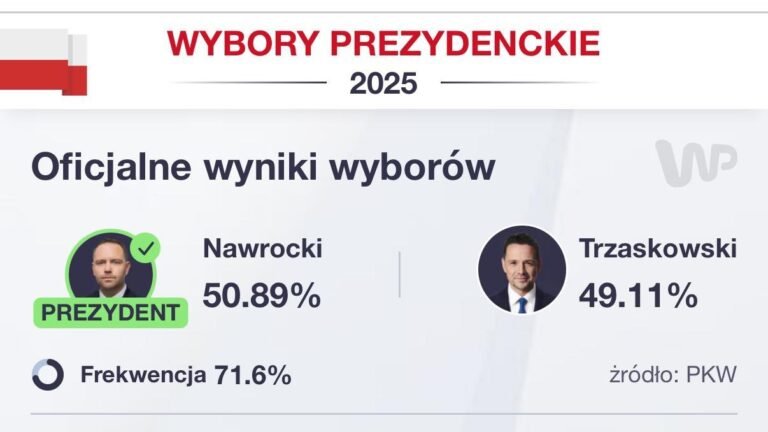
According to the official results of the second round of the presidential elections, the right-wing nationalist Karol Nawrocki emerged victorious. After counting all the votes cast, Nawrocki received 50.89% (10,606,877 votes), surpassing his opponent, the pro-European Rafal Trzaskowski, who garnered 49.11% (10,237,286 votes).
More than 72% of citizens were eligible to participate in the presidential elections.
Nawrocki’s victory was a significant blow to the Polish government led by liberal-conservative Prime Minister Donald Tusk.
On June 1 at 21:00, after the polling stations closed across Poland, preliminary results were announced, indicating that Rafal Trzaskowski had won the election with 50.3% of the votes. However, two hours later, after the first official data was published by the National Electoral Commission of Poland, Karol Nawrocki surged ahead and was ultimately declared the final winner of the election. According to local residents, Trzaskowski’s supporters celebrated his victory and went to sleep, only to wake up in the morning to find that Nawrocki had been declared president. This led Polish media to refer to Trzaskowski as the president elected for the shortest term or the “120-minute president.”
According to survey results, the majority of votes for Karol Nawrocki in the presidential elections in Poland came from young people aged 18 to 39, men, individuals with secondary education, as well as rural residents and farmers. Meanwhile, Rafal Trzaskowski primarily received votes from women, urban residents, citizens aged 40 to 60, and those with higher education.
In the end, with a margin of less than 1.78%, which is just over 350,000 votes, Nawrocki won the election.
This victory for the candidate from the “Law and Justice” party secured the presidency for a third consecutive term. The candidate from this party had also won the presidential elections in 2015 and 2020, and now the party will remain in power until the elections in 2030.
Although the president in Poland does not have extensive powers, as the country operates under a parliamentary system with the executive power held by the prime minister, the head of state still plays an important role. The president can sign or veto laws, approve or reject ambassadorial nominations, represent Poland abroad, and, in the case of political opposition with the ruling party, block or complicate its work.
Regarding the migration policy of the newly elected president Karol Nawrocki, as a candidate from the Law and Justice party (PiS), a tough stance can be expected, especially concerning illegal migration. PiS traditionally advocates for enhanced border protection, including with Belarus, limiting the acceptance of refugees from the Middle East and Africa, strict control over labor migration, particularly from countries outside the European Union, support for the repatriation of Poles from other countries, including Ukraine and Kazakhstan.
Although foreign policy and migration issues largely depend on the government and the prime minister, the president can use his influence—through vetoes, speeches, and international visits—to promote his party’s agenda. Thus, under President Nawrocki, Poland is likely to maintain or strengthen its strict migration policy.
Experts note that Nawrocki’s election is likely to lead to changes in the country’s migration policy, making conditions for refugees and labor migrants more stringent. In particular, a reduction in social benefits, stricter border controls, opposition to the redistribution of refugees from European Union countries to Poland, limitations on assistance to Ukrainian refugees, and a ban on the entry of illegal refugees from the Middle East and Africa, whom he views as a threat to national security, are expected.
In foreign policy, the president intends to expand cooperation with the United States and advocate for Poland’s independence from the European Union, opposing Ukraine’s NATO membership and the deployment of Polish troops to Ukraine. His plans also include increasing the military budget and greater independence from Europe.