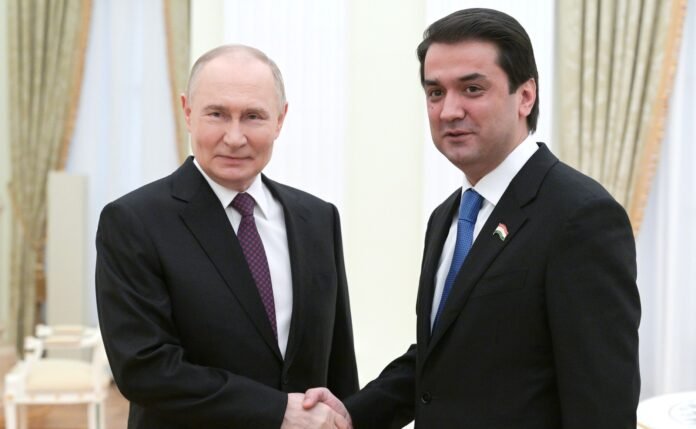
Rustam Emomali’s recent visit to Moscow and his meetings with the top leadership of Russia have sparked intense discussions and numerous theories among experts.
Some observers believe that the Russian leadership, particularly Vladimir Putin, supported the plan for a transfer of power in Tajikistan from father to son. Most experts are convinced that Rustam went to Moscow to receive the “green light,” take a “test,” and undergo an “interview” with Kremlin chief Vladimir Putin.
A glance at the course of the visit and the issues discussed is enough for any informed person to reach a similar conclusion. It is worth noting several nuances that indicate this trip was fateful and vital for the Tajik regime and its authoritarian leader, as everything was prepared quite cleverly and cautiously.
The Tajik national news agency “Khovar” initially limited itself to a dry and brief report on Rustam Emomali’s visit to Moscow. The report stated that he “departed for Moscow,” and that was all. Not a word was mentioned about whether the visit was working or official, let alone that a meeting with Putin was planned during the visit.
However, after Rustam Emomali was met at a fairly high level at Moscow airport (he was greeted by the Deputy Chairman of the Federation Council of the Russian Federation) and it became clear that everything was going according to a pre-approved plan, the media spread the information that the visit was “official.”
This indicates that Dushanbe was not sure until the last moment whether Putin would meet Rustam. That is why the first report about the visit was cautious. If Putin had refused to meet, this visit would not have been called official, and they would have pretended that nothing happened, as Putin again “did not succumb to persuasion.”
The level of formality of the visit can be determined by the number of signed documents, which usually indicates the importance of an official visit. However, during Rustam’s visit to Moscow, apart from his signature in the Book of Honorary Guests in the Federation Council, no documents were signed.
The consent and approval from Moscow for the transfer of the presidential chair from Emomali Rahmon to his son Rustam is as vital as air for Rahmon. Until recently, Putin had not shown any indication that he would agree to such a crucial step for Rahmon.
Here, we will not delve into why Putin ultimately agreed to meet Rustam and what countries or factors influenced this decision. But it can be said that Rahmon managed to convince Putin, and Rustam received the “approval,” passing the “test.” Perhaps the assertion that Rustam secured his future by taking a “selfie” with Putin sounds unserious. But now, no one will be able to prevent Rahmon from placing his son in the presidential chair while he himself remains in the status of the Founder of Peace and National Unity and Leader of the Nation.
Moreover, there is not a single other contender for this position in the country. Faromuz Irgashev, a newcomer to politics who openly expressed his desire for Rahmon’s seat, was arrested three years ago after the events in Khorog in May 2022 and was sentenced to life in prison.
There are no active opposition forces left in the country capable of challenging Rustam in the elections. Meanwhile, opposition groups abroad are mired in their internal disputes and are not prepared for serious competition for the presidential post or to fight against Rustam.
While Rahmon confidently moves towards his goal, distrust, division, and contradictions are growing within the ranks of the Tajik opposition. In other words, while the process of power transfer in the presidential palace seems to be approaching its final stage, fierce disputes have erupted among members of the largest opposition party – the Islamic Revival Party of Tajikistan regarding a new leader, which only plays into the hands of the long-standing dictatorial regime.
Due to recent disputes among supporters of the Islamic Revival Party of Tajikistan (IRPT), the organization has once again come into the spotlight. Despite the election of a new leader, disagreements persist. Some opposition groups congratulate the newly elected leader of the IRPT, while others criticize him.
The same atmosphere prevails among party members.
Divisions in the history of more than fifty years of the IRPT have occurred before, including during the years of armed confrontation and after the party’s return and participation in the country’s political life. However, this time the division is becoming more serious and the rift deeper. Today’s IRPT no longer holds the influence and authority it once had, making it significantly harder to overcome disagreements and eliminate divisions.
The party leader, Muhiddin Kabiri, stated at a meeting with associates in Warsaw that they should not get distracted by trivial matters, but rather maintain unity for the main struggle. However, the other side believes that such an approach is ineffective and does not yield the desired results.
Reports about Rustam’s “official” visit emphasize that he arrived at the “invitation” of the Russian leadership. However, as we have seen, there was not a single topic during this visit that was genuinely addressed with Rustam’s participation.
The construction of the Russian Drama Theater in Dushanbe or the Center for Gifted Children funded by Russia? These issues were also discussed with Matviyenko.
In fact, it was Valentina Matviyenko who accompanied Rustam to Putin. In the photo, the future president of Tajikistan seems to be taking a “state exam” before the commission – Putin and Matviyenko. In the conversation, Rustam emphasizes that the teaching of the Russian language in Tajikistan begins in the first grade, as if Putin was unaware of this.
The emphasis on this moment can be seen as a symbolic vow of loyalty: “We have been with you since the first grade, we will obey unconditionally.” And Putin seems to be satisfied, as if he saw that Rustam has “grown up,” “matured,” and that he can not only be counted on but also relied upon.
So, in this case, what else could Rustam’s invitation mean, aside from resolving the issue of “power transfer,” which Rahmon has been asking Putin about for many years?
Has Rustam been given the green light? Did he successfully pass the interview? Did he pass the exam? Time will tell. However, we do not rule out that Rahmon has managed to achieve his goal. He may want to start the power transfer while he is still capable and personally “install” his son in the presidential chair and help govern the country in the initial period. Therefore, it can be expected that early elections may soon begin. Even if there are no early elections, there is not much time left until the next elections in 2027.
Even if we assume that Putin has given the “go-ahead” and Rustam’s coming to power is guaranteed, the next logical question is — what will happen after Rustam comes to power?
Will there be any changes and reforms that will be in the interests of the people of Tajikistan? Or will the same policy that Emomali Rahmon pursued continue — a policy where, apart from himself and his family, everyone else means nothing? This question remains open, and judging by the current realities, there are few hopes for significant changes in favor of the common people.
Many experts and observers believe that the current policy will continue. One should not expect any easing regarding political parties, free press, or religious freedom or mosques. Most likely, in this direction, Rustam will implement even stricter policies.
However, according to others, in order to reduce the level of discontent, radicalization of youth, and prevent possible social upheavals, minor “cosmetic” changes are possible. For example, partial criticism in the media may be allowed, but only in areas permitted by Rustam. Or some political prisoners recognized by international organizations as political prisoners may be released. Or, perhaps, religious education may be allowed in some places at congregational mosques.
However, it is unlikely that the activities of opposition and especially Islamic parties will be permitted. The political arena will remain under control — after all, the current situation suits the authorities quite well.
It is possible that Rustam will build relations with Afghanistan under the Taliban in a different format and recognize their power — but only within the framework of Russian foreign policy, not of his own accord.
The main resources, large enterprises, and businesses will remain monopolized by the Family. At least as long as Rahmon is alive, everything will be used in the interests of his family.
The newspaper “Vedomosti,” close to the Kremlin, reported that the meeting between Putin and Emomali (referred to by his surname Rustam) was very brief. The emphasis on the shortness of the meeting may indicate that it is too early to draw conclusions about whether Rustam received the “green light” and passed the “interview.” Otherwise, a more substantive conversation would have been expected, and Putin would have introduced the future president of Tajikistan as a mature and informed politician, involving him in the topics of discussion and speaking about the prospects for relations between the countries.
Nevertheless, Rustam’s visit was different from previous ones: laying a wreath at the Tomb of the Unknown Soldier, meetings with the leadership of both chambers of the Russian parliament, a trip to Sochi — even if under a contrived pretext — all indicate a positive shift in his perception by the Kremlin.