News
HUMAN RIGHTS
Demonstrators in Germany called to stop cooperation with Tajikistan
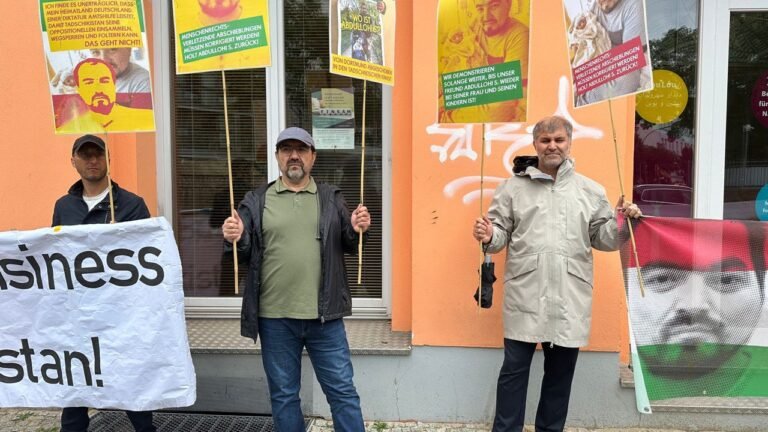
A group of activists held a protest in Germany and called for the release of Abdulloh Shamsiddin, as well as to stop trade and economic cooperation with Tajikistan. In Berlin, the capital of Germany, civil society and human rights activists organized another protest. Demonstrators staged a picket in front of the Tajikistan embassy and raised […]
A group of activists held a protest in Germany and called for the release of Abdulloh Shamsiddin, as well as to stop trade and economic cooperation with Tajikistan.
In Berlin, the capital of Germany, civil society and human rights activists organized another protest. Demonstrators staged a picket in front of the Tajikistan embassy and raised the slogan: “Stop Making Business with Tajikistan!” The protesters demanded that the German government cease trade and economic cooperation with the regime of Emomali Rahmon.
Participants in the action also called for the release of political prisoners in Tajikistan, specifically Abdulloh Shamsiddin and Dilmurad Ergashov.
Human rights organizations noted in their reports that they became victims of politically motivated persecution. After being deported from Germany to Tajikistan, they were immediately detained and sentenced to long prison terms.
According to human rights organizations, “due to direct and dangerous cooperation between German authorities and the repressive regime,” in 2023, two Tajik opposition activists — Abdulloh Shamsiddin and Bilol Kurbonaliev — were deported from Germany to Tajikistan. Upon arrival in Dushanbe, they were detained and later sentenced on fabricated charges, including “attempting to violently change the constitutional order.” Abdulloh Shamsiddin received a 7-year prison sentence, while Bilol Kurbonaliev was sentenced to 10 years in a penal colony.
Dilmurad Ergashov, a well-known activist and member of the Movement for Reform and Development of Tajikistan, was deported to Tajikistan in November 2024 when he was denied asylum in Germany. Tajik law enforcement detained him and, by court order, arrested him for two months. Official charges have not yet been announced.
In the past two years, more than 15 protests have been held in various cities in Germany, including Berlin, Frankfurt, Munich, etc. Despite the risk of detention and torture for deported individuals in Tajikistan, German courts continue to issue deportation orders for asylum seekers.
It is important to note that all deported individuals had extensive experience in political and anti-government activities.
Activists believe that Germany’s trade and economic cooperation with Tajikistan “indirectly” finances repression in Tajikistan.
Earlier, the head of the European Commission announced that the European Union would allocate 12 billion euros as part of the European infrastructure initiative Global Gateway for Central Asian countries, including Tajikistan.
Tajikistan possesses valuable natural resources, including rare metals that are important for European industry.
Activists called for “these investments to be provided on the condition of respecting human rights” and should not be accompanied by silent consent to repression.
Currently, there are no signs of a change in Tajikistan’s policy towards the opposition and political prisoners. Over the past decade, the government of Emomali Rahmon has pursued a harsh policy of persecuting dissenters. Furthermore, international organizations year after year include Tajikistan in lists of countries where violations of freedom of speech and political rights are observed.
Participants in the protests expressed concern over the close trade and economic cooperation of Western countries with the regime of a country where hundreds of political prisoners are registered, and where freedom of speech and expression is restricted.