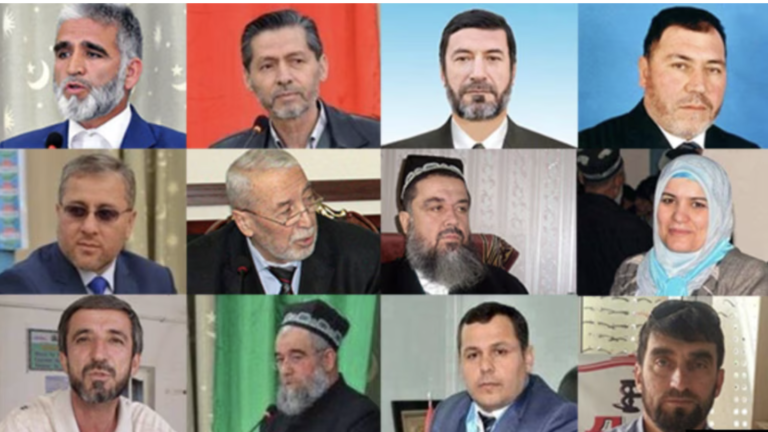
On the eve of the tenth anniversary of the arrest of the leaders of the Islamic Revival Party of Tajikistan (IRPT), we decided to raise the issue of these political prisoners. Exactly ten years ago, on this day, high-ranking members and leaders of the IRPT were detained by the law enforcement agencies of Tajikistan on the orders of Emomali Rahmon himself.
On September 16, 2015, the law enforcement agencies of Tajikistan detained the leaders of the Islamic Revival Party of Tajikistan. Among those detained were the party’s deputy chairmen Saidumar Khusaini and Muhammadali Khait, as well as 11 other members of the Supreme Presidium of the IRPT. They were accused of preparing a “coup d’état.” However, the IRPT rejected these accusations, calling them unfounded.
 Photo: Internet
The detentions of the IRPT leadership followed an unsuccessful coup attempt by then-Deputy Minister of Defense of Tajikistan Abduhalim Nazarzoda, which began on the night of September 4 and was completely suppressed by September 15. The authorities accused the IRPT of complicity with Khoji Halim; however, party representatives categorically denied any involvement or cooperation and even issued a statement condemning the coup attempt.
However, the statements did not prevent the detention of the IRPT leaders. Moreover, the Prosecutor General of Tajikistan declared the party a terrorist organization, banned its activities in the country, and sentenced the party leaders to long prison terms, including life imprisonment, sending them behind bars.
The security forces did not stop at the detention of 13 high-ranking party members; on the contrary, this marked the beginning of the largest repressive campaign against members and supporters of the IRPT both in the country and abroad.
In the following months, hundreds of members and supporters of the IRPT in the country were detained. Many were also detained in Russia and other countries. For example, Naimjon Samiev and others were detained in Russia and extradited to Tajikistan.
In other words, the government of Emomali Rahmon, using all available financial, diplomatic, and coercive levers, began a campaign to suppress the opposition. In Tajikistan, this manifested in arrests, imprisonments, property confiscations, dismissals from government positions, humiliation and insults towards the relatives of the prisoners, as well as organizing protests outside their homes. Abroad, through Interpol and using other mechanisms, the authorities began to pursue the opposition in post-Soviet countries, in Iran, Turkey, to the extent that the Tajik authorities made life unbearable for IRPT members even in some European countries. As a result, many opposition members were deported from Europe to Tajikistan and sentenced to long prison terms.
The international community, including the UN, the European Union, and the OSCE, condemned the arrest of the leaders of the Islamic Renaissance Party of Tajikistan (IRPT) and called for their release. However, in response to these calls, the authorities of Tajikistan detained the lawyers of the imprisoned IRPT leaders Buzurgmehr Yorov and Nuriddin Makhamov on fabricated charges and also sentenced them to long prison terms.
Since the detention of the IRPT leaders on September 16, 2015, more than 9 months passed before the announcement of the verdict. The Supreme Court of Tajikistan issued its decision on June 2, 2016. All hearings were held behind closed doors.
As a result, on June 2, 2016, the Supreme Court sentenced two deputy chairmen of the IRPT, Saidumaro Khusayni and Muhammadali Khait, to life imprisonment. Rahmatullo Rajab, Abdukakhhor Davlat, Kiyomidin Avaz, and Sattor Karimov received 28 years each, Zubaidulloh Rozik was sentenced to 25 years, Muhammadali Faizmuhammad to 23 years, Sa’diddin Rustam and Vokhidkhon Kosiddin to 20 years each, Hikmatullo Saifullodzoda to 16 years, Muhammadsharif Nabiyev and Abdusamad Gayratov to 14 years each, and finally, the only woman among them, Zarifo Rahmoni, to 2 years in prison.
Of the 13 imprisoned IRPT leaders, 10 remain in prison. Currently, only Zarifo Rahmoni is free. Sattor Karim, known as Mahsumi Sattor, was killed under mysterious circumstances during a riot in Vakhdat prison in May 2019.
Another imprisoned party leader, Muhammadali Faizmuhammad, known as “Qadiy Nakhzata,” died in July 2024 in prison after a prolonged illness.
On the eve of the tenth anniversary of the detention of the IRPT leaders, we spoke with international human rights lawyer and activist Steve Sverdlov, representative of the Norwegian Helsinki Committee for Central Asia Marius Fossum, IRPT leader Muhiddin Kabiri, as well as the children of political prisoners Shukhrat Rahmatullo and Khisom Zubaidullozoda.
Today, we will learn their perspectives on what has happened over these 10 years and how they see the fate of political prisoners.
Azda.tv asked the children of political prisoners:
Ten years have passed since the detention and imprisonment of your fathers. Do you have hope for their release? If so, how do you think this might happen — under international pressure or through the mercy and pardon of Emomali Rahmon?
 Photo: Internet
Shukhrat Rahmatullo, son of political prisoner Rahmatullo Rajab, told us that he hopes for his father’s release by the will of God.
According to him, he does not expect a pardon or amnesty from the authorities, as his father is innocent and should be released unconditionally.
Shukhrat also emphasized the important role of international organizations and foreign states in the release of political prisoners and stated that they should increase pressure on the authorities of Tajikistan.
 Photo: Internet
Khismiddin Rozikov, the son of the oldest political prisoner — 80-year-old Zubaidullo Rozik, also hopes for his father’s release. According to him, his father’s health has significantly deteriorated recently, and he is receiving treatment in the prison hospital of Vakhdat. Currently, he has shown some improvement.
Khismiddin hopes that the authorities will take into account his father’s health condition and age and will release him.
The son of Zubaidullo Rozik also expressed dissatisfaction with his father’s associates who live in exile. He stated that many of them do not even inquire about his father’s health.
Azda.tv also asked the leader of the Islamic Renaissance Party of Tajikistan (IRPT), Mukiddin Kabiri, what steps the party is taking to secure the release of imprisoned party members.
 Photo: Internet
Mukiddin Kabiri stated that from the very first day of the arrests, the leadership of the IRPT abroad has made the release of political prisoners, the mitigation of sentences, and the improvement of prison conditions one of the main focuses of its political struggle.
“The cases of more than 10 political prisoners, most of whom are members of the IRPT, have been submitted to the UN Human Rights Committee. No other country has submitted as many cases — not only among Central Asian countries but also among the states of the former USSR.
We have submitted a criminal case against Emomali Rahmon to the International Criminal Court in The Hague, and most of the materials in it are based on the cases of IRPT political prisoners. In addition, special organizations for the protection of political prisoners have been established, most of which are staffed by supporters and members of the IRPT,” emphasized Kabiri.
International lawyer and human rights activist Steve Sverdloff believes that the international community has not yet exerted sufficient pressure on the regime of Emomali Rahmon, despite gross human rights violations in Tajikistan.
 Photo: Internet
“International human rights organizations, such as the UN, the Human Rights Committee, and the European Parliament, document dozens of cases of human rights violations and try to draw the attention of the international community to them. However, we see that, for example, the European Union continues to cooperate with Rahmon’s regime and holds annual conferences on water issues in Dushanbe,” notes Sverdloff.
He noted that the difference between the statements and actions of international organizations sends a signal to the Tajik authorities:
“Rahmon can act with impunity.”
According to the human rights defender, even the USA shows weak interest in Central Asia and does not use existing pressure mechanisms, including sanctions against individuals.
“We have provided a large amount of data on Tajikistan’s government officials involved in torture for inclusion in the ‘Magnitsky list,’ but these appeals have gone unanswered,” added Sverdlov.
He also supported the idea of filing complaints with the International Criminal Court in The Hague and emphasized that cases of violations by Tajik officials should be referred to courts in various European countries, including Germany.
Marius Fossum, a representative of the Norwegian Helsinki Committee for Central Asia, regarding the detention of leaders of the IRPT and human rights violations in Tajikistan, stated that, unfortunately, very little is known in Europe about the situation in Tajikistan.
 Photo: Internet
“It is easier for European politicians to pay attention to the situation in Belarus. It is a neighbor, and crises there directly affect Europe. Tajikistan, however, is far away, so it is easier to ignore the tragedies of the people in this country. But this is a mistake. The development of Tajikistan and the fate of its people are of great importance for the entire region, and Europe must understand this,” emphasized Fossum.
He also noted that international organizations and Western countries have made many decisions and issued many statements, but they have remained only words. To achieve a real effect, it is necessary to impose personal sanctions against high-ranking Tajik officials responsible for repression and human rights violations, including for the tragic events in Badakhshan.
“This path is long, but only in this way can change be achieved,” concluded Fossum.
Mukhiddin Kabiri, in his address, called political prisoners “living heroes.”
“All political prisoners should be assured that their brothers, sisters, children, and all people whose hearts ache for the nation and the prisoners are always thinking of them and making every possible effort to free them from this plight as soon as possible, even if just one day earlier,” he said.
The leader of the IRPT added that the capabilities of justice fighters are limited and acknowledged that to some extent he feels guilty towards political prisoners, as over these 10 years they have not been able to alleviate their suffering.
However, he expressed confidence that political prisoners have consciously chosen this path and serve as mentors to all who are on this path; they have taught others resilience, patience, and the struggle for justice, and they understand the situation of those fighting for justice from the outside. According to him, their patience, resilience, and courage have already made them national heroes.
In his address, Kabiri called on the relatives of political prisoners, as well as all opposition members and justice fighters, to become one family.
“If we have disagreements on political or personal issues — that is natural, but in the matter of political prisoners, we must act as one family and fight for them together. This is the only issue on which we have no disagreements, and cooperation in this direction is our moral, spiritual, and political duty,” Kabiri stated.