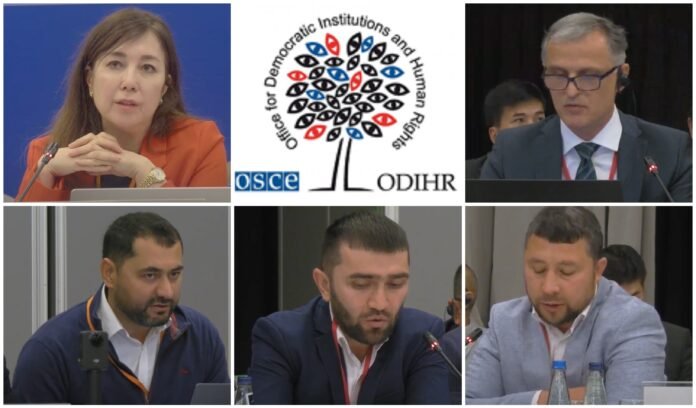
Participating in the session was Gulnoza Said, the Europe and Central Asia Program Coordinator at the Committee to Protect Journalists (CPJ). In her speech, she noted that over the past year, the situation regarding press freedom and journalist safety has significantly worsened worldwide, including in OSCE region countries and even in the largest democratic states.
Gulnoza Said cited the example of the deportation from the U.S. of prominent journalist Mario Guevara for his critical reports on the work of police and immigration services in the U.S. She emphasized that this case illustrates the increasing pressure on media even within the American journalistic environment.
Furthermore, the U.S. government has significantly reduced funding for international support programs this year, which has negatively impacted the work and sustainability of independent media. A CPJ representative noted that the funding cuts and the closure of American organizations, including USAID, NED, and others, have already affected journalists in Ukraine, Moldova, and Georgia, and have jeopardized the existence of U.S. Congress-funded media such as Radio Free Europe, Voice of America, and Radio Free Asia.
Gulnoza Said urged the U.S. government to reconsider its decisions on funding cuts and to resume support for journalists who provide millions of people with independent information daily.
She also drew attention to the situation in Central Asia, highlighting that Tajikistan has the highest number of imprisoned journalists in the region. Among them is the well-known journalist and human rights activist Uflatkhonum Mamadshoeva, sentenced to 20 years in prison.
Gulnoza Said called on OSCE member states to ensure the safety of journalists, combat violations of press freedom, and hold violators accountable.
No representatives of the Tajik government were present at the conference and did not make official statements, while activists, journalists, and opposition figures from the country, who mostly live abroad, continue to actively participate in the event, as in previous years.
In particular, the leader of the political movement “Group 24” Dilshod Sharipov accused the government of Tajikistan of monopolizing information and ignoring independent voices, emphasizing that society in the country is deprived of access to objective information.
Sharipov also stated that Emomali Rahmon illegally holds power, and international human rights organizations are aware of the torture, killings, and other crimes of this regime.
He noted that Tajik opposition figures and activists have been reporting on the crimes of Rahmon’s regime from abroad since 2016, however, Tajikistan has ignored meetings for four consecutive years and does not participate in the Warsaw Conference, fails to fulfill the recommendations and obligations of this organization, constantly violates its charter, and even did not allow OSCE observers at the parliamentary elections in March.
According to the leader of “Group 24,” the OSCE has lost influence and has turned into a bureaucratic structure that is unable to respond effectively to international crises and needs serious reform.
He emphasized that Russia has been waging war against Ukraine for four years, yet remains a member of the OSCE.
“If it is difficult to exclude Russia, at least exclude Russia’s puppet — Rahmon, who represents Tajikistan in the OSCE. You say that the charter does not provide for a procedure for excluding a country. What prevents you from amending the charter? The OSCE has transformed from an influential international organization into a bureaucratic structure that cannot change anything. Look at this relatively empty hall where the 50th conference is being held. Over these days, have you seen representatives of global, European, or local media? Have you observed the work of even one journalist analyzing this event?” — asked Dilshod Sharipov.
In conclusion, he asked the organizers of the meeting what is more important to them — the quality of work or the number of member states.
“If quality is important, the structure and charter of the organization need to be changed. If quantity is important, accept Venezuela, Eritrea, and North Korea, and the number of members will reach 60. And finally, esteemed attendees, conduct a survey of all conference participants about your activities. I assure you that the response will be unsatisfactory,” — concluded the leader of the political movement “Group 24.”
Also at the conference, journalist and head of the independent media Azda TV Mukhammadjon Kabirov spoke. He also criticized the situation with press freedom in Tajikistan. He stated that since 2015, the authorities have systematically restricted freedom of speech, closed independent media, and persecuted journalists.
According to Kabirov, independent publications such as “Nadzhot,” “Nigoch,” and “Ozodagon” have been forced to cease their activities in the country, and today even Radio Ozodi is under threat of closure.
Kabirov emphasized that with the closure of media outlets in the country, publications in exile emerged that provided independent information. However, without international support, many of them, including “Bomdod,” “Akhbor,” and others, have already ceased operations. Currently, the only independent publication in exile is Azda TV. However, this media outlet faces financial difficulties, and the relatives of journalists living in Tajikistan are under constant pressure from the authorities, facing threats and persecution.
He noted that in recent years, pressure and persecution of journalists have reached a new level. Many well-known journalists, such as Akhmad Ibrohim, Rukhshona Hakimova, Ulfatkhonim Mamadshoeva, Daleri Emomali, and others, have been sentenced to long terms on fabricated charges for carrying out their journalistic activities and research.
“These people are not criminals; they are journalists. Their only ‘sin’ is speaking the truth. And the truth should never be a crime,” said Muhammadjon Kabirov.
He reminded the global community that pressure and international support matter. When journalist Khayrullo Mirsaidov was arrested in 2017, he was released in 2018 under international pressure.
In his speech, Kabirov called for the use of the Moscow Mechanism of the OSCE to investigate the persecution of journalists, to apply pressure on the authorities of Tajikistan through diplomatic channels, to support independent media, especially Azda TV, and to award imprisoned journalists with international prizes.
“Ten years ago, we hoped that repression in Tajikistan would cease. But it has become deeper, darker, and more systematic. Nevertheless, I still believe in the power of solidarity and the principles of the OSCE. If we act together today, we can help secure the release of imprisoned journalists and protect the right of every citizen of Tajikistan to access the truth,” Kabirov concluded.
He also reminded: “Freedom of speech and the media is not a privilege, but a fundamental right of citizens.”
At the same conference, Tajik opposition figure Ubaidullo Said delivered a speech in which he stated that freedom of speech and the safety of journalists in Tajikistan have reached a level that raises concern.
According to him, freedom of speech and the press are not just words on paper, but essential needs of any free society. Said emphasized that journalists speak the truth, demand accountability from the authorities, and provide society with the opportunity to receive accurate information. However, in Tajikistan under Emomali Rahmon’s leadership, press freedom is almost destroyed.
The Tajik opposition figure added that in 2022 alone, 92 cases of pressure on media and journalists were recorded—from financial pressure to fabricated court cases. Under such pressure, many media outlets ceased operations or relocated abroad, and journalists were forced to abandon their profession to avoid persecution.
“When journalists cannot work freely, people do not hear the truth. Freedom of the press is not a gift; it is a human right that must be protected by laws and respected by society,” noted Said.
Ubaidullo Said called on the international community to pay more attention to the situation of journalists in Tajikistan and to take real measures to protect them from pressure and political persecution.
Also at this meeting, the representative of the National Alliance of Tajikistan Ilkhomjon Yokubov drew attention to the human rights situation and pressure on journalists in the country. He stated that despite the harsh criticism from international organizations, the government has not only failed to reduce pressure but has intensified it.
According to Yokubov, the restriction of basic human rights and freedoms in Tajikistan has become a “common occurrence,” and the government of Emomali Rahmon has established a “red line” for the press, such as prohibiting criticism of the president, his family members, and other officials. Crossing this line, a journalist faces revocation of accreditation, being placed on a “black list,” or even imprisonment.
Yokubov reported that currently, journalists Hikmatullo Saifullozoda, Abdullo Gurbati, Daleri Imomali, Abdusat tor Pirmuhammadzoda, Zavgibek Saidamini, Ulfatkhonum Mamadshoeva, Makhmadali Khayit, Akhmadshokh Komilzoda, Rahmatullo Rajab, Abduqakhhor Davlat, Abdukodiri Rustam, and Rukhshona Hakimova are in Tajik prisons. Some of them have been sentenced to life imprisonment.
“Today, not only journalists are at risk, but any citizen who writes critical comments on social media or even simply likes a post,” noted Yokubov.
He added that according to the official Deputy Attorney General of Tajikistan, over the past seven years, more than 1500 citizens of the country have been arrested and imprisoned solely for “likes” on social media.
“There is no other country in the world where more than 1500 people have been imprisoned for a single ‘like’,” he emphasized.
In conclusion, Yokubov urged the international community to pressure the government of Tajikistan to release all imprisoned journalists and to stop persecuting citizens for their opinions and expressions of views.
It is worth noting that at the conference on October 7, dedicated to humanitarian issues and democratic institutions, Tajik opposition figures also actively participated and spoke.