News
HUMAN RIGHTS POLITICS
What did the head of the Ministry of Foreign Affairs of Tajikistan and the Deputy Prosecutor General of the ICC discuss?
The Minister of Foreign Affairs of Tajikistan held talks with the Deputy Prosecutor of the International Criminal Court. According to the press service of the Ministry of Foreign Affairs of Tajikistan, on November 19, 2025, in Brussels, a meeting took place between the Minister of Foreign Affairs of Tajikistan, Sirojiddin Muhriddin, and the Deputy Prosecutor […]
The Minister of Foreign Affairs of Tajikistan held talks with the Deputy Prosecutor of the International Criminal Court.
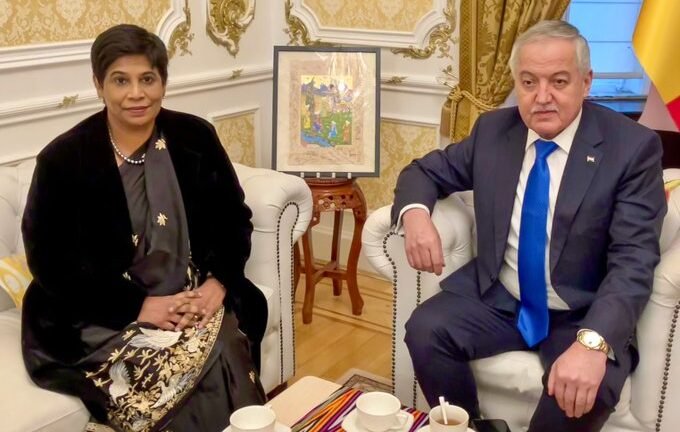
According to the press service of the Ministry of Foreign Affairs of Tajikistan, on November 19, 2025, in Brussels, a meeting took place between the Minister of Foreign Affairs of Tajikistan, Sirojiddin Muhriddin, and the Deputy Prosecutor of the International Criminal Court, Ms. Najat Shamim Khan.
According to the Ministry of Foreign Affairs, during the meeting, the parties exchanged views on the prospects for further development of cooperation between Tajikistan and the International Criminal Court and the preparations for the session of the Assembly of States Parties to the Rome Statute, scheduled to take place from December 1 to 6, 2025, in The Hague, Kingdom of the Netherlands.
The Ministry of Foreign Affairs did not provide further details about this meeting, and it is unknown whether the parties discussed any issues beyond those mentioned above.
The Minister of Foreign Affairs of Tajikistan, Sirojiddin Muhriddin, held talks with the Deputy Prosecutor of the International Criminal Court against the backdrop of recent reports that a coalition of opposition parties and movements has filed a lawsuit with the International Criminal Court against the President of Tajikistan, Emomali Rahmon, regarding crimes against humanity.
The preparation of the lawsuit involved several organizations – the Islamic Revival Party of Tajikistan (IRPT), the Ukrainian Fund for International Volunteers (FUVI), Freedom For Eurasia, as well as with the support of the Norwegian Helsinki Committee, and is based on allegations such as “arbitrary arrests, torture, rapes, solitary confinement, enforced disappearances of suspects, forced emigration, murders,” and others.
The legal representative of these organizations, lawyer Nicolas Liniel, stated that they submitted over 60 cases of human rights violations to the ICC — torture, rapes, arbitrary arrests of opposition members, persecution, pressure, and confiscation of property.
The case included alleged crimes committed by Emomali Rahmon and his officials from 2011 to the present. The complaint to the ICC requests the initiation of an investigation against Tajik authorities, including Emomali Rahmon, to hold them accountable and to issue an international arrest warrant.
It is currently unknown whether the meeting between the head of the Ministry of Foreign Affairs of Tajikistan and the high-ranking prosecutor of the ICC is related to the IRPT’s complaint against Tajik officials and Emomali Rahmon and what influence it may have on it.
However, Salim Sultonzoda, spokesperson for the National Alliance of Tajikistan, wrote on his Facebook page that the urgent trip of the Foreign Minister to Brussels pursued this goal, namely discussing, monitoring, and influencing the lawsuit of the National Alliance of Tajikistan, of which the IRPT is a member.
According to Sultonzoda, the authorities in Dushanbe understand well that the lawsuit in The Hague has a transnational and non-political nature, and that the ICC stands above the position and status of officials. The very fact of the acceptance of the lawsuit and the rumors surrounding it indicate that this lawsuit has dealt a serious blow to the reputation of the regime of Emomali Rahmon.
He also believes that the head of the foreign affairs agency of Tajikistan was sent to Brussels to monitor the situation, prevent or reduce the likelihood of the case being considered at a higher level. However, Sultonzada emphasizes that lobbying, pressure, and manipulation in the mechanisms of the International Criminal Court do not yield results.