News
AFGHANISTAN TAJIKISTAN
Why is no one investigating the deaths of Afghans in the mines of Tajikistan?
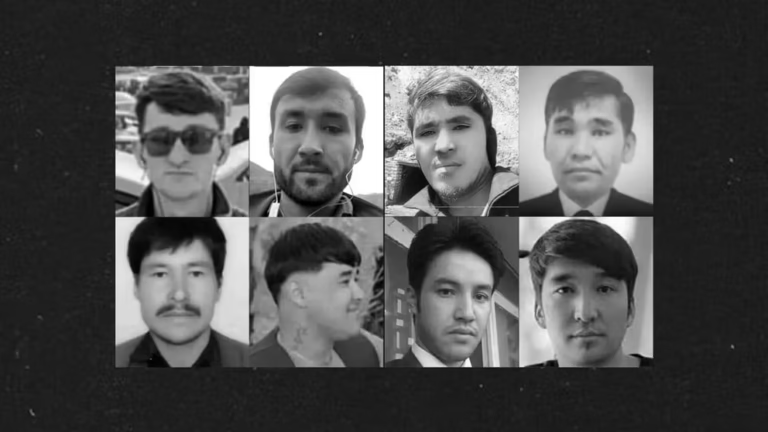
The bodies of six Afghan workers, who died on November 2 of this year at a coal mine in the Ayni district of the Sughd region, were delivered back to their homeland. It is reported that these six citizens of Afghanistan died as a result of a methane explosion that occurred on November 2 at […]
The bodies of six Afghan workers, who died on November 2 of this year at a coal mine in the Ayni district of the Sughd region, were delivered back to their homeland.
It is reported that these six citizens of Afghanistan died as a result of a methane explosion that occurred on November 2 at the coal mine in the Ayni district.
On December 4, the bodies of the deceased were sent back to their homeland, specifically to the provinces of Daykundi and Bamiyan in Afghanistan.
Earlier in May of this year, eight citizens of Afghanistan died in the same mine due to an explosion. The authorities of Tajikistan have not yet commented on the causes of the explosions and the deaths of the miners, and it is not reported whether an investigation is being conducted.
Afghan workers told Persian-language media that working conditions in the mines are extremely dangerous, and insufficient attention is paid to the safety of miners.
The Afghan publication Afghanistan International prepared and published its own investigative report. They found that the explosion inside the coal mine was not an accident, but rather the “result of ignoring multiple warnings from geologists about critically high levels of methane.” Workers claim that the person responsible for the mine warned of a sharp increase in gas concentration two months before the tragedy, but instead of halting operations, he was fined, and extraction continued under the same conditions.
Journalists conducted the investigation based on personal interviews with four Afghan workers, the examination of two copies of their employment contracts, discussions with representatives of the Afghan embassy in Tajikistan, and one senior employee of the mining company, as well as an analysis of key provisions of the Labor Code of Tajikistan.
Workers describe the working conditions as “inhumane” and “prison-like.” According to them, upon entering Tajikistan, the company confiscates their passports and documents, and they are not allowed to leave the workplace for up to a year. Between 12 to 18 people are housed in one room, and workers labor for 12 hours under harsh conditions without overtime pay.
The investigative material notes that this coal mine is managed by the “Tajik Metallurgical Plant” — a company characterized in international reports as part of a corruption scheme. The investigation established that the hiring of workers from Afghanistan is carried out through a network of corrupt intermediaries: they demand up to $1,700 for obtaining a visa, while its actual cost is about $300.
The report also mentions the company “Faroz.” The company was founded in 2008 by Shamsullo Sokhibov, the son-in-law of Tajikistan’s President Emomali Rahmon, and in less than ten years grew from a small firm into a large group of companies. The company has interests in various sectors — from banking and energy to mining, logistics, insurance, and construction materials trading.
According to an investigation published in 2018 by the OCCRP program “Tajikistan: Millions in the Marriage Basket,” the growth of “Faroz” was driven not by fair competition, but by a complex system of political patronage, the elimination of rivals, and the acquisition of unjustified privileges.
Although in 2019 the company announced the liquidation of part of its activities, and the company’s name disappeared from tax documents in 2020, industry officials, workers, and independent researchers claim that the assets of “Faroz” continue to operate, but under different brands. According to them, control over several coal mines, including the one where the tragedy occurred, is still under the influence of this network. A significant portion of the extracted coal is exported to Uzbekistan and Pakistan.
Tajikistan’s labor legislation stipulates that miners should receive annual leave, medical insurance, and work in safe conditions; however, Afghan workers are deprived of all these rights. Even in the event of death, instead of the legally mandated 60 months’ salary, families receive only 150,000 to 200,000 afghanis (20,000 to 27,000 somonis).
Local authorities and supervisory bodies in Tajikistan have yet to respond to the incidents. The Embassy of Afghanistan also acknowledged that because workers typically enter the country unofficially, monitoring and protecting them is a complex task.
The families of the deceased say that their sons went to hard work not for wealth, but for “a piece of bread.” They demand that the Tajik government conduct a transparent investigation and ensure the enforcement of their legal rights.
Experts note that the series of tragedies in the Sughd region’s mines indicates an uncontrolled labor market, total corruption, and the exploitation of Afghan workers—a group deprived of any political or legal protection.