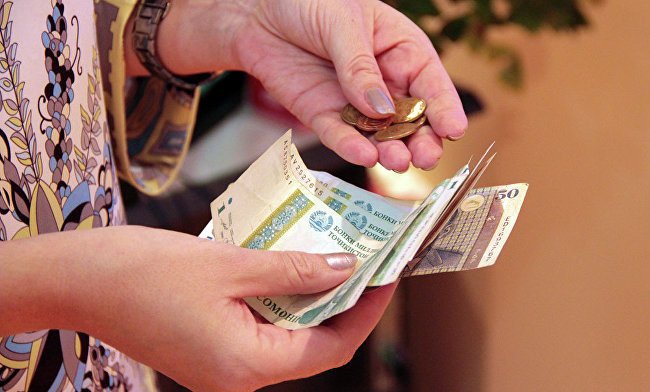
The President of Tajikistan, Emomali Rahmon, delivered a message to the Majlisi Oli (upper house of parliament) on December 16, stating that from September 1, 2026, the salaries of budget organizations will increase by 15-20 percent. In his message, Emomali Rahmon stated that this decision by the government of Tajikistan is driven by the need […]
AZDA.TV· Send to others
Photo: Internet
The President of Tajikistan, Emomali Rahmon, delivered a message to the Majlisi Oli (upper house of parliament) on December 16, stating that from September 1, 2026, the salaries of budget organizations will increase by 15-20 percent.
In his message, Emomali Rahmon stated that this decision by the government of Tajikistan is driven by the need for “further improvement of the population’s living standards,” as well as the goal of “enhancing the social situation of vulnerable groups.” This means he is not doing it because he considers improving the living standards of the population to be his primary task.
The president noted that the salaries of employees in educational institutions, including preschool and general secondary education institutions, will be increased by 25 percent, while other educational institutions, sectors of science, culture, sports, healthcare, social protection institutions, government bodies, and other budget institutions will see an increase of 20 percent in their salaries, as well as in scholarship amounts.
Additionally, the government plans to increase the current salaries of law enforcement officers, military personnel, and other workers in these agencies by 20 percent.
The minimum wage for all sectors of the economy and the social sphere of the country will be increased from the current 1000 somoni to 1300 somoni per month.
The president also noted that insurance, labor, and social pensions, as well as their supplements, and the amount of the basic pension will be increased in line with the inflation rate of 2025, but by no less than 15 percent of their established amount.
The low level of wages remains one of the serious problems for the residents of Tajikistan. Citizens often complain that each increase in salaries and pensions is accompanied by a sharp rise in prices for essential goods, resulting in the real effect of these measures being hardly felt by the population.
For this reason, millions of citizens of the country go abroad for work, often under extremely difficult conditions.
We use cookies to improve your experience and to understand how the site is used. You can accept or decline. Declining may limit some features.
Functional
Always active
The technical storage or access is strictly necessary for the legitimate purpose of enabling the use of a specific service explicitly requested by the subscriber or user, or for the sole purpose of carrying out the transmission of a communication over an electronic communications network.
Preferences
The technical storage or access is necessary for the legitimate purpose of storing preferences that are not requested by the subscriber or user.
Statistics
The technical storage or access that is used exclusively for statistical purposes.The technical storage or access that is used exclusively for anonymous statistical purposes. Without a subpoena, voluntary compliance on the part of your Internet Service Provider, or additional records from a third party, information stored or retrieved for this purpose alone cannot usually be used to identify you.
Marketing
The technical storage or access is required to create user profiles to send advertising, or to track the user on a website or across several websites for similar marketing purposes.