News
AFGHANISTAN
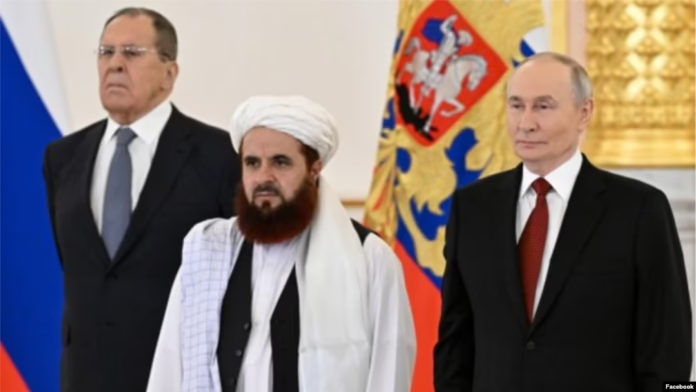
Putin received the credentials from the Ambassador of Afghanistan
Russian President Vladimir Putin accepted the credentials of the Ambassador of Afghanistan to Russia, Mawlawi Gul Hasan. This was reported by the Kremlin press service. In total, the Russian president accepted credentials from ambassadors of more than 30 countries. The ceremony took place in the Kremlin. In the list of foreign ambassadors, Gul Hasan was […]
Russian President Vladimir Putin accepted the credentials of the Ambassador of Afghanistan to Russia, Mawlawi Gul Hasan. This was reported by the Kremlin press service.
In total, the Russian president accepted credentials from ambassadors of more than 30 countries. The ceremony took place in the Kremlin. In the list of foreign ambassadors, Gul Hasan was noted as the ambassador of the Islamic Emirate of Afghanistan. He became the first ambassador of the state after the Taliban came to power in 2021.
At the end of the event, Putin traditionally addressed the arriving ambassadors and outlined his vision of the current international situation.
In the published video footage from the Kremlin, it can be seen how the Taliban ambassador hands over his credentials during the ceremony, shakes hands with him, briefly stops nearby, and then steps back.
The official reception of credentials is a generally accepted diplomatic procedure and, after its completion, effectively signifies the recognition of the ambassador by the acting government of the respective state. This occurs against the backdrop of the fact that more than four years after the Taliban came to power in Afghanistan, no country, except for Russia, has officially recognized their government.
Tajikistan shares the longest common border with Afghanistan—over 1300 kilometers. In this regard, Dushanbe has expressed concern for many years about the presence of extremist groups in the border areas and has therefore taken a tough stance towards the Taliban.
Earlier, experts noted that if relations between Russia and the Taliban were established, it could lead to a change in regional policy and force Tajikistan to reconsider its position. Currently, it seems that Dushanbe has also come to this conclusion: last year, the activities of opponents of the “Taliban”—the National Resistance Front of Afghanistan—were halted in the capital, and steps are now being taken to establish diplomatic relations with the Taliban in Afghanistan.