News
TAJIKISTAN
Pressure on Mardikors in Dushanbe
The authorities of Dushanbe have banned the gathering of mardikors – day laborers who used to assemble in certain areas of the capital in search of daily work. According to the mardikors themselves, the city authorities no longer allow them to gather in mardikor bazaars (day labor markets), where they wait for new employers. As […]
The authorities of Dushanbe have banned the gathering of mardikors – day laborers who used to assemble in certain areas of the capital in search of daily work.
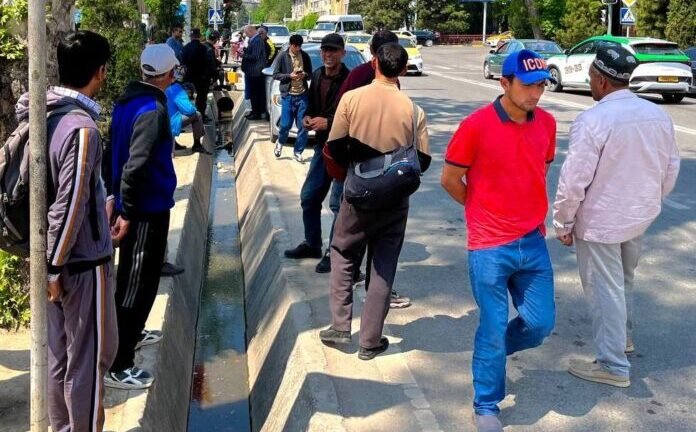
According to the mardikors themselves, the city authorities no longer allow them to gather in mardikor bazaars (day labor markets), where they wait for new employers. As a result of the imposed bans, the activity of job seekers in several districts of the capital has noticeably decreased.
Journalists from Radio Ozodi visited one of the traditional “mardikor bazaars” in the Firdausi district of the capital and noted an atypical scene. Unlike previous years, day laborers no longer display their working tools but merely wait for new employers to arrive.
According to the day laborers, the reason for such caution is the raids by police officers. They claim that law enforcement representatives can appear at any moment, disperse the gathered individuals, and confiscate their working tools.
Mardikors also reported that over the past two months, police officers have regularly chased them away from their usual mardikor bazaars and warned them not to gather there again. This situation raises serious concerns among job seekers, as for many of them these spots are the only opportunity to find daily work.
Day laborer Zafar Khojaev told Radio Ozodi that they engage in honest work to earn a living and do not commit crimes. According to him, a person left without means of subsistence may resort to anything.
“What to do? Steal or engage in something bad. If a person is left without work, they may go down a wrong path. It is said for a reason: a hungry person will even jump on a lion,” he says.
Another day laborer named Safarali also complained about the oppression.
“As long as they don’t torment us and tell us not to stand here. We stand here, and if work appears, we take it and leave. Once we finish work, we immediately return home.”
The Ministry of Internal Affairs of the Firdausi district and the Ministry of Labor and Migration of Tajikistan have not yet commented on this issue.
Experts believe that most of the residents who traditionally gather at the “mardikor bazaars” in Dushanbe are labor migrants deported from Russia or forced to return to their homeland. After returning to Tajikistan, in the context of a severe shortage of jobs, they are compelled to earn a living through day labor.
Experts emphasize that for many returning migrants, day labor is not a conscious choice but a forced way to obtain a minimum subsistence income. In their opinion, restricting or banning such activities without offering alternative job opportunities may only exacerbate social tension.
Experts note that driving away job seekers from “mardikor-bazars” will not solve the problem, but rather may increase dissatisfaction among this vulnerable part of society with government policy. They believe that if temporary labor is not legalized and real jobs are not created, such measures could lead to negative social consequences.
Experts are convinced that instead of prohibitions, authorities should officially regulate the activities of temporary workers, introduce a simple registration and taxation system, and simultaneously create new jobs for returning labor migrants.