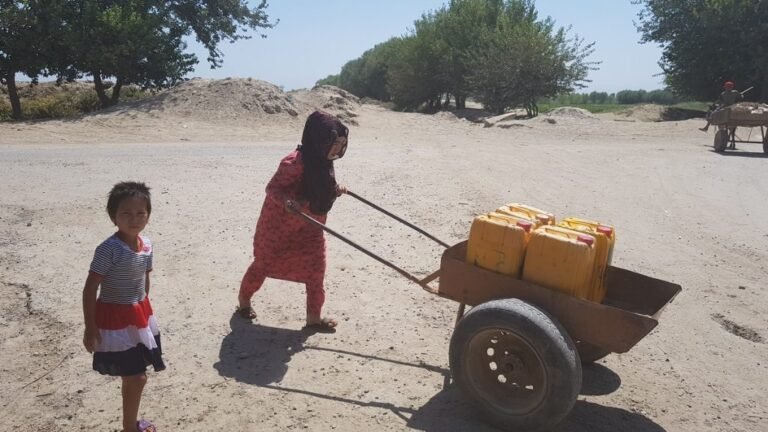
More than 3 million residents of Tajikistan lack access to drinking water
The authorities of Tajikistan confirmed that in 2025, only 67 percent of the country’s population had access to clean drinking water. The director of the State Unitary Enterprise “Housing and Communal Services,” Jamshid Tabarzoda, reported at a press conference on February 2 that out of 10.2 million residents of the country, only 67.3%, or about […]
AZDA.TV· Send to others
Photo: Internet
The authorities of Tajikistan confirmed that in 2025, only 67 percent of the country’s population had access to clean drinking water.
The director of the State Unitary Enterprise “Housing and Communal Services,” Jamshid Tabarzoda, reported at a press conference on February 2 that out of 10.2 million residents of the country, only 67.3%, or about 6 million 864.6 thousand people, were connected to the centralized drinking water supply system.
According to him, 90.7% of residents in cities and district centers are connected to the centralized water supply, while in rural areas, this figure is only 57.8%. This means that more than 3 million people, mostly in rural areas, are not connected to the centralized water supply and are forced to carry water. Some residents buy water and have it delivered by water trucks or personal vehicles and store it in tanks.
Jamshid Tabarzoda also noted that in 2025, water supply enterprises provided 831 million cubic meters of drinking water, and the volume of wastewater services amounted to 25.5 million cubic meters, which is almost 7.7 million cubic meters more than in 2024.
The authorities reported improvements in water supply and wastewater services amid ongoing complaints from residents about serious issues with access to clean water, especially in rural areas and hard-to-reach regions of the country.
In many cases, residents of remote areas are forced to independently lay water pipes to their homes at their own expense and through a method called “hashara.” At the same time, some citizens complain that despite the lack of a constant water supply, the authorities continue to issue bills for drinking water.