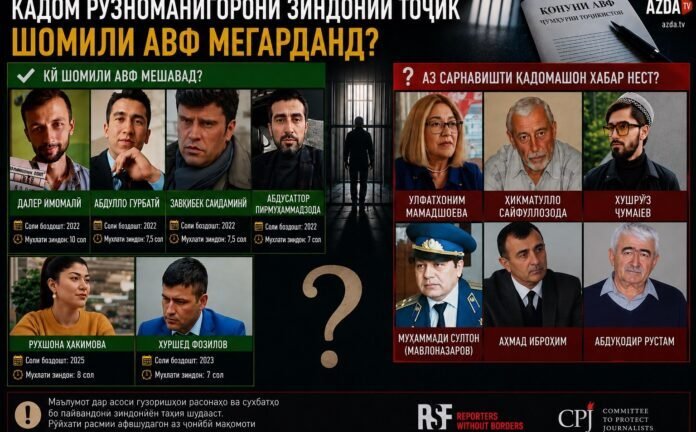
After the adoption of the amnesty law, a number of convicted journalists hope to be released, but the fate of some of them remains unclear.
Against the backdrop of the new law “On Amnesty” in Tajikistan, it is expected that the sentences of some convicted Tajik journalists and bloggers will be reduced. Relatives of some convicted journalists confirmed that their loved ones have already signed the necessary documents, and it is expected that they will be released in the coming weeks or months.
On June 16, deputies of the Majlisi Namoyandagon (lower house of parliament) of the Republic of Tajikistan adopted the law “On Amnesty” at their regular session, and on the same day, President of Tajikistan Emomali Rahmon signed the law.
The amnesty law applies to 18,038 convicted individuals, who will either be released immediately or have their sentences reduced.
Which convicted journalists are covered by the amnesty?
The Asia-Plus agency, citing relatives of some convicted journalists, reports that their sentences have been reduced by three years.
According to the publication, relatives of independent journalist Zavkibek Saidamini reported that he has signed the amnesty documents, and it is expected that he will be released on July 18 of this year. Saidamini was detained on July 22, 2022, and sentenced to seven years in prison.
Relatives of Abdullo Gurbati also reported that his sentence has been reduced by three years. Gurbati was detained in June 2022 and sentenced to seven and a half years in prison. According to his relatives, he may be released on December 16, 2026.
Young journalist Rukhshona Hakimova, who was sentenced to eight years in prison for treason in February 2025, has also had her sentence reduced by three years, according to her relatives.
Relatives of blogger Daler Emomali also confirmed that his sentence has been reduced by three years. He was detained in June 2022 and sentenced to ten years and four months in prison. Considering the time already served and the amnesty, it is expected that he will be released in about three years and four months.
There is currently no official information about Abdusattor Pirmukhammadzoda, but his relatives also believe that he may be released in the coming months. He was detained in July 2022 and sentenced to seven years in prison.
Relatives of Khurshed Fozilov also reported that his sentence has been reduced by three years. He was detained in March 2023 and sentenced to seven years in prison. If the amnesty law is applied, it is expected that he will be released next year.
There is currently no precise information about the editor-in-chief of the weekly “Paik” Ahmad Ibrohim, who was detained in August 2024 and sentenced to ten years in prison in January 2025.
The fate of other convicted journalists remains unclear.
Although it is reported that the amnesty law will be applied to convicted journalists, it is still unknown whether Hikmatullo Saifullozoda, Ulfatkhonim Mamadshoeva, writer Abdukodir Rustam, journalist Mukhamadi Sultan, as well as a number of Badakhshan journalists and bloggers, will fall under the amnesty.
Hikmatullo Saifullozoda, the editor-in-chief of the weekly publication of the Islamic Revival Party “Najot,” was detained in September 2015 and sentenced to 16 years in prison. The 70-year-old prisoner is expected to be released in 2031 if he serves his full sentence. There is currently no information on whether the amnesty law will be applied to him.
Ulfatkhonim Mamadshoeva, a journalist and civil activist from GBAO, was detained in May 2022 and sentenced to 21 years in prison. If her sentence is not changed, she will be released in 2043. There is also no available information on whether she will be included in the amnesty.
Khusruz Jumayev, a blogger and journalist from the Gorno-Badakhshan Autonomous Region, was detained after the events in Badakhshan in 2022 and sentenced to eight years in prison. It is still unknown whether the amnesty law will be applied to him and, if so, when he will be able to be released.
There is also no official information on whether writer Abdukodir Rustam, journalist Mukhamadi Sultan, and other imprisoned bloggers and journalists from Badakhshan will be included in the amnesty.
The amnesty law — a pardon or an opportunity to profit from prisoners?
Several sources in a conversation with Azda tv claimed that prison administration officials contacted them and offered to include them in the list of individuals eligible for amnesty. In return, they demanded money, which, according to them, prisoners were supposed to ask from their relatives. The sources claim that otherwise, prisoners would not be included in the list of those granted amnesty.
According to observers and relatives of prisoners, in the past, when the amnesty law was applied in Tajikistan, prison administration officials took advantage of this opportunity and demanded money from the relatives of prisoners for including them in the list of individuals eligible for amnesty.
They also claim that the amnesty law is mainly applied to individuals convicted of serious crimes, including murder, theft, and bribery. However, political prisoners generally do not fall under the amnesty.
Observers claim that Emomali Rahmon takes a tough stance against his political opponents, who have been sentenced to long prison terms, and does not forgive them. For instance, during previous amnesties, well-known figures such as former commander of the Presidential Guard Ghaffor Mirzoev, leader of the “New Tajikistan” party Zaid Saidov, as well as convicted deputies of the chairman of the Social Democratic Party of Tajikistan Shokirjon Hakimov and Mahmurad Odinaev were not included in the amnesty. Furthermore, the amnesty did not extend to imprisoned leaders of the Islamic Revival Party of Tajikistan, the political movement Group 24, and “Youth for the Revival of Tajikistan,” as well as a number of religious figures and representatives of the clergy.
What do RSF and CPJ say?
The organization Reporters Without Borders (RSF) has repeatedly called on the authorities of Tajikistan to release detained and imprisoned journalists.
According to RSF reports, at least nine journalists are behind bars in Tajikistan. The names mentioned in the organization’s statements and reports include Daler Emomali, Abdullo Gurbati, Zavkibek Saidamini, Abdusatтор Pirmukhammadzoda, Khursheda Fozilova, Ulfatkhanim Mamadshoeva, Khushruz Jumayev, Muhammad Sulton, Rukhshona Hakimova, and Ahmad Ibrohim.
The Committee to Protect Journalists (CPJ) has also consistently demanded that the government of Tajikistan release imprisoned journalists over the past few years.
In CPJ statements and publications, the names of Daler Emomali, Abdullo Gurbati, Zavkibek Saidamini, Abdusatтор Pirmukhammadzoda, Khursheda Fozilova, Ahmad Ibrohim, Ulfatkhanim Mamadshoeva, and Khushruz Jumayev are mentioned.
Earlier, CPJ called on the authorities of the country to release Daler Sharifov, who was at that time in custody.
These international organizations have repeatedly expressed concern over the lack of transparency in judicial processes, the abuse of charges of extremism, as well as the restriction of press freedom in Tajikistan, and called for the immediate and unconditional release of all imprisoned journalists.
While the amnesty law has instilled hope for the release of some convicted journalists, the fate of some of them remains unclear.
Officially, the authorities have not yet published a list of individuals to whom the amnesty law will apply.