News
SOCIETY
Parents and teachers complain about illegal fees in schools across the country
After the publication of an article about illegal fees in one of the schools in the city of Vahdat, numerous complaints were received by Azda.tv from various regions of Tajikistan. Previously, Azda.tv reported that parents were complaining about frequent fees in one of the schools in the city of Vahdat. In the article “Parents Complain […]
After the publication of an article about illegal fees in one of the schools in the city of Vahdat, numerous complaints were received by Azda.tv from various regions of Tajikistan.
Previously, Azda.tv reported that parents were complaining about frequent fees in one of the schools in the city of Vahdat.
In the article “Parents Complain About Fees in a School in Vahdat” dated February 6, 2026, Azda.tv reported that parents whose children attend secondary school No. 133 named after Asliddin Abdukhodikov in the city of Vahdat were dissatisfied with the school principal Dilafruz Rozikova due to constant illegal fees.
After the publication, this article caused a wide resonance on social media. Parents and teachers from different regions of the country began to contact Azda.tv with similar complaints — in particular from school No. 15 in the city of Levakant, schools No. 31, 87, 65, 89, and 22 in the city of Dushanbe, school No. 1 in the city of Tursunzoda, several schools in the city of Kulyab, schools in the Zafarabad and Vose districts, the city of Vahdat, school No. 15 in the Rudaki district, school No. 10 in the city of Spitamen, and other educational institutions.
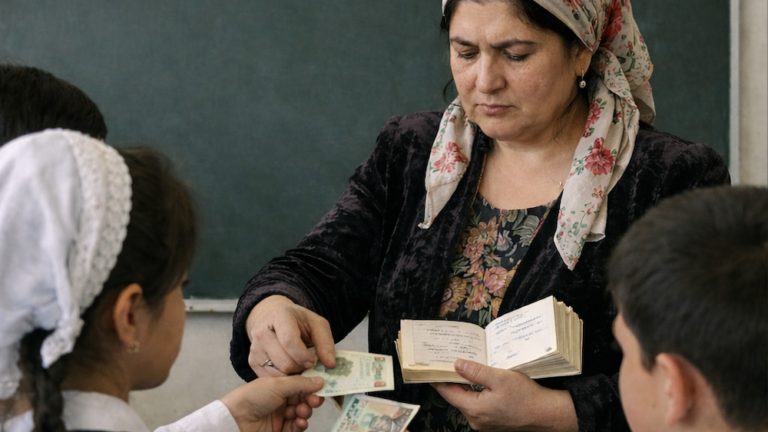
Parents complain that in many schools in Tajikistan, in addition to the so-called “monthly school fee,” which is illegal in itself, teachers and school administration regularly collect money under various pretexts. This includes money for buying chalk and rags, repairing or installing doors and windows, repairing roads and toilets, celebrating March 8, Teacher’s Day, and the birthdays of teachers and principals, where parents are asked to contribute from 100 to 200 somoni or more, for school repairs from 100 to 500 somoni (with funds for the director’s office collected separately), for purchasing electronic boards — 150 somoni, for installing surveillance cameras — 100 somoni, etc.
Some parents also complain that when enrolling a child in the first grade, schools require a certain amount, and if parents do not make the payment, they are told that there are “no places” in the school.
A number of parents informed Azda.tv that in some families, 4-5 children go to school at once. Meanwhile, most residents live in difficult economic conditions; however, school administrations require payment for each child separately, which is an unbearable financial burden for large families.
At the same time, some teachers in correspondence with Azda.tv reported that school administrations put pressure on them. According to them, they are forced to collect money from students, and sometimes the entire teaching staff is even required to pay out of their own pockets.
One teacher, who wished to remain anonymous, said:
“In addition to other expenses collected from students, teachers are forced to contribute to the ‘union’, ‘tariffing’, for military personnel, for celebrating Teacher’s Day, Mother’s Day, for the birthdays of the director and his deputies, for hosting guests from government agencies and the Ministry of Education, and even for planting potatoes.”
According to him, teachers are also forced to pay money in order to receive more teaching hours.
Former teacher Gulya Khuseynzoda stated that she was forced to leave the school due to constant contributions “for guests,” as well as the manifestation of “nepotism” from the education system’s leadership. According to her, despite having two higher education diplomas, she is now forced to look for work as a dishwasher or cleaner.
Numerous complaints from parents and teachers about monetary contributions in schools come against the backdrop of statements from representatives of the Ministry of Education of Tajikistan, including Minister Saidzoda Rahim Hamro, who have repeatedly emphasized that education in public schools is free and collecting money from parents is prohibited.
Experts believe that monetary collections in schools arise from a number of reasons, including insufficient funding for educational institutions and low teacher salaries. If schools are not adequately funded for repairs, equipment, and other everyday needs, the school administration tries to cover the shortfall through parents. The fact that money is collected regularly and under various pretexts — from school repairs to holidays and gifts for the administration — indicates total and systemic corruption in the education sector.
Experts also note that since corruption is entrenched in many areas of the country, solving the problem of illegal collections in schools will be extremely difficult.
Experts also point out that total corruption in many sectors of the country significantly complicates the resolution of the issue of illegal collections in schools.
Dear readers: If you have also encountered contributions in schools and want this to be known to the public, please write to us at +48 571 608 008 (WhatsApp), and we will publish your story.