News
MIGRATION
“Agreement on Loyalty” and “Register of Controlled Persons” – Russia Tightens Legislation
Russia will adopt a new package of bills that tighten state control in the field of migration. More than three months have passed since the bloody terrorist attack at the Crocus City Hall concert venue in the Moscow region, which led to an increase in repression against migrants from Central Asia — the governments of […]
Russia will adopt a new package of bills that tighten state control in the field of migration.
More than three months have passed since the bloody terrorist attack at the Crocus City Hall concert venue in the Moscow region, which led to an increase in repression against migrants from Central Asia — the governments of the region are asking the Kremlin to ensure better protection for their citizens. However, given the proposed law that tightens the migration regime, there are concerns that the lives of labor migrants from Kyrgyzstan, Tajikistan, and Uzbekistan will not improve in Russia.
Author: Chris Rickleton
More than three months after the bloody terrorist attack at the concert hall in the Moscow region, which triggered repression against migrants from Central Asia, the governments of the region are asking their ally for leniency.
But will Moscow heed their requests or double down on its efforts? Xenophobia and calls for stricter migration rules are not new to Russia, but public demands for immediate action have sharply increased following the arrest of 11 men from Tajikistan for their alleged involvement in the attack on the Crocus City Hall in March of this year, which resulted in the deaths of 144 people.
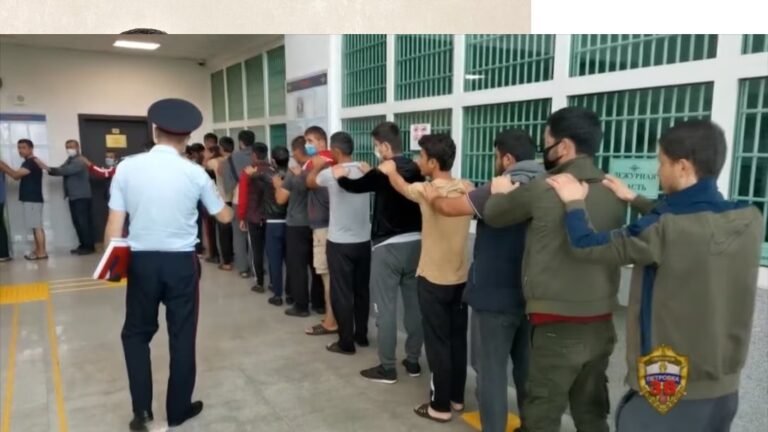
Currently, the increased pressure on migrants mainly takes the form of arbitrary measures — more police raids, more deportations, and multi-day detentions of groups of migrants arriving at the Russian border. But now, labor rights advocates are drawing attention to a new threat: a bill that passed its first reading last month could expand police powers over foreign workers, who are so desperately needed by the Russian labor market facing a labor shortage.
This, in turn, will create new risks for Kyrgyzstan, Tajikistan, and Uzbekistan — three Central Asian countries where billions of dollars in annual remittances from Russia keep millions of poor families afloat.
THE LAW WILL MAKE “PROTECTION FOR MIGRANTS IMPOSSIBLE”
Many of the proposed amendments to the strict migration legislation, which the State Duma of Russia adopted in the first of three readings on June 18, were developed several years ago. But it was the attack at Crocus, for which the Islamic State (IS) claimed responsibility — the deadliest attack of its kind on Russian territory in the last two decades — that sparked serious discussion of discriminatory changes.
One of the provisions looks quite ominous, as it states that incoming migrant workers must sign a “loyalty agreement,” implying their consent to the restriction of rights. This document covers a wide range of points, including respect for Russian national traditions, a commitment not to interfere in Russia’s internal affairs, and acknowledgment of the possibility of deporting foreign citizens for administrative offenses.
This agreement makes “the protection of migrants impossible,” believes Valentina Chupik, a native of Uzbekistan, lawyer, and advocate for migrant rights, who continues to work in the interests of Russian migrant workers despite being banned from entering Russia herself in 2021. Even more concerning, according to Chupik, is the law’s provision for a “registry of controlled persons,” which will allow the police to impose extrajudicial house arrests on migrants and deny them access to public services.
“Migrants can end up on this list simply by being suspected of committing an administrative offense or because their employer has not paid taxes for them. The text contains at least seven grounds for such arrests, but in reality, their number could be infinite,” says Chupik, who reported that she first saw a copy of the amendments in 2019.
“At that time, it was clear that its main function was police corruption. So, it is not so much that the law was needed because of ‘Krokus,’ but rather that something like ‘Krokus’ was needed for the adoption of this law,” explains Chupik, who led a center for migrants in Moscow before Russia revoked her refugee status and banned her from entering the country.
The amendments were initially proposed by the Ministry of Internal Affairs of Russia. And Interior Minister Vladimir Kolokoltsev did not apologize for tightening Moscow’s stance on migration during a recent working trip to Tashkent. After talks with Uzbekistan’s President Shavkat Mirziyoyev on June 25, the Ministry of Internal Affairs stated that Kolokoltsev “assured” Mirziyoyev of the absence of “political or other motives” in the authorities’ actions regarding citizens of Uzbekistan. At a meeting with the leadership of Uzbekistan’s Ministry of Internal Affairs on the same day, Kolokoltsev asked Tashkent to enhance cooperation with Russia on the exchange of citizen data to help reduce “negative trends” in migration and ensure the security of both states.
Kolokoltsev’s visit took place about a week after the Embassy of Uzbekistan in Moscow reported that it had sent a note to the Russian Foreign Ministry regarding “additional and excessively lengthy checks” of Uzbek citizens attempting to enter Russia through Moscow’s Domodedovo Airport. This is a clear shift in Tashkent’s position.
“A VERY SENSITIVE ISSUE”
In early May, the Uzbek Agency for External Labor Migration denied reports that Uzbeks were being turned back at the borders of Russia. However, on May 27, Mirziyoyev raised the issue of migration after talks with Vladimir Putin, stating that the Russian president “supported my proposals on this sensitive issue” during their bilateral meeting in the Uzbek capital. The leaders of Kyrgyzstan and Tajikistan, whose countries send fewer migrants to Russia in absolute terms than Uzbekistan but are more dependent on remittances from the latter, also raised this topic.
Tajikistan’s President Emomali Rahmon called migration “a very sensitive and one of the main issues” during talks with Putin in Moscow on May 9. Earlier this week, a group of migrants from Tajikistan complained to Radio Ozodi that they had been stuck at the land border between Russia and Kazakhstan, which they used as a transit country, for five days.
Migrants from Kyrgyzstan enjoy certain advantages in Russia compared to those from Uzbekistan and Tajikistan, due to the country’s status: Kyrgyzstan is one of the five members of the Eurasian Economic Union (EAEU). However, Kyrgyz President Sadyr Japarov stated at the EAEU summit on May 9 that the union’s agreements regarding the mobility of labor resources are not being upheld. According to Japarov, this threatens “serious damage to the image of our union.”
These signals of disappointment, as well as the potential consequences of changes in Russia’s migration system, sharply contrasted with the optimistic assessment of Russian Ombudsman Tatyana Moskalkova at the meeting of the Human Rights Commission of the Commonwealth of Independent States (CIS) held in Moscow on June 27 — another regional association where Russia has significant influence. “An analysis of the legislation of the CIS countries showed that it is largely synchronized in terms of creating favorable conditions for the labor activity of foreign workers,” Moskalkova said, who is under sanctions from the U.S. and EU due to Russia’s full-scale invasion of Ukraine.
“Nevertheless, [participants] noted that there are still bottlenecks in ensuring the rights of migrants that need to be addressed, and the commission will continue to work on these issues,” Moskalkova added in her summary of the meeting. “The main goal is to propose legal protection mechanisms that make citizens of our states and all those present in the Commonwealth feel socially protected.”