News
SOCIETY TAJIKISTAN
Birth rates in Dushanbe and GBAO are declining
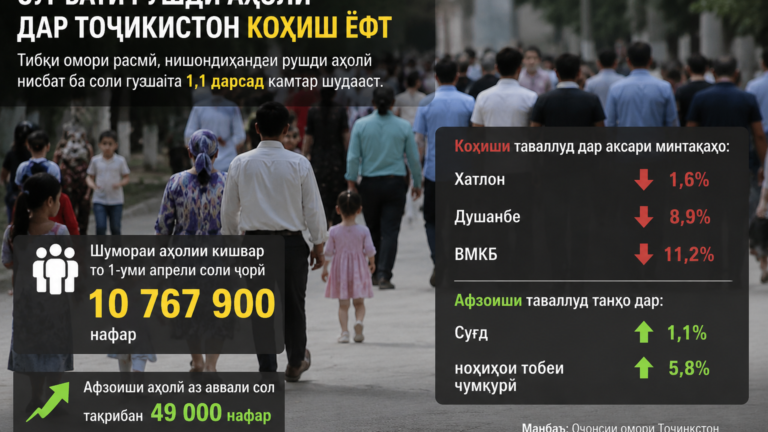
According to official data, birth rates in the country have decreased compared to last year. According to the Agency for Statistics under the President of Tajikistan, although the population continues to grow, the growth rate has decreased by 1.1%. As of April 1 of this year, the population of Tajikistan reached 10 million 767 […]
According to official data, birth rates in the country have decreased compared to last year.
According to the Agency for Statistics under the President of Tajikistan, although the population continues to grow, the growth rate has decreased by 1.1%.
As of April 1 of this year, the population of Tajikistan reached 10 million 767 thousand 900 people. Since the beginning of the year, the country’s population has increased by almost 49 thousand people.
Based on the data from the Agency for Statistics, a decline in birth rates is observed in most regions of the country. For instance, the birth rate in the Khatlon region has decreased by 1.6%, while in Dushanbe it has dropped by as much as 8.9%. The most significant decline in birth rates was recorded in GBAO, at 11.2%.
At the same time, there has been an increase in birth rates in the Sughd region and in districts under republican jurisdiction. Specifically, the birth rate in the Sughd region has risen by 1.1%, while in the districts under republican jurisdiction it has increased by 5.8%.
There has been no official explanation yet as to why birth rates are falling in certain regions of the country.
Meanwhile, there is a rise in mortality rates. The Agency for Statistics reports that from January to March 2026, 9,100 people died, which is 5.1% more compared to the same period in 2025.
The agency clarified that the increase in mortality has been recorded across all regions of the country.
A number of sociologists note that the decline in birth rates may be linked to the economy, migration, inflation, rising prices, and the uncertainty of youth about the future.
According to them, these and other factors may lead young people to postpone having children until better times, which in the long term could negatively impact the country’s demographics.