News
MIGRATION
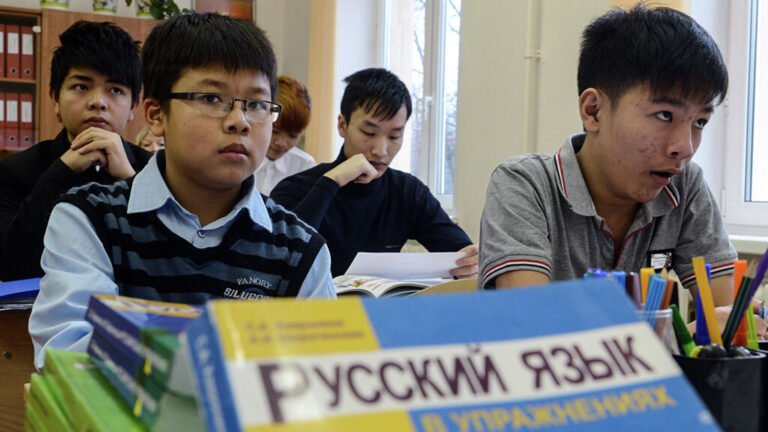
Children of migrants in Russia can attend school only on a paid basis
A proposal has been made in the State Duma of Russia to introduce paid education for migrant children. Deputies of the State Duma of the Russian Federation are preparing a new bill that would allow children of foreigners to attend Russian public schools only on a paid basis. The chairman of the State Duma’s committee […]
A proposal has been made in the State Duma of Russia to introduce paid education for migrant children.
Deputies of the State Duma of the Russian Federation are preparing a new bill that would allow children of foreigners to attend Russian public schools only on a paid basis.
The chairman of the State Duma’s committee on labor and social policy, Yaroslav Nilov, stated that migrant children should be educated in Russian schools only on a paid basis, regardless of age, grade, or level of knowledge.
As proposed by the parliamentarian in his Telegram channel, the number of attempts to pass the Russian language proficiency test for migrant children should also be limited to three attempts.
According to him, these measures will help preserve “the nerves of both our teachers and underage foreigners, who are not given the Russian language,” who, in his opinion, should wait for their parents at home or study through special programs on a paid basis.
The bill proposing to educate children of foreigners on a paid basis, previously suggested by Nilov, was rejected. The government deemed that the initiative needed further refinement, and the responsible Committee on Education decided that it was a “half-measure.” It was noted that there is a problem that needs to be addressed, and the bill “hypothetically addresses the financial aspect” of educating migrants and compensating teachers for additional workloads.
Earlier, in December 2024, Russian President Vladimir Putin signed a law stating that migrant children are allowed to attend school only if their and their parents’ stay in Russia is legal and their proficiency in the Russian language is confirmed by a special test.
This law came into effect on April 1, 2025. According to the new rules, migrant children can enroll in schools only after successfully passing the Russian language test, answering at least 90% of the questions correctly. The results from the first two months of testing showed that only a few applicants managed to pass this test.
However, the Russian authorities, under the pretext of “inaccurate information in documents,” did not allow thousands of migrant children to take the test. In May 2025, it was reported that 81% of migrant children were denied the acceptance of documents, including due to the identification of inaccuracies in them.
However, education specialists and experts criticized this law, warning that it would lead to the exclusion of adolescents from the education system and increase the risk of their involvement in criminal groups.
Despite these warnings, the chairman of the State Duma, Vyacheslav Volodin, called the enforcement of these laws important and stated that additional amendments would be made if necessary.