News
POLITICS
Criminal penalties are proposed for non-payment of electricity bills
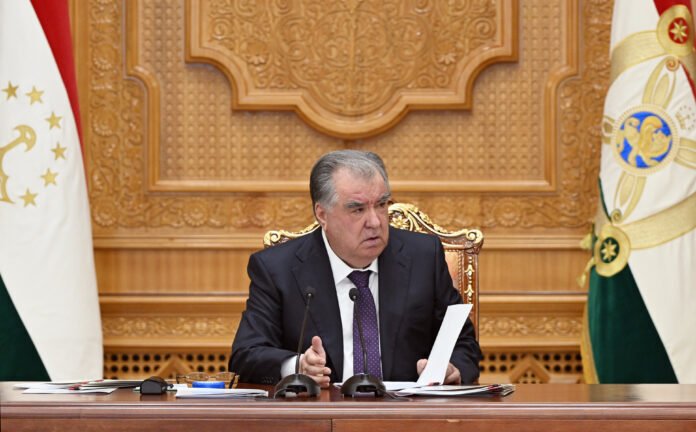
On March 27, an expanded meeting of the government of Tajikistan was held with the participation of ministers, heads of departments, and President Emomali Rahmon. During the meeting, government members discussed changes and additions to certain laws, issues of land distribution, economic and social spheres, as well as customs policy, and the problem of electricity […]
On March 27, an expanded meeting of the government of Tajikistan was held with the participation of ministers, heads of departments, and President Emomali Rahmon.
During the meeting, government members discussed changes and additions to certain laws, issues of land distribution, economic and social spheres, as well as customs policy, and the problem of electricity usage.
According to the official website of the president, Emomali Rahmon expressed concern about the “inefficient use of electricity and its excessive losses during the autumn-winter period of 2024-2025” and gave specific instructions to responsible officials to address existing serious shortcomings and prevent similar situations in the future.
In addition, Rahmon proposed introducing criminal liability for “illegal use of electricity” and “non-payment for it.”
These statements came against the backdrop of ongoing complaints from citizens about the lack of electricity, and it remains unclear what measures the president has taken to address this issue.
At the same time, the main debtors for electricity in the country are enterprises and individuals connected to high-ranking officials and civil servants.
In particular, at a recent press conference, representatives of the “Electric Networks” company stated that the debt for electricity has exceeded 4 billion somoni. The main debtor is the “Talco” company, owned by Hasan Asadullozoda, the brother-in-law of Emomali Rahmon. The company’s debt amounts to 570 million somoni. In second place is the Agency for Melioration and Irrigation with a debt of over 186.6 million somoni, and in third place is the “Gorvodokanal” enterprise with a debt of 123.4 million somoni. Budget organizations owe 96.6 million somoni, while the “Rogun” hydropower plant owes more than 14.3 million somoni.
Authorities previously reported that the population’s debt for electricity by January 2025 amounted to 1.7 billion somoni. However, experts and citizens themselves doubt these figures, noting that if an ordinary citizen does not pay for electricity on time, they are disconnected from the grid.
According to a new government decree, electricity tariffs will be increased starting April 1, 2025. Residents will pay 35.36 dirams for each kilowatt-hour instead of 30.37 dirams. Cotton processing plants will pay 40.45 dirams, private lyceums and gymnasiums will pay 60.70 dirams, and industrial enterprises will pay 80.90 dirams.
However, under the new tariff plan, companies connected to Emomali Rahmon’s circle will purchase electricity at a lower price. In particular, “Talco” will pay 20.77 dirams per kilowatt-hour, “Azot” will pay 35.36 dirams, and the “Tajik Metallurgical Plant” will pay 14.19 dirams from May 1 to September 30 and 80.90 dirams from October 1 to April 30.
The cost of one kilowatt-hour of electricity for Afghanistan will be 46 dirams (4.2 cents), for Uzbekistan it will be 21.2 dirams (approximately 2 cents), and for Kyrgyzstan it will be 10.7 dirams (0.98 cents).