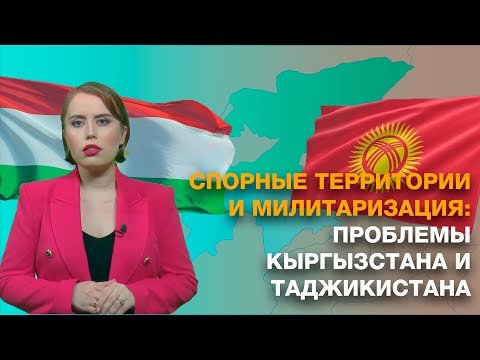
Disputed Territories. Where Does the Border Between Kyrgyzstan and Tajikistan Actually Lie? (VIDEO)
Rahmon Gave Land to Kyrgyzstan? The head of the State National Security Committee of Tajikistan met with his Kyrgyz counterpart in early October and signed another protocol numbered 44. Saymumin Yatimov stated that the signed “protocol resolves all issues that were previously prerequisites for conflicts.” A logical question arises: what served as the prerequisites for […]
AZDA.TV· Send to others
Photo: Internet
Rahmon Gave Land to Kyrgyzstan?
The head of the State National Security Committee of Tajikistan met with his Kyrgyz counterpart in early October and signed another protocol numbered 44. Saymumin Yatimov stated that the signed “protocol resolves all issues that were previously prerequisites for conflicts.” A logical question arises: what served as the prerequisites for conflicts? The answer here is very simple: disputed territories! This will be the topic of discussion in this issue.
The head of the State National Security Committee of Tajikistan met with his Kyrgyz counterpart in early October and signed another protocol numbered 44. Saymumin Yatimov, the chairman of the State National Security Committee of Tajikistan, made the following statement after the meeting:
“This protocol, when implemented, resolves all issues and problems that were previously the basis and prerequisites for conflicts on the Tajik-Kyrgyz border. The signing of this protocol is the realization of the will of the leaders of the two states. We are convinced that by signing this protocol, we will purposefully and constructively implement it step by step, and in the shortest possible time, we will arrive at fundamental documents.”
In Yatimov’s statement, the most interesting part is his words that the signed “protocol resolves all issues that were previously prerequisites for conflicts.” A logical question arises: what served as the prerequisites for conflicts? The answer here is very simple: disputed territories! Let me tell you the backstory.
The subject of the conflict between the two countries is territories with a total area of 211 thousand hectares. They are located in three sections along the border of the two countries. The largest section, 84 thousand hectares, borders the southern side of the Bobodjon Gafurov and Kanibadam districts of Tajikistan.
The second section, 56 thousand hectares, adjoins from the east to the Devashtich district and from the north to the Gorno-Matchin district of Tajikistan.
The third, most populated section of 61 thousand hectares is located in the southern part of the Isfara district. This section can be considered the most complex, as about 90 percent of all border conflicts flare up precisely here. This territory is of the greatest significance to both sides, as it contains strategic transport arteries – “Isfara-Vorukh” and “Batken-Isfana,” as well as the important water distribution station “Golovnoy” on the Isfara River.
The essence of the dispute between the two countries lies in who actually owns these territories. Discussions about them between Dushanbe and Bishkek have been ongoing since the 1950s. However, due to the two republics being part of the Soviet Union, their resolution was not given priority. During the USSR period, Kyrgyzstan unilaterally took the majority of these territories for its actual use and, contrary to the mechanism established by the USSR constitution, unilaterally appropriated them.
As of today, the situation is such that, in fact, the disputed territories are under the control of Kyrgyzstan, while Tajikistan disputes the legality of the neighboring country’s rights to them and is trying to reclaim the territories. As an argument, Dushanbe presents maps of administrative-territorial division and corresponding acts and documents, according to which the disputed areas were not alienated from Tajikistan and therefore are the property of the republic.
Officially, Dushanbe states that the disputed territories were, contrary to all union-wide rules and norms, effectively seized by Kyrgyzstan, and Bishkek cannot provide documents confirming the legal transfer of land from Tajikistan.
The situation is further complicated by the fact that since the collapse of the Soviet Union, Kyrgyzstan has built nearly two dozen settlements along the perimeter of the disputed territories to secure its claim, laid highways between these settlements, and taken control of a water distribution station. Tajikistan, due to the civil war and subsequently due to complicated relations with Uzbekistan, when the country, due to a transport blockade, depended on Kyrgyzstan, was unable to prevent Bishkek’s unilateral actions in the disputed territories.
Now, let’s return to the statement of the head of the State National Security Committee of Tajikistan. From his words, it appears that under the protocol he signed, Protocol 44, the government of Tajikistan is renouncing its claims to the territories seized by Kyrgyzstan? Officials in Dushanbe remain silent on this matter.
However, immediately after the meeting between Yatimov and Tashiev, a journalist close to the head of the State National Security Committee of Kyrgyzstan, Nurgazy Anarkulov, in his publication on Facebook, called the protocol “historic” and stated that “Tajikistan has renounced its territorial claims.”
Whether this is true will be revealed in the near future. But another question arises: why did the leadership of Tajikistan make concessions on this issue? Did they really, as reported in Kyrgyz social media, become frightened by the recent threats from Kamchybek Tashiev? I remind you that the head of the Kyrgyz State National Security Committee explicitly threatened Tajikistan with territorial claims and to forcibly reclaim them for Kyrgyzstan.
“Recently, we discovered new documents. Based on these documents, we know that many of our lands have passed to the Tajik side. We can confirm this with historical and legal documents. If our neighbors do not renounce their territorial claims, we will present our territorial claims. We have enough strength and resources for this. We have the means to reclaim lands that passed to neighbors 10, 100 years ago,” – said Kamchybek Tashiev, head of the State National Security Committee of Kyrgyzstan.
Did Dushanbe really become frightened by Tashiev’s threats? What military advantages does Bishkek possess to speak to Dushanbe in such a tone?
In Bishkek, it is openly acknowledged that since 2021, there has been an active procurement of modern weaponry. According to Tashiev, around 1.5 billion dollars have been spent on these purposes during this period. In particular, Bishkek’s arsenal includes strike drones such as Bayraktar TB2, Anka, “Akyndzhy,” and “Akshungur.” The exact number of these drones is unknown.
Nevertheless, the presence of such an arsenal allows official Bishkek to approach the resolution of border issues from a position of strength.
Negotiation Tactics of the Parties
Continuing on the topic of negotiations. According to the Tajik side, official Bishkek almost always proposes, based on its own interests, to consider data from various periods as the basis for determining the border line. It is worth noting that the parties have long debated which maps and materials to use as the foundational document. According to pro-government Tajik expert Abdullo Rakhnamov, Kyrgyz negotiators rely on different documents depending on their own interests in a given “disputed area.”
“For example: According to Protocol No. 10 of the joint commission dated February 4, 2011, the Kyrgyz side proposed using materials from the bilateral commission of 1989 as the legal basis for the delimitation of the state border. In subsequent protocols 11 and 12, the Kyrgyz side suggested considering materials from the bilateral commission of 1958-1959. According to Protocol No. 16 from 2013, the Kyrgyz side stated that it considers the Agreement on the Establishment of the Commonwealth of Independent States dated December 8, 1991, the Almaty Declaration dated December 21, 1991, the Moscow Declaration dated April 15, 1994, the Charter of the CIS, and the Treaty on the Basics of Intergovernmental Relations between the Republic of Tajikistan and Kyrgyzstan as the main documents defining the border division. In the protocol from 2021, the Kyrgyz side again agreed to use “documents from 1924-1927,” – said political scientist Abdullo Rakhnamov.
However, the neighboring side’s attitude towards the documents is predominantly selective, and in cases of their own interests or changes in leadership and group members, their position can change significantly. The policy of double standards in dealing with documents from 1924-1927 or regarding the concept of “existing borders” is a vivid example of the negative attitude of the Kyrgyz side.
Unlike Kyrgyz negotiators, Tajik diplomats have almost always made concessions. For instance, in 2014, Tajikistan agreed to the construction by Kyrgyzstan of a section of the road Batken – Ak-Sai on its territory, subsequently, using this same road, Kyrgyz special forces seized the water distribution station “Golovnoy” on the Isfara River.
Earlier, in 2009, Tajikistan leased its territory to Kyrgyzstan for a section of the Batken – Isfana road. After the change of power in Bishkek in 2020, the new leadership of the country questioned Tajikistan’s rights to this territory and declared the signed document illegal. The former national security secretary who signed the document was even accused of treason and imprisoned.
Another concession from official Dushanbe is the return of 63 thousand hectares of land in the Alai Valley to Kyrgyzstan, which were under the use of Tajikistan at the time of the collapse of the USSR. If we consider the arguments of Kyrgyzstan, which claims that the Almaty Declaration of 1991 should be the basis, according to which former administrative borders become state borders, then Tajikistan should have retained those lands. However, contrary to this, in 2003 Kyrgyzstan demanded the return of the leased lands, while retaining 211 thousand hectares of land that were leased from Tajikistan during the Soviet era.
Conclusions
Judging by the latest reports in the media, the agreement on the border line between Tajikistan and Kyrgyzstan has significantly accelerated. Whether this is a result of Tajikistan conceding its legitimate territories is still unknown. However, considering the apparent lack of a strategy from Tajikistan’s leadership to reclaim its territories, it can be assumed that in Dushanbe, in order to expedite the transfer of power from Emomali Rahmon to his son Rustam, a decision was made to give up significant territories. For reflection, Emomali Rahmon, in order to transfer power to his son, gave up territory nearly the size of Luxembourg or an area equal to ten times the area of the capital of Tajikistan – Dushanbe – 2,110 square kilometers.