News
SOCIETY WORLD
Dozens killed as a result of Israeli strikes on the Gaza Strip
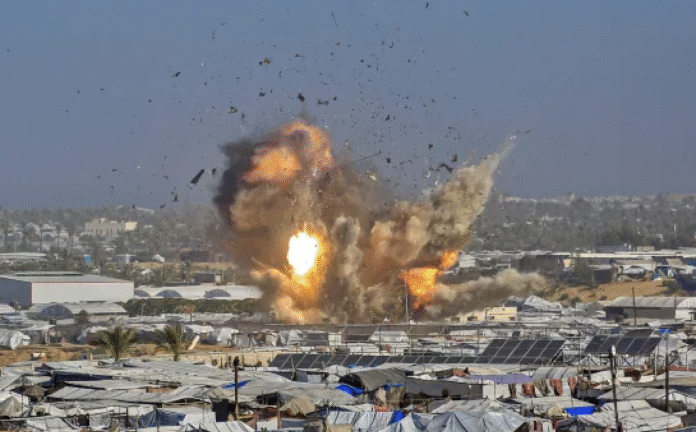
On Wednesday, April 4, as a result of new airstrikes by Israel on tent camps for displaced persons in Gaza, more than 20 people were killed, including small children. This occurred against the backdrop of previous massive attacks: the day before, according to Palestinian sources, another 31 people were killed in various regions of the […]
On Wednesday, April 4, as a result of new airstrikes by Israel on tent camps for displaced persons in Gaza, more than 20 people were killed, including small children. This occurred against the backdrop of previous massive attacks: the day before, according to Palestinian sources, another 31 people were killed in various regions of the country.
Amid the new strikes, Israeli Defense Minister Israel Katz stated that if Hamas refuses to completely lay down its arms, they will be “destroyed along with their entire military infrastructure.”
The Israeli side claims that it is conducting strikes in response to Hamas’s military activity. However, as residents of Gaza told the media, the strikes are being directed specifically at refugee camps and destroyed homes, where civilians had previously returned.
International experts describe Israel’s arguments regarding military targets as “fabricated.” According to them, there was no recorded open military activity in the areas that were bombed. Analysts note that Israel has previously declared refugee camps, hospitals, and mosques as “Hamas targets,” after which it conducted strikes against them.
The Palestinian Ministry of Health reports that since the announcement of the ceasefire in October 2025, Israel has killed at least 550 people as a result of various attacks. Among the dead are civilians, including dozens of children. According to the ministry, victims also included residents who went out for firewood near the “yellow line.”
The Gaza State Emergency Service states that the intensity of Israeli strikes has significantly increased. Meanwhile, rescuers are facing a severe shortage of resources and are unable to provide timely assistance to the victims. According to them, the Israeli side is obstructing rescue teams’ access to the shelling sites. “Yesterday we were forced to suspend operations due to a lack of fuel,” said service representative Mahmoud Basal.
He emphasized that hostilities have effectively not ceased since October 7, 2023.
“The number of casualties reported by the media is significantly underestimated. Thousands of people may remain under the rubble. We cannot reach them. Sometimes Israel allows rescuers access only several days after the attack—by that time, many have already died. If we could get there in time, some lives could be saved,” Mahmoud Basal said.
According to the ceasefire agreement between Hamas and Israel reached in October of last year, the first stage was to return all living and deceased prisoners, while Israel was to release more than two thousand Palestinian prisoners. Then, a transition to the second stage was anticipated—withdrawal of Israeli troops beyond the “red line.”
Several days ago, HAMAS found and handed over the body of the last deceased Israeli hostage. According to agreements, Israel was supposed to fully open the “Rafah” border crossing, ensure free movement, and increase the volume of humanitarian aid to Gaza. Although the crossing was formally opened, its operation turned out to be severely limited: of the 50 people allowed to return to Gaza, only 12 were let through, and of the 40 seriously ill patients heading for treatment in Egypt, only eight were permitted to cross. According to the latest data, today Israel has once again completely closed this crossing.
Analysts believe that Israel is obligated to move to the second stage of the ceasefire and gradually withdraw troops from Gaza. However, experts think that Israel has no intention of doing this and aims to consolidate along the “yellow line,” maintaining the ability to resume massive shelling at any moment — similar to the practice it applied in Lebanon.
Journalists in Gaza note that, despite the announcement of the first stage of the ceasefire, hostilities are effectively continuing. According to their reports, Israel is not even adhering to the initial conditions of the agreement, including the obligation to allow hundreds of trucks with food and humanitarian aid to pass daily, and systematically obstructs their import.
Experts believe that Israel is deliberately maintaining the situation in a prolonged crisis, hoping that the international community will eventually come to terms with what is happening and begin to perceive it as normal.