News
ECONOMY
EBRD will finance the modernization of Tajikistan’s energy sector
The European Bank for Reconstruction and Development (EBRD) will provide a loan and grant to reduce electricity losses in Tajikistan. According to the press service of the Ministry of Finance of Tajikistan, a ceremony for signing several agreements with the European Bank for Reconstruction and Development took place at the ministry on December 4. In […]
The European Bank for Reconstruction and Development (EBRD) will provide a loan and grant to reduce electricity losses in Tajikistan.
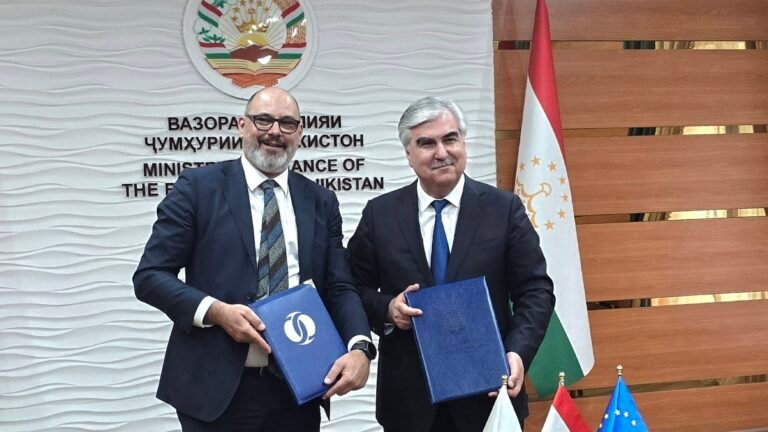
According to the press service of the Ministry of Finance of Tajikistan, a ceremony for signing several agreements with the European Bank for Reconstruction and Development took place at the ministry on December 4.
In total, the ministry reports that the EBRD will allocate 43 million euros for the implementation of the “Reduction of Electricity Losses” project, part of which is provided on a non-repayable basis.
The documents were signed by the Minister of Finance of Tajikistan Faiziddin Sattor Kahhorzoda and the EBRD’s resident representative in Tajikistan Holger Wiefel.
“The total value of the agreements is 43 million euros. Of this, 28 million euros are allocated as a loan, and 15 million euros as a grant from the Asian-Pacific Region Investment Fund of the European Union,” the ministry’s statement said.
The ministry reported that the project’s goal is to modernize the electricity metering system and install new electricity meters in the distribution networks in the Khatlon and Sughd regions.
The Ministry of Finance of Tajikistan has not published details of this project, and it remains unclear what specific measures, besides “modernizing the electricity metering system and installing new electricity meters,” are planned to reduce electricity losses.
The EBRD will allocate 43 million dollars for this project against the backdrop of a sharp tightening of the electricity supply limit to the population across the country. In recent days, residents have received less than 2–3 hours of electricity per day. According to local residents, such a total blackout has never occurred before, affecting even large cities, including the capital and administrative centers of the regions.
Previously, representatives of the distribution electric networks, particularly the company “Barki Tojik,” repeatedly stated that the population has debts for electricity and that household consumers create a significant portion of the losses. However, as experts note, the authorities continue to urge citizens to save electricity in conditions where it is practically unavailable.