News
TAJIKISTAN
European Union imposes sanctions against banks of the Rahmon family
The European Union has approved the 19th sanctions package against Russia. The majority of the sanctioned companies are banks and energy producers. The list includes several financial institutions from Tajikistan. The European Union has once again tightened sanctions against Russia for the war in Ukraine. Leaders of the 27 EU countries have approved the 19th […]
The European Union has approved the 19th sanctions package against Russia. The majority of the sanctioned companies are banks and energy producers. The list includes several financial institutions from Tajikistan.
The European Union has once again tightened sanctions against Russia for the war in Ukraine. Leaders of the 27 EU countries have approved the 19th sanctions package.
The new EU sanctions package includes several Russian enterprises. The sanctions target companies, banks, as well as energy suppliers.
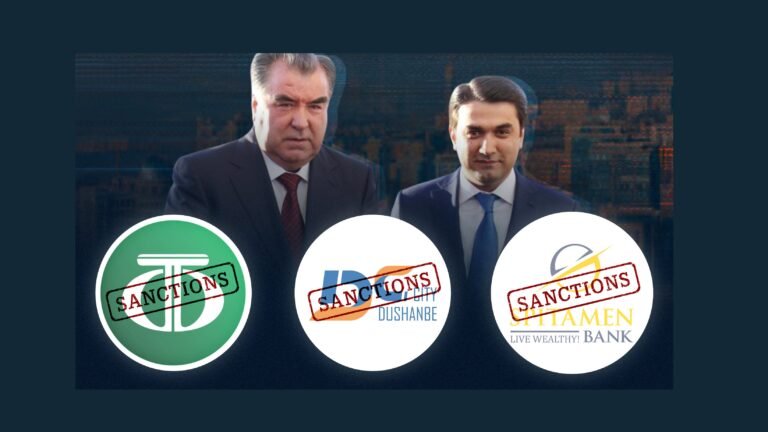
According to the new decision by the European Commission, three Tajik financial institutions have been added to the sanctions list – “Spitamenbank,” “Dushanbe City Bank,” and “Commercial Bank of Tajikistan.” Now, companies and individuals from EU countries are prohibited from conducting financial transactions with these three Tajik banks.
So far, the three mentioned Tajik banks or the Tajik regulator, the National Bank, have not commented on the new sanctions list. As soon as representatives of these banks comment on the EU’s decision, Azda.tv expresses its readiness to publish.
It should be noted that “Dushanbe City Bank” is part of the monopoly company “Avesto Group,” which belongs to Rustam Emomali, the son of the President of Tajikistan, the mayor of Dushanbe, and the chairman of the upper house of the Tajik parliament. This large company is managed by Mirzo Muhammad Faizullozoda, the brother of Mirzo Khurshed Faizullozoda, one of Rustam Emomali’s close friends, the vice president of the Football Federation, and the head of the Agency for Innovations and Digital Technologies of Tajikistan.
Amid the sanctions against “Dushanbe City,” bank clients in the country are increasingly complaining about poor service. Bank clients write on social media that their complaints go unanswered simply because the bank belongs to the president’s son.
It is believed that “Spitamenbank” is also affiliated with relatives of the President of Tajikistan.
Additionally, starting from November 12, a complete ban on transactions with five Russian banks will be implemented – “NKO Istina” (JSC), LLC “Zemsky Bank,” “Absolute Bank” (PJSC), PJSC “MTS Bank,” and JSC “Alfa Bank.”
Sanctions have also been imposed against five Kyrgyz banks, including “Tolubai” and “Eurasian Savings Bank.”
The restrictions also affect several banks from the United Arab Emirates, Hong Kong, Belarus, and Kazakhstan.
Furthermore, transactions with the Russian payment systems “Mir” and SBP (System of Fast Payments) are completely prohibited.
A separate block of sanctions targets the cryptocurrency sector. The EU has banned transactions with the stablecoin A7A5, created with the support of Russian authorities. Sanctions also affect the cryptocurrency developer, a Kyrgyz creator, and the platform where transactions with this cryptocurrency were primarily conducted.
According to the European Commission, these measures are aimed at cutting off alternative financial channels through which Moscow continues to finance military expenses.
The High Representative of the EU for Foreign Affairs, Josep Borrell, emphasized the importance of sanctions.
“Every euro that we deprive Russia of is a euro that it cannot spend on war,” the EU’s chief diplomat stressed.
Along with financial measures, the new sanctions package also affected the energy sector, maritime transport, and the military industry. According to EU representatives, the restrictions are intended to complicate Russia’s access to global financial resources and reduce its ability to continue the war in Ukraine.
Recently, U.S. President Donald Trump announced sanctions against the two largest oil companies in Russia — Rosneft and Lukoil — due to Moscow’s unwillingness to end the war in Ukraine. He cited Russia’s reluctance to conclude the war in Ukraine as the reason.