News
ECONOMY
European Union removed Tajikistan’s banks from the sanctions list
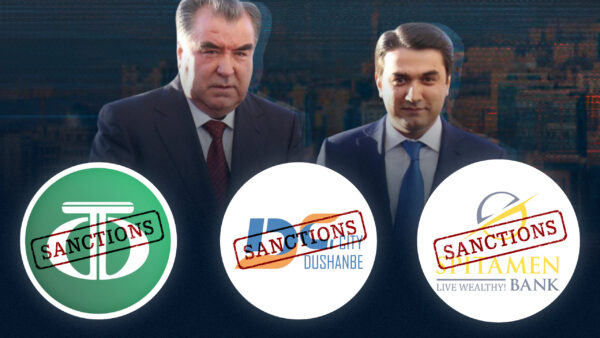
Three Tajik banks controlled by relatives of President Rahmon have been removed from the sanctions list of the European Union. On April 23, 2026, the European Commission decided to lift sanctions on three financial institutions in Tajikistan — CJSC “Spitamen Bank,” CJSC “Dushanbe City Bank,” and OJSC “Commercial Bank of Tajikistan.” The European Commission noted […]
Three Tajik banks controlled by relatives of President Rahmon have been removed from the sanctions list of the European Union.
On April 23, 2026, the European Commission decided to lift sanctions on three financial institutions in Tajikistan — CJSC “Spitamen Bank,” CJSC “Dushanbe City Bank,” and OJSC “Commercial Bank of Tajikistan.”
The European Commission noted that the reason for their removal from the sanctions list was the dialogue with Tajikistan and the negotiations held regarding compliance with rules and norms. The goal of this decision was stated to be the change in the relationships of financial institutions that had, in one way or another, assisted Russia in circumventing sanctions.
The National Bank of Tajikistan also reported that the sanctions against these banks were lifted based on “the outcomes of negotiations between Tajik representatives and European partners.”
The National Bank emphasized that this decision by the European Commission was a direct result of “the expansion of cooperation between the regulatory authority and the relevant ministries and departments of Tajikistan with the European Commission, the implementation of international compliance standards, and the strengthening of the system to combat the legalization of proceeds from crime.”
In October 2025, the European Union approved the 19th package of sanctions against Russia. The list included several financial institutions from Tajikistan, Kazakhstan, Kyrgyzstan, China, and India.
Thus, three Tajik financial institutions — “Spitamen Bank,” “Dushanbe City Bank,” and “Commercial Bank of Tajikistan” — were included in the sanctions list.
Under the European Union sanctions, all institutions, companies, and individuals are prohibited from cooperating and conducting any banking operations with these three Tajik banks.
The European Commission accused these banks of facilitating the circumvention of previously imposed sanctions, as well as financing Russia’s military economy.
These institutions were accused of helping to bypass sanctions on the export of goods, including computers, equipment control systems, microelectronics, unmanned aerial vehicles, and other goods and advanced technologies, indirectly contributing to the strengthening of Russia’s military capabilities.
It is believed that “Spitamen Bank,” “Dushanbe City Bank,” and “Commercial Bank of Tajikistan” are affiliated with relatives of the President of Tajikistan. It is still unknown how much the ban on operations with these banks affected their activities and to what extent it limited their operations.
“Dushanbe City Bank” is part of the monopoly company “Avesto Group,” which belongs to Rustam Emomali, the son of the President of Tajikistan, the mayor of Dushanbe, and the chairman of the upper house of the Tajik parliament. This large company is led by Mirzo Muhammad Faizullozoda, the brother of Mirzo Khurshed Faizullozoda, one of Rustam Emomali’s close friends, the vice president of the Football Federation, and the head of the Agency for Innovations and Digital Technologies of Tajikistan.
Against the backdrop of sanctions imposed on “Dushanbe City,” bank clients in the country have frequently complained about poor bank service. Bank clients write on social media that their complaints go unanswered simply because the bank belongs to the president’s son.