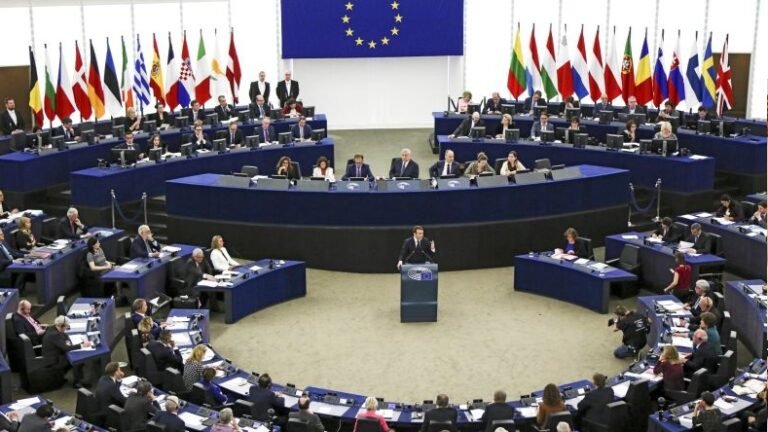
The European Parliament is directly elected by the citizens of EU countries. After the elections, the European Council proposes a candidate for the position of President of the Commission, taking into account the results of the elections to the European Parliament. The proposed candidate must then be approved by a majority of the members of the European Parliament. After the approval of the President of the European Commission, the elected president, in consultation with the member states, proposes a team of commissioners (which also includes the High Representative of the Union for Foreign Affairs and Security Policy).
Then this team, or “College of Commissioners,” must be approved by the European Parliament. This process ensures that the European Commission has the support of the directly elected European Parliament. The European Commission, in turn, is a key supranational body of the European Union, as it has the unique prerogative to initiate EU laws.
The European Union and Central Asia are set to hold their first full summit, which is scheduled to take place in Uzbekistan in 2024. As noted by the assistant to the President of Uzbekistan, Saida Mirziyoyeva, the first official EU-Central Asia summit will take place in the near future. She emphasized that this meeting “will open a new chapter in our friendly relations.” It remains unclear whether we will see the familiar faces of European Commission President Ursula von der Leyen and European Council President Charles Michel at this summit, or if new figures will emerge after the European Parliament elections.
Additionally, “Politico” has obtained a draft document with recommendations for the future composition of the European Commission regarding the establishment of international partnerships. Among the highlighted regions are Central Asian countries. The document states that the new composition of the European Commission should not miss the unique opportunity to strengthen the EU’s position, counter China’s expansion, and respond to the growing desire of Central Asian countries to cooperate with the EU. The document recommends enhancing the significance of two key EU projects in Central Asia under the “Global Gateways” initiative, as well as focusing on strategic partnerships for essential raw materials and addressing the consequences of the Aral Sea’s desiccation.
What will change in the EU’s foreign policy in Central Asia after the elections?
The European Parliament has clearly designated Central Asia as an area of geopolitical interest for the EU, highlighting the region’s role in security, transport routes, energy diversification, and resource supply. Brussels is seriously interested in creating effective trade and energy corridors connecting Europe and Asia, bypassing Russia. In addition, the regions have several other points of contact and common challenges, such as conflict resolution and combating climate change.
The topics raised by Borrell during the last major EU-Central Asia meeting included reforms, economy and trade, regional connectivity, green energy, security, and people-to-people contacts. The rise of right-wing parties on the political scene in Europe is not new; right-wing parties are those that govern in several European countries, such as Hungary, Italy, and the current government in Slovakia. These examples will allow us to study how the right’s approach to Central Asia is changing.
Access to rare earth metals in Central Asia and countering the influence of Russia and China has become increasingly prioritized for the European Union, meaning it aims to expand its own economic presence through exports, as the EU is already the largest importer of raw materials from the region. However, despite the EU’s efforts to strengthen economic ties, the trade scenario within the European Union itself is facing difficulties. As Euronews Business reports, EU exports and imports are experiencing a sustained decline. Recent data from Eurostat revealed a troubling trend: exports have decreased for the third consecutive quarter, while imports have faced a decline for the fourth consecutive quarter. In the third quarter of 2023, EU exports and imports fell by 1.2% and 4.6% respectively compared to the previous quarter.
Despite these challenges, the EU managed to achieve a positive trade balance of about 18 billion euros, sharply contrasting with the surplus of 6.9 billion euros observed in the same period of 2021. The decline in imports outside the EU during this period was due to a reduction in imports of other industrial goods, machinery and vehicles, as well as energy resources. At the same time, exports of machinery and vehicles decreased, while there was growth in the energy and chemical industries. This trend once again highlights the importance of opening the market of Central Asian countries for the European Union, as the market in the form of Russia has directly closed off, and Russia itself has entered into an economic struggle for its interests both in Central Asia and in other parts of the world, such as Africa.
The European Union needs to enter the Central Asian market, where 80 million people live, gain access to local resources, and compete with China and Russia for economic influence in this region. For this, the European Union requires communication channels, which is why EU officials are so actively discussing the development of the Trans-Caspian International Transport Route. We are observing a trend towards the strengthening of right-wing parties and even the presence of right-wing populism among ruling parties in Europe. Although traditionally, right-wing parties’ economic programs include elements of economic protectionism, Central Asian countries do not fall under this category. Why? Because it mainly concerns gaining access to Central Asian raw materials and expanding the export of European goods to the region’s markets. Unfortunately, Central Asia’s exports to Europe are concentrated on raw materials, particularly on Kazakh oil.
In addition to economic cooperation issues, the European Parliament pays significant attention to regulatory aspects such as democratic reforms, human rights protection, and the promotion of the rule of law in Central Asian countries. The European Parliament expressed concern about the future of Central Asia and called on the EU to empower the region’s youth to influence it. To this end, it is proposed to strengthen support for civil society, develop “roadmaps” for reforms leading to the simplification of the visa regime to facilitate grassroots contacts. The EU is also ready to assist in exchange for democratic transformations, but right-wing parties in the European Parliament may shift the focus to pragmatic cooperation. The current ruling coalition, fearing the strengthening of Russia and China, does not want to pressure the countries in the region on human rights issues, which may lead to geopolitical considerations prevailing over democratic ones.
After the elections, the EU’s foreign policy in Central Asia will become more active, focusing on security, transport routes, energy diversification, and countering the influence of Russia and China. The EU intends to develop the Trans-Caspian International Transport Route and improve access to the region’s rare earth metals. Despite internal economic difficulties, Brussels aims to support democratic reforms and human rights, but right-wing parties may shift the focus to pragmatic cooperation and tightening visa requirements. Examples from Hungary and Slovakia show that right-wing or populist parties can change the approach to Central Asia, emphasizing economic interests and restraining democratic pressure.
The New European Parliament: The Rise of Right-Wing Parties, Their Ideology, and Influence on the Future of Europe
Migration, economic crisis, and social stratification are the issues the European Union faces ahead of the European Parliament elections. Against this backdrop, right-wing parties, which adhere to nationalist, populist, and conservative approaches and actively advocate for reducing the powers of EU institutions and increasing the sovereignty of member states, are gaining popularity in European countries. These parties also often support protectionist economic policies to shield domestic industries from international competition. They promote economic nationalism, which prioritizes national enterprises and sectors over foreign ones.
Europe is rapidly “turning right” — far-right parties dominate opinion polls in much of Europe. In France, the far-right “National Rally” gathers more than 30 percent of the votes, significantly ahead of President Emmanuel Macron’s Renaissance party. In Germany, the “Alternative for Germany” (AfD) holds second place in the polls, competing with the Social Democrats. Notably, the chairman of the inter-parliamentary group “Germany-Central Asia” in the German Bundestag is a member of the AfD and a native of Ust-Kamenogorsk, Eugen (Evgeny) Schmidt.
According to some polls, in the upcoming EU elections (June 6-9), the far-right could garner over 30% of the votes, significantly strengthening their position in the European Parliament. Some forecasts even claim that nearly half of the seats in the next European Parliament will be occupied by MEPs not part of the “grand coalition” of three centrist groups, and that for the first time a far-right coalition of Christian Democrats, conservatives, and right-wing radical MEPs may gain a majority in Parliament.
Therefore, even with the rise of more ideologically moderate political forces in the European Parliament, they will still have to take the right agenda into account, as it is quite popular among the European population. Even at a symbolic level, European leaders are already taking steps in this direction. A striking example is the photo session of French President Emmanuel Macron during boxing training, which has widely circulated online. Macron aimed to present himself as a defender of Europe ahead of the European Parliament elections.
Despite the popularity of right-wing sentiments among EU voters, the party blocs on the right are heterogeneous in terms of the ideological spectrum. In this regard, the prospects for their rapprochement are ambiguous, meaning that the consolidation of right-wing forces may not occur, and the right agenda could be seized by those in the center.
Additionally, despite the right-wing demand among voters, intra-party contradictions, ideological disagreements, and issues with the image of certain party leaders among the right may undermine these parties’ chances of ultimately gathering more votes and strengthening their influence on the political priorities of the EU.
What are the other parties bringing into the new political season and what does this mean for Central Asia?
The upcoming elections for the European Parliament may significantly impact relations between the EU and Central Asia, particularly due to differences in the priorities of political groups. The European People’s Party (EPP), holding 176 seats, emphasizes defense and security in the context of the aggressive war in Ukraine, advocating for NATO expansion and the creation of a European Commissioner for Security and Defense, as well as for limiting migration and expanding free trade partnerships while adhering to climate goals outlined in the “European Green Deal.” This security-oriented approach may enhance EU support for Central Asian countries facing their regional threats.
The Progressive Alliance of Socialists and Democrats (S&D), with 139 seats, advocates for social and environmental equality, affordable energy, housing, and an inclusive labor market, as well as strengthening Europe’s defense sector and expanding international partnerships. Their holistic approach may contribute to sustainable development and the promotion of human rights in Central Asia.
The group Renew Europe, which supports the expansion of pan-European defense capabilities and individual freedoms such as same-sex marriage, is expected to lose 16 seats but will remain influential. This liberal position may help strengthen ties with civil society and protect human rights in Central Asia.
In contrast, the Eurosceptics from the European Conservatives and Reformists (ECR), who are projected to gain 17 seats according to Europe Elects, advocate for national control over defense policy.
Similarly, the Identity and Democracy (ID) group may gain 26 seats and promotes nationalist and Eurosceptic policies, which will affect the EU’s unified stance towards Central Asia.
Finally, the Greens/European Free Alliance and the Left, despite expected seat losses, pay special attention to issues of climate justice and peaceful negotiations, which may influence the EU’s policies on sustainable development and conflict resolution in Central Asia.
Overall, the increase in representation of far-right and Eurosceptic parties may lead to a more fragmented EU approach to Central Asia, while centrist and leftist parties may continue to insist on a comprehensive, rights-based engagement with the region. To illustrate this more clearly, changes in the foreign policies of Hungary, Slovakia, and Italy towards Central Asia after the rise of right-wing and Eurosceptic parties were analyzed.
Hungary is Open to the East
Since 2010, the party of young democrats “Fidesz,” led by Viktor Orbán, has been in power in Hungary. At that time, the new government announced the start of the “Openness to the East” policy, which implied the activation of cooperation with several countries such as Turkey, Central Asian countries, China, etc. The key task for Hungary is to expand economic cooperation with Eastern countries and to act as a mediator between the West and the East. Additionally, Hungary’s Minister of Foreign Affairs Péter Szijjártó stated that during its presidency in the Council of the European Union from July 1 to December 31, 2024, Hungary will strive to strengthen cooperation between the EU and the Organization of Turkic States (OTS). The effectiveness of Hungary’s “Openness to the East” policy can be measured by political (visits, signed agreements) and economic criteria (trade growth, investments).
Since 2010, Hungary has managed to sign declarations of strategic cooperation and partnership with several Central Asian countries. In 2014, such a declaration was signed with Kazakhstan, in 2021 with Uzbekistan, and in 2020 with Kyrgyzstan. The parties also decided to expand the legal framework for cooperation and signed a declaration in 2023 to strengthen and develop the strategic partnership between Kyrgyzstan and Hungary. It is important to note that Hungary is one of the few European countries that have signed declarations of strategic partnership with Central Asian countries, particularly with Uzbekistan and Kyrgyzstan. Furthermore, the expansion of political cooperation between Central Asian countries and Hungary is supported by regular meetings at the summits of the Organization of Turkic States, where Hungary has been an observer since 2018.
Economic cooperation has also noticeably intensified since 2010. Hungary has opened joint funds for the development of joint investment projects with three countries in the region: Kazakhstan, Kyrgyzstan, and Uzbekistan. Additionally, the government of Hungary plans to allocate 100 million USD for the Turkic Investment Fund. A similar dynamic is observed in trade relations, where since 2010 there has been active growth in Hungarian exports to Central Asian countries; unfortunately, there is not always a reciprocal growth in exports from Central Asia.
Slovakia: from implementing foreign policy interests through the EU to an independent foreign policy?
A noticeable trend with the arrival of the new government in Slovakia is a shift from implementing the country’s foreign policy interests through the European Union to greater self-initiative. This may be facilitated by the further deterioration of relations between the Slovak government and EU bodies. So far, this has not significantly affected Central Asian countries. However, the elevation of relations between Slovakia and Azerbaijan to a strategic level and the signing of military cooperation agreements between the two countries open up great prospects for Slovakia’s ties with Central Asia, especially after the European Parliament elections.
Currently, Slovakia has once again attracted attention as Robert Fico, the founder and chairman of the “Direction – Social Democracy” party, also known as SMER, became Prime Minister for the second time on October 25, 2023. Although it is difficult to categorically place Fico and his party within the right political spectrum, Fico himself and his party are criticized for populism. Fico is known for his ambiguous position regarding the war in Ukraine, which has drawn significant attention and criticism both domestically and internationally. This may have been a reason for an assassination attempt on the Prime Minister. Fico has repeatedly stated that his government will not provide military assistance to Ukraine and has expressed doubts about the effectiveness of the Western strategy regarding the conflict. We can also see certain changes in Fico’s foreign policy.
Prior to this, Fico served as Prime Minister from 2012 to 2018. In 2018, Slovak political scientists Peter Plenta and Matej Ulik noted that, despite Slovakia being the smallest country in the Visegrad Group, it can be considered a superpower in the field of European diplomacy in Central Asia.
In 2014, Slovakia’s key approach to implementing its foreign policy interests in Central Asia was joint work with the European Union. In support of this, Plenta and Ulik state that Slovak diplomats significantly strengthened relations with Central Asia, playing various roles in international organizations. Jan Kubis became the first EU Special Representative for Central Asia in 2005. Miroslav Jenča headed the UN Regional Centre for Preventive Diplomacy for Central Asia from 2008 to 2015. Additionally, in 2015, Peter Burian was appointed as the EU Special Representative for Central Asia. In principle, Central Asian countries could also view the development of relations with Slovakia in the context of expanding partnership with the EU. For instance, the Chairman of the Senate Committee on International Relations, Defense, and Security Mukhtar Kul-Mukhammed stated at the end of 2022 that “The development of bilateral cooperation with Slovakia is important for us in the context of strategic partnership with the European Union.”
Despite the fact that Fico has only recently returned to power, signs of a new approach between Slovakia and the region are already emerging. On May 6 of this year, Fico for the first time in his political career visited Azerbaijan. During this visit, the parties signed important agreements that opened a new chapter in relations between Azerbaijan and Slovakia. In particular, the parties signed a declaration on strategic partnership. At that time, Fico stated that he wants to position Slovakia as a bridge between Azerbaijan and the European Union. This approach closely resembles the actions of Viktor Orban, who also actively concluded declarations of strategic partnership with Azerbaijan and Central Asian countries and positioned Hungary as a bridge between the two regions.
The fact that the parties have only now signed a declaration on strategic partnership and cooperation documents in the defense sector against the backdrop of existing tensions in relations between the European Union and Azerbaijan indicates that Slovakia may be gradually moving away from promoting its own interests through the European Union towards demonstrating greater initiative with the arrival of a new government. It is also worth adding the pressing conflicts between the EU institutions and Slovakia. In March, Vice President of the European Parliament Martin Hojsik stated to Politico that Slovakia could lose access to EU funds if Fico’s government continues its “illiberal” policies, similar to those in Hungary. In September 2022, the European Commission proposed to apply a special mechanism to protect the EU budget from violations of the rule of law in Hungary, resulting in €7.5 billion for Budapest being frozen.
In conclusion, it is worth noting that Slovakia is the most dependent country in the European Union on Russian energy resources, therefore cooperation in the energy sector (particularly oil, gas, and green hydrogen) with Central Asian countries will become increasingly relevant for Fico’s government. Currently, Azerbaijan and Slovakia are discussing the possibilities of supplying Azerbaijani gas to Slovakia, but Azerbaijan also has plans to supply large volumes of “green” hydrogen with the involvement of Central Asian countries. In May of this year, Azerbaijan, Kazakhstan, and Uzbekistan signed a Memorandum on the integration of the energy systems of the three countries. According to the document, the countries will explore the possibilities of connecting energy systems by laying a high-voltage cable along the bottom of the Caspian Sea and through the territories of other countries to reach European countries.
Italy: the first “far-right” government since World War II and its own “C5+1” format
The new government of Italy, formed after the elections on September 25, 2022, is led by Giorgia Meloni, the head of the “Brothers of Italy” party. This party is often characterized in the media as “far right.” This government marks a significant shift in Italian politics. As noted by several media outlets, this is the first “far-right” administration since World War II. Meloni’s coalition, which includes the League led by Matteo Salvini and “Forza Italia” led by Silvio Berlusconi, received a significant majority of votes in the 2022 elections.
The current government of Italy has significantly intensified its activities in Central Asia. The working visit of Deputy Prime Minister and Minister of Foreign Affairs of Italy A. Tajani to Astana in September 2023 was a landmark event, as it was the first visit by an Italian foreign policy chief to Kazakhstan in 25 years, which contributed to the activation of strategic partnership. A new chapter in the relations between the two countries was opened by the official visit of President of Kazakhstan Kassym-Jomart Tokayev to Italy on January 18-19, 2024. This was the first visit in 15 years by a Kazakh leader to Rome. After 26 years, last year saw the visit of the President of Italy to Uzbekistan. Most recently, President of Tajikistan Emomali Rahmon made a first official visit to Italy.
Traditionally, Italy has been interested in energy and security issues, and with the new government, interest in cooperation in this area has increased. Recently, the third meeting of foreign ministers from Central Asian countries and Italy took place. Central Asia presents significant economic opportunities, especially in the energy sector. Italy, in particular, through the company ENI, is actively investing in oil and gas extraction in Kazakhstan and Turkmenistan. This allows Italy to diversify its energy resources and reduce dependence on other sources.
Conclusions
The upcoming elections to the European Parliament mark a critical moment for the foreign policy of the European Union, especially in its relations with Central Asia. The anticipated shift towards a more fragmented political landscape, dominated by right-wing and Eurosceptic parties, could significantly impact the EU’s strategy for engagement in the region.
First, the strengthening of right-wing parties in the European Parliament may lead to a more pragmatic and economically driven approach to the European Union’s foreign policy. Resource-rich and strategically located Central Asian countries could become coordinators of the EU’s efforts to create new trade and energy corridors, particularly those bypassing Russia. This aligns with the broader goals of the EU – diversifying energy sources and ensuring access to rare earth metals, which are crucial for the “green” and digital transitions.
However, this shift may also lead to more transactional relationships, where economic interests overshadow normative issues such as democratic reforms and human rights. Right-wing parties, with their emphasis on national sovereignty and economic nationalism, may prefer economic partnerships and investment opportunities over the promotion of democratic standards and governance reforms. This could manifest in a potential tightening of visa regimes and a stricter stance on migration from Central Asian countries, reflecting broader populist sentiments in Europe.
Examples from individual EU member states, such as Hungary, Slovakia, and Italy, illustrate varying degrees of influence from right-wing forces on foreign policy, where less attention is paid to human rights and democracy issues. Hungary’s “Open to the East” policy and Slovakia’s emerging independent foreign policy highlight a trend where priority is given to bilateral relations and strategic partnerships. These countries are actively seeking to strengthen economic ties and political cooperation with Central Asia, often positioning themselves as a link between the EU and the region.
Italy’s active involvement, expressed through high-level visits and strategic partnerships, underscores the importance of Central Asia in the EU’s agenda for ensuring energy security. The Meloni government’s focus on energy cooperation reflects the EU’s broader interest in diversifying energy sources away from dependence on Russia. At the same time, in a joint statement at the conclusion of the “Germany-Central Asia” summit, the parties expressed commitment to joint cooperation in the field of human rights, while at the end of the “Italy-Central Asia” ministerial conference, cooperation in this area was not mentioned on the website of the Italian Ministry of Foreign Affairs.
Despite these trends, the diverse composition of the European Parliament means that centrist and leftist parties will continue to advocate for a comprehensive, rights-based engagement with Central Asia. The EU’s commitment to supporting civil society, promoting human rights, and encouraging democratic transformations is likely to be sidelined by pragmatic economic considerations.
In general, the new balance of power in the European Parliament after the upcoming elections is likely to lead to a more multifaceted approach to Central Asia. Economic interests and strategic partnerships will be prioritized. Central Asian countries can expect increased cooperation, especially in trade and energy, but they must also navigate the changing political dynamics within the EU. As the EU seeks to find a balance between its geopolitical interests and fundamental principles, the future of relations between the EU and Central Asia will be characterized by both opportunities and challenges.
Based on materials from Cabar.asia