News
MIGRATION
In Russia, 6 years in prison is proposed for forging a language proficiency certificate
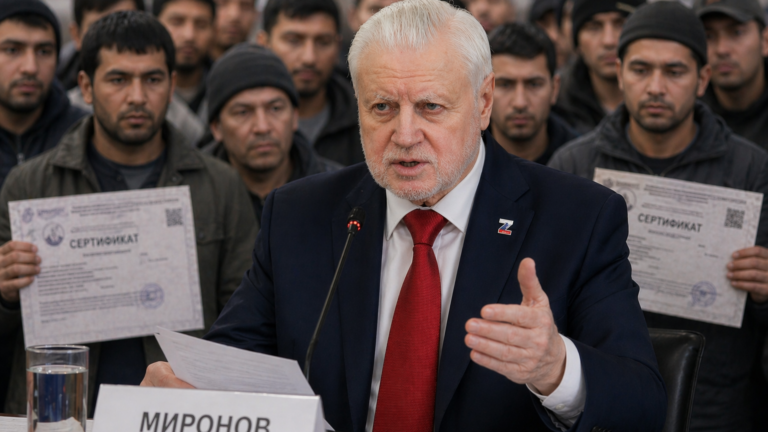
State Duma deputies propose to tighten penalties for document forgery to obtain Russian citizenship. The “Fair Russia” party has proposed introducing criminal liability for forging a document certifying knowledge of the Russian language for migrants. Deputies from the “Fair Russia” faction submitted a bill to the State Duma that provides for criminal liability for forging […]
State Duma deputies propose to tighten penalties for document forgery to obtain Russian citizenship.
The “Fair Russia” party has proposed introducing criminal liability for forging a document certifying knowledge of the Russian language for migrants.
Deputies from the “Fair Russia” faction submitted a bill to the State Duma that provides for criminal liability for forging a certificate of knowledge of the Russian language, history, and legislation. This document is necessary for obtaining Russian citizenship and a work permit.
The authors of the bill propose to add part 6 to Article 327 of the Criminal Code of the Russian Federation, providing for criminal liability for forging this certificate, as well as for the sale of such documents.
Leader of “Fair Russia” Sergey Mironov, in addition to prison terms ranging from two to six years, proposed introducing a fine of up to 500,000 rubles or an amount equal to the convicted person’s salary or other income for a period of three years, as well as an additional year of restriction of freedom for the production of forged certificates for sale or personal use.
The parliamentarian claims that current regulations do not take into account the degree of public danger posed by such crimes. Currently, the law provides for a penalty of up to two years in prison, fines, and corrective labor for forging official documents. According to him, the new initiative aims to close this legal gap and significantly increase responsibility for such violations in the migration sphere.
He also noted that in recent years, Russian authorities have taken measures to increase the transparency of document issuance rules. According to him, the rules for taking exams have already been tightened. Now, they can only be conducted by state institutions from a list approved by the government, and a federal register of certificate accounting has been created, but the problem of using forgeries remains relevant. Therefore, they proposed to strengthen criminal liability for such violations.
The “Fair Russia – For Truth” party is the author of a number of anti-immigration laws and initiatives. Previously, the party advocated for the introduction of a visa regime with Central Asian countries, as well as a ban on hiring migrants for work in social sectors such as construction and transport.
Sergey Mironov also proposed banning diasporas on Russian territory and implementing a rotational work method for migrants based on the principle of “arrived – worked – left.”
Additionally, Sergey Mironov has repeatedly stated that entry into Russia should only be allowed for those migrants who have biometric data and paid medical insurance, and they should also be charged a special amount in advance in case of possible deportation, so that this procedure is not carried out “at the expense of Russian taxpayers.”
In the past two years, especially after the attack on the Crocus City Hall concert venue, in which the suspects are migrants, there has been a rise in xenophobia and anti-migrant sentiment in Russia. Law enforcement agencies are conducting mass raids on the streets, in hostels, cafes, and markets, checking places where migrants gather, such as teahouses and mosques, where migrants are often treated brutally, beaten, and have their permits or residence permits revoked. This particularly affects citizens of Central Asian countries, including Tajikistan. They are also stripped of their residence permits and even citizenship for evading participation in the war in Ukraine.
Observers note that although the situation for foreign workers has noticeably worsened after the attack on the Crocus City Hall, subsequent statements from politicians and deputies further fuel the fire.
According to observers, due to the parliamentary elections scheduled in Russia for 2026, smaller parties such as “Fair Russia – For Truth” and “New People” are using populist statements to increase their number of mandates. Promoting initiatives aimed at tightening migrants’ rights is seen by them as a way to attract the largest number of voters.