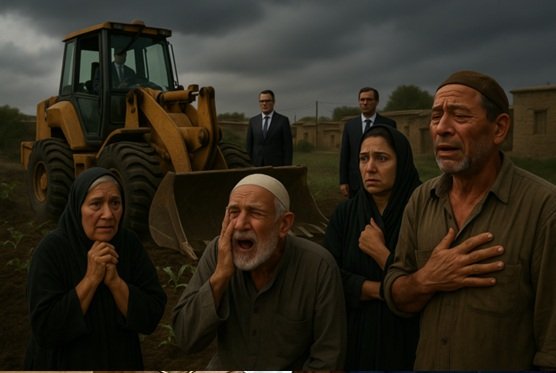
The authorities openly threaten that, according to current legislation, religious education for individuals under 18 years of age is prohibited. In case of violation, both parents and those providing instruction will be held accountable.
Emphasizing the illegality of youth under 18 visiting mosques and performing prayers, the authorities are holding meetings with parents and conducting “explanatory work” about the “danger and harm of illegal religious education.” These “explanatory works” are not only unclear to many but also cause concern and anxiety among the people.
In recent days, more and more complaints from residents of the republic about the actions of the authorities have been received by the Azda TV editorial office. Our interlocutors, wishing to remain anonymous for security reasons, say that the authorities have not explained how and by what methods it is permissible and possible to provide religious education to their children if they are Muslims.
After all, there is not a single religious school, educational institution, or madrasah operating in the country where children could receive religious education. Residents, as Muslims, find themselves at an impasse between their faith and the pressure from local authorities. Previously, educational circles operated at mosques where children received basic religious education, and traditional home education in the form of “hujra” – religious education at home – was also practiced.
A resident of the Mastchinsky district expressed his deep concern during our conversation.
“All imams, muezzins, and mosque staff are individuals appointed by the authorities. They constantly talk only about the government and the Leader of the Nation. But despite this, the authorities are dissatisfied even with the basic religious awareness of the youth. Why does the education of religion, familiarity with prayers, the rituals of ablution, and the concepts of halal and haram cause anxiety for the authorities?” – he said.
“We do not know how to introduce our children to the foundations of the religion of our ancestors. For us, this is an obligation. Why does the government reject the religion of its ancestors and want the new generation to grow up as non-believers?” – our interlocutor stated.
However, the issue is not limited to just the prohibition of religious education for youth and their presence in mosques. This is not the only concern in society.
Recently, alarming reports have been coming from the country that authorities are forcibly making farmers plow fields during the peak of the harvest season.
It is already mid-May, the harvest season for hay, barley, clover, and other animal feed has begun. However, “state commissions,” traveling through all the villages, are forcing farmers to plow their fields again and plant potatoes. All costs for plowing, land preparation, and seed purchase fall on the farmers themselves. They have to buy diesel fuel, fertilizers, and seeds on their own, despite the fact that the potato planting season has long passed.
“These actions by the government will only harm us and all the residents. The farm owner knows best what he needs to plant to get a harvest and profit. He did not just plant fodder crops for his livestock for no reason. If he does not prepare feed, he will be forced to buy hay for his livestock at inflated prices,” says one of the farmers.
“You have transferred the land to the farmer, you collect taxes from him, the farm is registered with the Tax Committee as a taxpayer, there are documents confirming that this is a farm, and based on this, he pays taxes every year. It is logical and legal for him to grow what he deems necessary. Why then do you interfere?” – says the farmer, addressing the authorities.
The farmer invested his money, plowed, and bought seeds in hopes of making a profit from the rented land. But at that moment, the authorities come and destroy his harvest during the collection. Who will compensate for all his efforts and expenses? Who will reimburse him for his losses? But the “government commissions” do not think about this; they only order: “plow the land and plant potatoes.”
How can a farmer pay the land tax under such conditions? Why do the authorities disturb people, sow anxiety, and cause harm? Is this proper governance, or is it improper?
One farmer from Istaraushan says that “this is absolutely unfair and harmful to us. We planted these lands with our own money, in April, in favorable weather, we planted clover, barley, or corn, and provided mineral fertilizers. But in the midst of the haymaking season, we were approached by the district administration, the village council, and the police, who brought tractors and plowed the fields so that we would plant potatoes. We lost everything, as we incurred serious losses.”
Forced plowing to the detriment of landowners and tenants is happening not only in Istaraushan but throughout the country.
A former chairman of a farming enterprise, now retired, says: “International rankings do not indicate the price of bales of barley or wheat hay and other feeds. But they do indicate the cost of food products — potatoes, carrots, onions, eggplants, chickpeas, beans.
The authorities want to show that these products and their prices are under control and accessible to the population, and that government policy in this direction is successful. Currently, prices for potatoes, carrots, and onions have risen. The authorities want to influence market prices by increasing the sowing of these crops. For example, carrots cost 7 somoni (70 cents), potatoes start at 50 cents, and onions start at 40 cents per kg. Chickpeas and beans are priced at 2–2.5 dollars per kg. This indicates that the government of Tajikistan has completely failed in its agricultural policy. At the same time, the authorities do not take into account that forcing the sowing of potatoes cannot lower prices. These coercive measures against farmers are illogical and will not solve the problem. This is not a way out of the situation.
“In such cases, the government should import more potatoes from abroad. Let all customs duties and taxes for importers be waived for a certain period so they can bring the necessary products to the market in larger volumes. Plowing and forcing the use of land with ready crops for other crops is not a solution. This causes serious harm to farmers, and overall to the people and the government itself,” says our interlocutor.
It is obvious that not all regions have a climate suitable for growing potatoes. An employee of the agriculture department of one of the districts in the north of the country told Azda:
“Sowing potatoes in hot weather is unprofitable. At this time of year, it is already difficult to find seed potatoes. We do not have money to buy diesel fuel again or rent a tractor. All these works require money. In our area, potatoes are planted in March because it is hot here. At this time of year, they will not yield a harvest. Overall, the government has only complicated our lives and caused significant damage. It should determine which regions are suitable for which crops. For example, in the Lakhsh, Gorno-Mastchik, and Shahristan districts, in the Khatlon Valley, potatoes can be planted as the conditions are suitable. But in the Vakhsh, Zafarabad, and Yavan districts, where it is too sunny and hot, potatoes will not yield a good harvest; it is an unreasonable use of land. If absolutely necessary, potatoes should only be planted in March. All this needs to be calculated well. This is basic arithmetic. Does the government not understand this? Thousands of hectares of land are being used unreasonably here. It is absolutely pointless.”
Farmers say they rent land to make a profit, not to sow at a loss. They are not obliged to plant what will cause damage.
They harvest two crops for animal feed. Early barley is harvested, and corn is planted in its place, yielding both grain and straw.
“We get two harvests for our livestock. First, we harvest spring barley, and in its place, we sow corn. We obtain both barley grains and straw, as well as grain and stalks of corn, which we feed to our livestock and live off of. In our household plots, we grow carrots, onions, and potatoes for our own consumption, and we also sell some of this at the market. But when one or two hectares of our barley field are plowed up, we are left without barley and straw, and we can no longer plant corn.
“If the goal is to reduce prices, then why should the price of one product increase at the expense of another? When the harvest of fodder crops decreases, it naturally leads to a multiple increase in the prices of meat and dairy products. In the end, the people will suffer again,” says our interlocutor.
A former employee of the Ministry of Economy, now living in exile abroad, explained the current situation in the country to Azda TV:
“This is the essence of authoritarian and dictatorial regimes — to keep the people in constant stress, anxiety, and concern. So that they do not live peacefully. People must constantly face problems. Having solved one — for example, with a ‘raid’ or power outages — they must face another. So that they do not think about whether the government is worthy and competent. So that they think this is how it should be, that the authorities are doing everything right, and that the people are to blame. That it was not barley and clover that should have been sown, but potatoes. Therefore, in such countries, the government is a source of anxiety for the people, and the people are a source of anxiety for the government.”