News
HUMAN RIGHTS
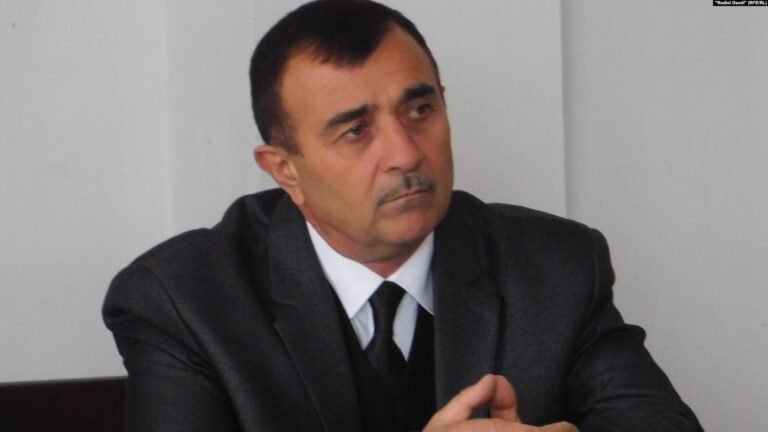
Journalist Akhmad Ibrohim is now accused of “extremism”
According to media reports, the trial of the editor-in-chief of the independent newspaper “Paik” took place in the pre-trial detention center of Kulyab. The journalist was detained in August of this year on charges of “bribing an employee of the State Committee for National Security” in Kulyab, and has since been held in the detention […]
According to media reports, the trial of the editor-in-chief of the independent newspaper “Paik” took place in the pre-trial detention center of Kulyab.
The journalist was detained in August of this year on charges of “bribing an employee of the State Committee for National Security” in Kulyab, and has since been held in the detention center of this city. Now, the case of Akhmad Ibrohim has been classified as secret.
Radio Ozodi reported on October 18 that two more charges have been added to the case of Akhmad Ibrohim – “extremism” and “extortion.” It is reported that the investigation found “signs of extremism” in the materials of Akhmad Ibrohim.
However, sources familiar with the situation believe that Akhmad Ibrohim is being targeted due to his criticism of the authorities in the Khatlon region and officials in the city of Kulyab. The journalist has consistently criticized the incompetence of the authorities in providing residents with water and electricity, as well as in keeping the city clean. He has always written about the pressing issues faced by local residents.
In response to the news of the new charges against Akhmad Ibrohim, journalist Isfandiyar Odina, who lives in exile, condemned the detention of the journalist and called the charges “fabricated.”
“This is the essence of authoritarian regimes; they cannot tolerate concepts such as freedom of expression and a free press, and the authoritarian regime of Rahmon is no exception,” he wrote.
Isfandiyar Odina also emphasizes that the emergence of new charges in the case of Akhmad Ibrohim after two months of detention shows that “the corrupt authorities of Tajikistan first arbitrarily detained this local journalist and then initiated a criminal case against him! That is, he is innocent. On the contrary, it is the corrupt officials who should be in prison for such a full-fledged conspiracy against freedom of expression.”
The Kulyab prosecutor’s office accuses Akhmad Ibrohim of “extremism,” while in January 2015, he was threatened by Nusrat Nazarov, better known by the nickname Abu Khalid Kulobi (from Kulyab), who was then fighting with ISIS in Syria.
In a phone conversation, Abu Khalid Kulobi threatened Akhmad Ibrohim with death if “he does not stop slandering the mujahideen, he will be killed, and his editorial office will be blown up.”
62-year-old Akhmad Ibrohim is the author of books such as “Kuroshi Kabir” (The Great Kir), “Rudi Purkhun” (River Full of Blood), “Spitaman. Katan. Takhorizon” (Spitamen. Katan. Takharestan), and “Dzhakhishi Okhirini Babur” (The Last Jump of the Tiger).
In 2012, he registered the only independent newspaper in the Khatlon region, “Paik.” Throughout his more than ten years of activity, he has faced numerous difficulties. Sometimes due to sharp criticism, he caused a stir, and at other times, due to funding difficulties, the newspaper did not go to print.
In 2023, Tajikistan ranked 153rd out of 180 countries in the world, dropping from the “problematic” category to the lowest category – “very serious.” Even Afghanistan, where the Taliban seized power, ranked 152nd, one position better than Tajikistan.
Experts noted that Tajikistan has worsened its position in the press freedom ranking due to repression against journalists.
“Journalists who criticize the government risk facing physical violence, threats, detention, and even imprisonment by law enforcement and security services. Journalists find it nearly impossible to cover issues that the government considers ‘sensitive’ without endangering themselves, their friends, and their families. In 2022, four journalists received harsh sentences of up to ten years in prison,” the report by the international non-governmental organization Reporters Without Borders stated.
In recent years, Tajik law enforcement has imprisoned several well-known journalists and bloggers for fabricated charges.
In 2022 and 2023, seven journalists in Tajikistan were sentenced to long prison terms on fabricated charges. Four journalists – Abdullo Gurbati, Zavkibek Saidamini, Abdusat tor Pirmukhammadzoda, and Khurshed Fozilov – were sentenced to prison terms ranging from 7 to 7.5 years. Khushom Gulom was sentenced to 8 years, Daleri Emomali to 10 years, and Ulfatkhanim Mamadshoeva to 20 years in prison. In 2024, the well-known Tajik writer Abdukodir Rustam was sentenced to 4.5 years, businessman and author of the book “Events of My Life” Abduhalil Kholikzoda received 6.5 years, and Sukhrab Rajabzoda, the owner of the publishing house that published the book, was sentenced to 1 year in prison.
A number of human rights organizations, including the international organization Committee to Protect Journalists, have called on the authorities of Tajikistan to immediately release the editor-in-chief of the independent newspaper “Paik,” Ahmad Ibrohim.
During her speech at the Warsaw Human Dimension Conference of the OSCE on October 2, Gulnoza Said, the coordinator of the Committee to Protect Journalists’ program for Europe and Central Asia, noted that over the past 3-4 years, the level of freedom of expression in Tajikistan has been characterized by a decline, and the country ranked last in Central Asia. According to her, Tajikistan ranked first in the region for the number of imprisoned journalists.
Gulnoza Said reported that currently 8 journalists have been sentenced to prison terms ranging from 8 to 20 years. Their detention and judicial proceedings were conducted in violation of the law, the trial was held behind closed doors, and the details of the verdict have not been made public.