News
HUMAN RIGHTS RELIGION
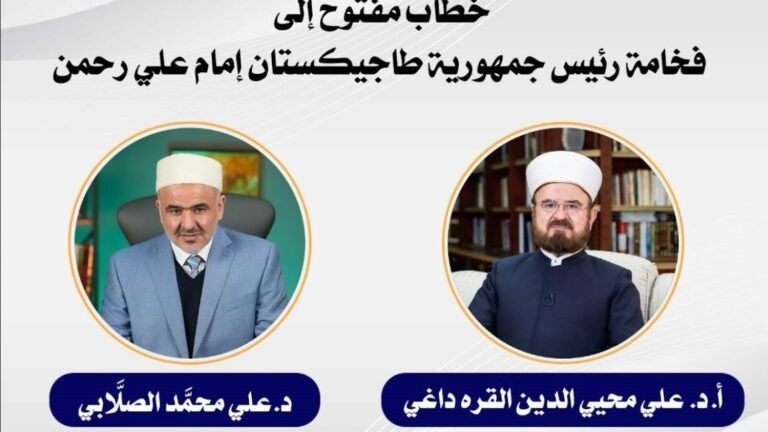
Open letter from the International Union of Muslim Scholars to Emomali Rahmon
The leadership of an influential Islamic organization has called on Emomali Rahmon to end the fight against Islamic values in Tajikistan. The President of the International Union of Muslim Scholars Sheikh Ali al-Qaradaghi and the Secretary General of this organization Sheikh Muhammad As-Sallabi addressed an open letter to the President of the Republic of Tajikistan […]
The leadership of an influential Islamic organization has called on Emomali Rahmon to end the fight against Islamic values in Tajikistan.
The President of the International Union of Muslim Scholars Sheikh Ali al-Qaradaghi and the Secretary General of this organization Sheikh Muhammad As-Sallabi addressed an open letter to the President of the Republic of Tajikistan Emomali Rahmon.
In their letter, the influential Muslim scholars reminded Rahmon that the Tajik people are renowned worldwide for their ancient and rich culture, and globally recognized Tajik scholars such as Ismail Samani, Ibn Sina, Imam Bukhari, Imam Tirmidhi, Hakim Nishapuri, and others made unique contributions to the development of Islamic and other sciences.
“We sincerely advise you from the bottom of our hearts that the recently adopted laws in the country do not serve the rich heritage of the Tajik people,” the letter states.
In the letter, the theologians criticized the “ban on wearing the hijab, strict rules for visiting mosques, prohibition of names of Arabic origin, ban on wearing traditional Islamic clothing, ban on beards, ban on women and children under 18 visiting mosques, ban on performing Hajj for those under 40, ban on studying in Islamic schools outside Tajikistan, ban on the import and export of Islamic literature without official permission, as well as the ban on using loudspeakers to broadcast the adhan, and the ban on registering Islamic associations and parties,” calling them violations of citizens’ freedom of religion.
Prominent theologians Sheikh Ali al-Qaradaghi and Sheikh Muhammad As-Sallabi also described measures such as the ban on wearing the hijab, restrictions in mosques, and the fight against Islamic rituals as a “war against Almighty Allah, who is the Creator of this universe, the Creator of Emomali Rahmon, and the Creator of all people.”
It was previously reported that the President of Tajikistan signed the law of the Republic of Tajikistan “On the Regulation of Celebrations and Rituals in the Republic of Tajikistan” and the law of the Republic of Tajikistan “On Responsibility for the Education and Upbringing of a Child.”
The day before, parliament deputies, under the leadership of the Chairman of the Majlisi Oli Majlisi Milli (upper house of parliament) of Tajikistan Rustam Emomali, fully supported the proposed amendments to the law of the Republic of Tajikistan “On the Regulation of Celebrations and Rituals in the Republic of Tajikistan” and adopted them.
Experts expressed concern over the adoption of this law, primarily the ban on wearing the hijab and holding children’s festive celebrations “idgardak” in Tajikistan, and believe that the adoption of this law will increase problems in Tajik society.
As previously reported, the head of the Committee on Religious Affairs of Tajikistan Sulaymon Davlatzoda proposed that deputies amend the law to prohibit “foreign clothing” and “idgardak.”
This decision by the authorities has caused a wide resonance in Tajik society. Both ordinary citizens and experts of various levels have expressed their opinions on this issue. Most believe that the strict position of the Tajik authorities regarding Islamic values may lead to serious consequences. The forced removal of hijabs from women and the shaving of beards from men, in their opinion, will only increase tension in society. Since the majority of Tajikistan’s population are Muslims, such measures may provoke a rise in discontent among the people. As a result, this discontent could lead to the emergence of extremist and terrorist groups, further exacerbating the situation in the country.
Experts note that “preventing the propaganda of foreign culture” only includes Muslim clothing and hijabs, and not other types of clothing that are far from Tajik culture.
The detention and questioning of women in hijabs by law enforcement agencies, as well as the forced removal of hijabs in front of hospitals and markets, have intensified the resonance in Tajik society.
Earlier, Radio Ozodi reported that according to the norms provided in Article 18 of the new edition of the law “On the Regulation of Traditions and Rituals” and the Code of Administrative Offenses, fines ranging from 8,000 to 65,000 somoni (from 800 to 6,500 dollars) will be imposed for “importing and selling clothing that does not correspond to national culture” and for wearing such clothing in public places in Tajikistan.
After the ban on wearing hijabs was legalized in Tajikistan, threats against the government increased both in the country and abroad. On May 27, 2024, a video circulated on social media in which three young men, natives of Tajikistan, threaten the authorities and especially the enforcers of the Law of the Republic of Tajikistan “On the Regulation of Traditions and Rituals,” which prohibits the wearing of Muslim clothing in public places, in Tajik.
A large group of religious figures and civil activists declared the upcoming Friday as “Hijab Day” in Tajikistan and called on Tajik men and women to take to the streets in protest against the repression of the Tajik authorities towards women in hijabs and to hold demonstrations, demanding that the government repeal the harsh law prohibiting the wearing of hijabs and beards.
On Friday, May 31 of this year, the League of Muslim Scholars based in Istanbul condemned the law prohibiting the wearing of hijabs in Tajikistan. The League of Muslim Scholars states that the Tajik law banning hijabs is a “blatant violation of Islamic law,” that wearing a hijab is obligatory (fard), and that no one has the right to prohibit women from wearing hijabs. The League of Muslim Scholars called on the Tajik authorities to repeal the harsh and unjust law.