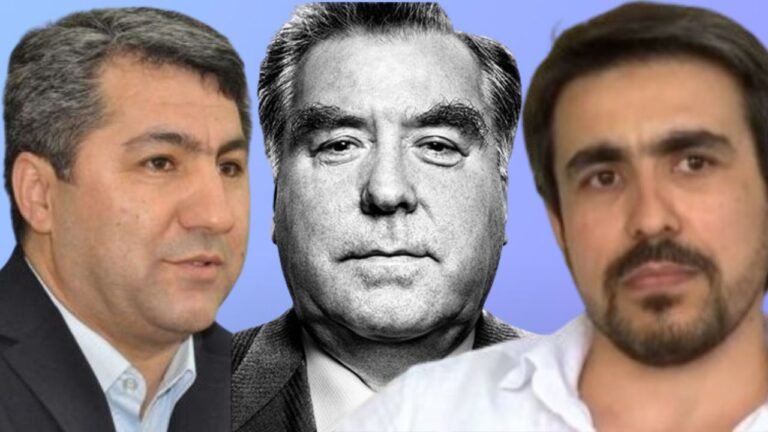
OPPOSITION IN TAJIKISTAN. WHO IS FIGHTING AGAINST THE DICTATORIAL REGIME IN THE COUNTRY?
Uncertain, fragmented, and on the brink of survival. This is a general description of the current state of the Tajik opposition. Once, it was considered one of the strongest in the post-Soviet space, even Russia had to reckon with it. But that is history now. What does the Tajik opposition look like TODAY? Who is trying to challenge Emomali Rahmon, and who is merely playing the role of the opposition? We will discuss this today.
The Tajik opposition can be described as uncertain, fragmented, and on the brink of survival. Once considered one of the strongest in the post-Soviet space, it was even acknowledged by Russia. But that is now history. What does the Tajik opposition look like TODAY? Who is trying to challenge Emomali Rahmon, and who is merely playing the role of opposition? We will discuss this today.
Systemic Opposition
The Tajik opposition can be divided into “systemic” and “non-systemic.” The systemic opposition consists of political parties that operate legally within the country and have representatives in the republican parliament. There are five such parties in the country. However, all of them are controlled by the authorities and are necessary for the authoritarian regime only as a decoration for the Western audience.
In reality, the systemic opposition remains in a state of suspended animation during the inter-election period and only awakens when it is necessary to legitimize the elections conducted by the regime. That is all.
Non-Systemic Opposition
The non-systemic opposition is much more complex. It has been expelled from the country, is heterogeneous in composition, weak and fragmented, and lacks clear goals, or at least cannot define the paths to achieve them. However, even in this form, the non-systemic opposition causes significant concern for the regime. Consequently, Rahmon’s family-clan regime conducts a continuous struggle against it. The authorities spend considerable resources on this, inventing and improving repressive tools, and do not lose hope of discrediting it outside the country.
The non-systemic opposition is represented by two major groups – the National Alliance of Tajikistan and Group-24.
National Alliance of Tajikistan
The larger of these two is the National Alliance, led by the exiled chairman of the Islamic Revival Party, Muhiddin Kabiri.
The organization was established in September 2018 in Warsaw. In addition to the IRPT, it includes three other associations: the “Congress of Free Thinkers of Tajikistan,” “Reform and Development of Tajikistan,” and the “Congress of Migrants of Central Asia.”
A year later, the Supreme Court of Tajikistan recognized the Alliance as a terrorist-extremist organization.
The National Alliance stands out for its activity on social media – thanks to the party experience, former members of the IRPT have also managed to establish affiliated information resources with the Alliance. Because of this, the Supreme Court of Tajikistan periodically adds them to the list of banned resources in the country.
In addition, the Alliance sometimes holds rallies in support of political prisoners or against Emomali Rahmon’s visits to various European capitals. Furthermore, the Alliance does not lose hope of freeing convicted IRPT members in Tajikistan through existing mechanisms in the UN, although all attempts so far have been in vain.
Group-24
The political movement Group-24 was established in 2012 in Moscow by Tajik entrepreneur Umarali Kuvvatov and a group of his like-minded individuals. In a short time, the movement gained popularity among Tajik labor migrants. The energetic leader and the rapid rise in popularity of the opposition coalition seriously frightened the authorities of Tajikistan at that time.
Two years later, in October 2014, the Supreme Court of the republic recognized the activities of “Group-24” as extremist and banned it on the territory of Tajikistan. Five months after this, in March 2015, the leader of the movement, Umarali Kuvvatov, was killed in Istanbul.
After that, the group was led by Kuvvatov’s nephew, Sharofiddin Gadoev. However, after some time, due to internal contradictions within the movement, the group was led by Sukhrab Zafar.
Group-24 is somewhat bolder than the National Alliance. It conducts daring pickets in Moscow and European capitals. However, ultimately, the results of its activities are not much different from those of other opposition groups.
Weaknesses of the Tajik Opposition
The main goal of the Tajik opposition today is to consolidate the socially active part of the population of the republic. And this is none other than the Tajik labor migrant. All informational activities of opposition groups are aimed at achieving this goal. United around the opposition, migrants could change the existing regime. However, without the support of the Russian authorities, achieving this goal is extremely difficult. The authorities of Tajikistan have made every effort to eliminate potential leaders among Tajik labor migrants; the expulsion of the late Karomat Sharipov, the extradition of Izzat Amon and Maksud Ibragimov are proof of that.
As long as the situation remains as it is, the opposition has no choice but to “wait on the shore until the corpse of their political enemy floats by.”