News
SOCIETY
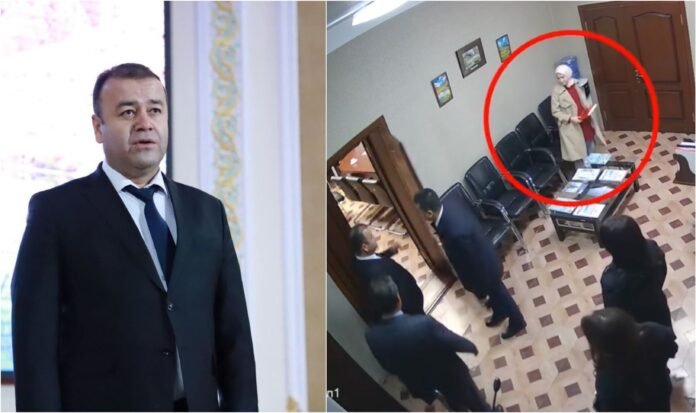
Rector expelled journalist from university due to her hijab
The newly appointed rector of the Russian-Tajik (Slavic) University (RTSU), Ilkhomiddin Ibrokhimzoda, expelled a journalist from “Asia-Plus” from the university building. Ibrokhimzoda himself reported this in an interview with the news agency “Hamsado.” On November 3 of this year, the President of Tajikistan, Emomali Rahmon, replaced the rectors of several universities in the country, including […]
The newly appointed rector of the Russian-Tajik (Slavic) University (RTSU), Ilkhomiddin Ibrokhimzoda, expelled a journalist from “Asia-Plus” from the university building. Ibrokhimzoda himself reported this in an interview with the news agency “Hamsado.”
On November 3 of this year, the President of Tajikistan, Emomali Rahmon, replaced the rectors of several universities in the country, including RTSU. Faizullo Mashraba, whose son was responsible for a traffic accident that resulted in the death of young singer Nekruz Niyozov, was succeeded in this position by Ilkhomiddin Ibrokhimzoda, who previously headed the Research Institute of “Tourism and Entrepreneurship” at the Tajik International University of Tourism and Entrepreneurship.
After this, the journalist from “Asia-Plus” attempted to interview Ibrokhimzoda about his plans, but the new rector of RTSU refused to speak with her. On the contrary, he ordered that she be removed from the university building.
The university administration cited “inappropriate clothing” as the reason for this, specifically jeans and sneakers.
This announcement sparked a strong reaction from users in the Tajik segment of social media. In particular, “Asia-Plus” stated that it remains unclear what kind of clothing a journalist is allowed to wear when coming for an interview with the rector, as there are no such requirements in any law of the country, and their introduction by the rector contradicts norms, including those related to access to information.
Following the surge of discussions, the new rector gave a brief interview to the news agency “Hamsado” and confirmed the fact of the journalist’s expulsion from the building.
Ibrokhimzoda stated that when he entered his office, there was a person in the reception area “in clothing that is prohibited for visiting the university,” namely in a headscarf, jeans, and sneakers, who wanted to speak with him. He allegedly told the journalist, “Please fix your headscarf, you may enter.”
The rector also claimed that he did not know it was a journalist from “Asia-Plus,” as she did not mention this and did not show identification confirming her work.
At the moment, neither “Asia-Plus” nor the journalist herself have commented on the rector’s statements. The Ministry of Education has also not yet responded.
However, the rector’s comments about the hijab caused even greater resonance. Residents in the comments wrote that the real reason was not the jeans and sneakers, but the wearing of the hijab and headscarf.
“Some kind of senseless policy. If you are almost undressed, you are greeted warmly. If you are dressed in a Muslim manner, there are immediately suspicions. Where is democracy? Who gave the rector such a right? The constitution? No. Then why do we need such a constitution that we do not accept, but rather violate?” wrote user Bakhtiyor Qurbонов.
“Did not the mother of Sadriddin Aini wear a headscarf? Did not the mother of Bobojon Gafurov wear a headscarf? Did not the mother of President Emomali Rahmon wear a headscarf? Why does the rector despise the headscarf of Tajik women – a part of our millennia-old culture? Unfortunately, today many have become admirers of Europe and turned away from their national values,” complains user Saididdin Oyev.
The case of the expulsion of the journalist under the pretext of clothing raises the main question: what right do educational institutions have to impose such restrictions, and does this not contradict the freedom of choice in clothing, freedom of speech, and the right to access information.