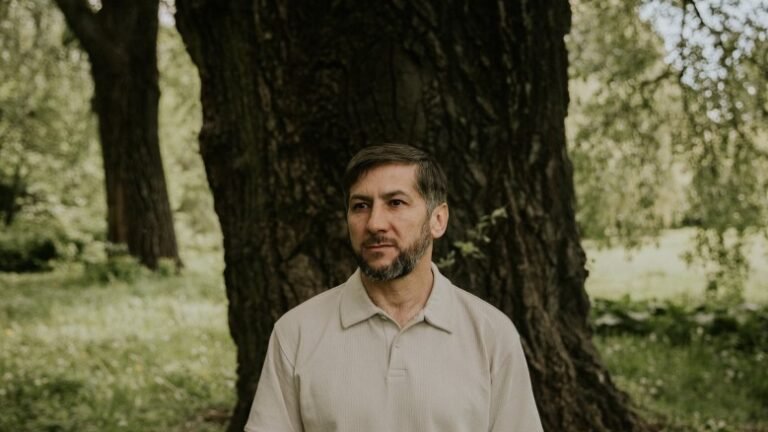
Refugee from Tajikistan has been living under the threat of deportation for six years. “I don’t want to ruin my children’s lives again”
Muhamadjon Kabirov, Anna Zaleska. Wyborcza.pl “I do not want to uproot my family again from a place where they have started to acclimatize. The children already have friends here, they know the language. My son would like to become a football player, and I would like to give him that opportunity,” says Islomjon Saidov, a […]
“I do not want to uproot my family again from a place where they have started to acclimatize. The children already have friends here, they know the language. My son would like to become a football player, and I would like to give him that opportunity,” says Islomjon Saidov, a refugee from Tajikistan who has been waiting for refugee status in Poland for several years.
When in 2015 the authorities of Tajikistan began seriously persecuting the opposition Islamic Revival Party of Tajikistan (its leaders were arrested and later sentenced to life imprisonment), Islomjon Saidov, a member of this party, found himself in Russia. The threat of deportation to Tajikistan pushed him to flee further — through Ukraine to Poland. He has been living here with his wife and three children since 2016.
Photo: InternetIslomjon Saidov. Photo by Dawid Żuchowicz / Agencja Wyborcza.pl
“We knew we would have to flee; among those arrested was the director of the Academy of Sciences of the Islamic Revival Party of Tajikistan, where I was also a researcher,” recounts Islomjon Saidov.
He adds that almost immediately, in 2016, he applied for asylum (formally — international protection) in Poland. However, neither the Office for Foreigners nor the Refugee Council took into account the arguments for granting this form of protection to Islomjon Saidov and his family. The case has already been sent twice to the Voivodeship Administrative Court (WSA) in Warsaw, which has twice annulled the decisions of the Refugee Council and returned the case for reconsideration.
Uncertain status undermines his son’s dreams
Mirzo is now 17 years old. His teenage years are marked by uncertainty, the rhythm of which is set by his parents’ worries about the stability of his stay in Poland. But he has his own niche — football. And dreams — to build his future around it. The problem is that, faced with a complicated approval system for players from non-EU countries to play in European clubs, Mirzo has become a hostage of bureaucracy and the unregulated situation in Poland in which his father finds himself.
“I would like to become a professional football player, to join Barcelona in the future. Without regulation of our status in Poland, it will be very difficult,” says the young athlete.
His father adds: “I do not want to ruin my children’s lives again. When we fled from Tajikistan, Mirzo was 10 years old. Now he would like to start a football career; he knows the language, he has friends. Just like my daughters, who are also already in middle school.”
Not only his son’s dreams are at stake
Islamjon Saidov continues his political activities in Poland. Among other things, he is a representative of the National Alliance of Tajikistan, a coalition of opposition parties operating in exile in Europe. He participates in conferences on human rights and democracy in Poland, organizes protests against human rights violations in Tajikistan, and provides assistance to refugees.
The authorities of Tajikistan are well aware of this.
“My brother lost his job as a high school teacher, local authorities threaten to confiscate my father’s house and land, protests have taken place in front of his house, and he has been called a ‘traitor to the people.’ My parents and relatives are regularly interrogated by the police,” says Islamjon Saidov.
He himself, absent from Tajikistan for six years, is also under investigation in the country. In November 2020, the State Committee for National Security of Tajikistan (formerly the KGB, the security service) opened a criminal case against Saidov. In an interview with Gazeta Wyborcza, Jamshid Yorov, a Tajik lawyer and director of the “Buzurgmera Yorova” Foundation, stated that if deported to Tajikistan, Saidov would be sentenced to imprisonment for a term of five to seven years.
During the subsequent proceedings at the Refugee Council (the case is currently in the process of transferring documents from the Voivodeship Court of Warsaw to the Council), it is important for the Council to consider that not only Saidov’s previous political activities—criticizing the authorities in Tajikistan—but also his current activities, which he continues in Poland, expose him to persecution in his country. Therefore, Saidov intends to present this argument.
Reports so far indicate that officials are examining the Saidov family’s application rather superficially—rejecting the refugees’ argument about the danger posed by Islamjon’s political activities, not confirming the evidence provided by the family, but at the same time not conducting their own investigation to gather information.
The regime holds firm
“If I am deported, I face years in prison and possibly torture,” says Islamjon Saidov. This has already happened to his friends. Abdullo Shamsiddin was deported from Germany to Tajikistan earlier this year and was sentenced to seven years in prison. Another Tajik refugee, Khizbullo Shovalizoda, was deported from Austria in 2020 and was sentenced to 20 years of imprisonment.
Human rights organizations note that the regime in Tajikistan, influenced by Russia, is becoming increasingly repressive. In addition to widespread violations of rights and freedoms, last year was marked by the bloody suppression of protests in the Gorno-Badakhshan Autonomous Region (GBAO), where authorities targeted the ethnic minority living in the region. Human Rights Watch (HRW) reports in its 2022 report that from November 2021 to June 2022, at least 40 people were killed during the suppression of protests that the Tajik authorities deemed “illegal.” Leaders of ethnic minorities from GBAO, as well as journalists and bloggers covering the protests, faced repression. The Tajik authorities were condemned for these actions by the European Parliament.
HRW emphasizes that the conflict on the border of Tajikistan with Kyrgyzstan (which also has casualties) continues, opposition figures remain imprisoned on politically motivated charges, and violence against women and girls persists.
The number of applications from Tajik citizens for international protection in Poland (refugee status or so-called “subsidiary protection”) is increasing. In 2020, there were 87 applications, in 2021 — 115, in 2022 — 173, and this year (data up to April 10) — 45. However, positive decisions are in the minority. Since 2020, only four people have received refugee status, and a total of 86 people have received subsidiary protection during this period. On the other hand, there were 222 refusals and 101 withdrawals (all data covers the period from the beginning of 2020 to April 10, 2023).