News
RELIGION
Representatives of Tajikistan and the Vatican discussed cooperation
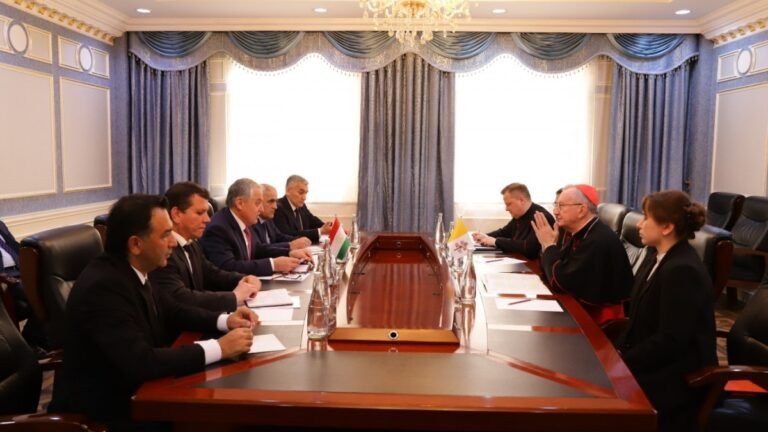
According to the press service of the Ministry of Foreign Affairs of Tajikistan, on June 10, the Minister of Foreign Affairs of Tajikistan, Sirojiddin Muhriddin, met with the Secretary of State of the Vatican, Cardinal Pietro Parolin. The Ministry of Foreign Affairs reported that during the conversation, the parties discussed “the current state and prospects […]
According to the press service of the Ministry of Foreign Affairs of Tajikistan, on June 10, the Minister of Foreign Affairs of Tajikistan, Sirojiddin Muhriddin, met with the Secretary of State of the Vatican, Cardinal Pietro Parolin.
The Ministry of Foreign Affairs reported that during the conversation, the parties discussed “the current state and prospects of bilateral relations,” as well as “issues of regional security and other matters of mutual interest.”
According to official data, about 98 percent of the population of Tajikistan are Muslims. However, over more than 30 years of Emomali Rahmon’s rule in Tajikistan, more than 70 religious associations have been officially registered, most of which are followers of various Christian denominations.
Earlier, on April 26, the President of Tajikistan, Emomali Rahmon, during an official visit to the Vatican, met with Pope Francis and the Secretary of State of the Vatican, Cardinal Pietro Parolin.
As reported by the press service of the country’s president, at this meeting, the parties discussed issues of strengthening fruitful cooperation. Emomali Rahmon assured the pontiff that “all conditions for tolerance and coexistence of representatives of all religions have been created in Tajikistan.”
While Emomali Rahmon is establishing relations with the Roman Catholic Church in the Vatican, repressions against citizens wearing Muslim clothing continue in Tajikistan.
Earlier, the Parliament of Tajikistan adopted amendments to the law “On the Regulation of Traditions and Rituals” and prohibited “clothing that does not correspond to national culture.” Thus, the new amendments to the law prohibit “the importation, sale, promotion of clothing alien to national culture, as well as wearing such clothing in public places.”
After the adoption of this law, law enforcement officers and government officials began conducting raids against hijabs in public places and detaining women in hijabs.