News
MIGRATION
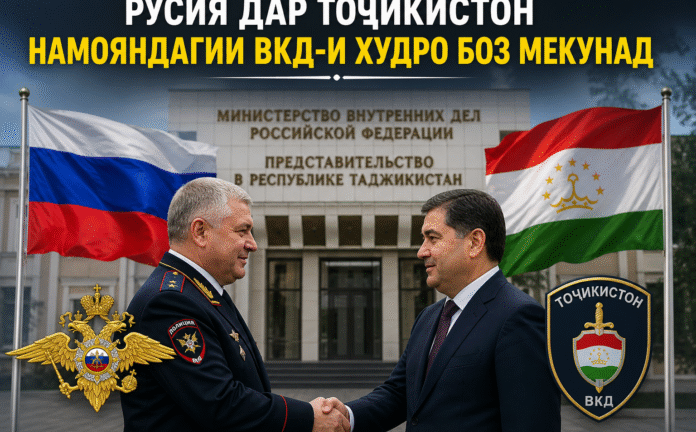
Russia will open an Interior Ministry representative office in Dushanbe
The draft of the bilateral agreement has already been submitted to the State Duma for consideration. According to Russian media, President Vladimir Putin has submitted for ratification to the State Duma an agreement with Tajikistan on the status of representations of the competent authorities of the two countries. It is reported that the purpose of […]
The draft of the bilateral agreement has already been submitted to the State Duma for consideration.
According to Russian media, President Vladimir Putin has submitted for ratification to the State Duma an agreement with Tajikistan on the status of representations of the competent authorities of the two countries.
It is reported that the purpose of this document is to strengthen bilateral cooperation between Russia and Tajikistan on internal affairs and migration issues.
The agreement on the opening of representations of the Ministry of Internal Affairs between Tajikistan and Russia was signed in Dushanbe on October 9, 2025.
As part of the agreement, in order to strengthen cooperation, the Ministry of Internal Affairs of Russia will open its representation in Dushanbe. In turn, Tajikistan will establish representations of the Ministry of Internal Affairs and the Ministry of Labor, Migration and Employment of the Population of Tajikistan in Moscow.
It is noted that this agreement is aimed at developing international cooperation in the fight against transnational crime, the illegal drug trade, and psychotropic substances, as well as addressing migration issues.
It is currently unclear what specific functions the representations of the Ministry of Internal Affairs of Russia and Tajikistan will perform on each other’s territory. Official sources are limited to general statements without providing details.
In this regard, observers are questioning on what basis Russia intends to establish a representation of its law enforcement agency on the territory of another state.
Experts note that although this agreement is formally bilateral, the Russian representation may have broader powers than just “diplomatic status.” They believe that the experience of post-Soviet countries shows that such structures can:
- engage in intelligence gathering;
- exert influence on local investigative and law enforcement agencies;
- be used as a tool of influence regarding labor migrants.
Experts emphasize that, given that millions of citizens of Tajikistan go to work in Russia, for Moscow, control over Tajik migrants has not only economic but also political significance. The attitude of Russian authorities towards Tajik migrants has particularly changed sharply after the armed attack on “Krokus City Hall.” Now Russia seeks to preemptively control the flow of labor migrants and verify their personal data on-site through its representation of the Ministry of Internal Affairs in Dushanbe.