News
HUMAN RIGHTS
Six human rights organizations demand the release of the relatives of opposition members
In a joint statement, six human rights organizations from various countries called on the authorities of Tajikistan to put an end to the detention of the relatives and loved ones of Tajik opposition activists. The joint statement, signed by human rights organizations Freedom for Eurasia (Austria), Buzurgmehr Foundation (Poland), Central Asian Migrants Association (Lithuania), Human […]
In a joint statement, six human rights organizations from various countries called on the authorities of Tajikistan to put an end to the detention of the relatives and loved ones of Tajik opposition activists.
The joint statement, signed by human rights organizations Freedom for Eurasia (Austria), Buzurgmehr Foundation (Poland), Central Asian Migrants Association (Lithuania), Human Rights Center (Austria), Committee for the Rescue of Hostages and Political Prisoners in Tajikistan (Poland), the group “ALGA UZBEKISTAN,” and the Central Asian Civil Initiatives Assembly “Vybor” (France), notes that the law enforcement agencies of Tajikistan continue to detain the relatives of activists and opposition members.
“According to information received directly from the relatives of the victims, the detentions occur without the presentation of any documents. Individuals taken to law enforcement agencies are subjected to rough treatment, threats, blackmail, and insults. Among the detainees are an elderly man of 81 years and a one-and-a-half-year-old child. To date, reports have been received of more than forty cases of detentions in various regions of Tajikistan,” the statement says.
According to these organizations, the authorities of Tajikistan have revived a form of collective punishment known as Sippenhaft (German for family responsibility), where the entire family is held accountable for the actions of individual family members. The principle of Sippenhaft was widely applied in Nazi Germany.
“We call on the entire progressive global community, human rights organizations, the governments of countries, and representatives of diplomatic corps in Tajikistan to take urgent, real, and necessary measures to free innocent citizens,” the joint statement of the human rights organizations notes.
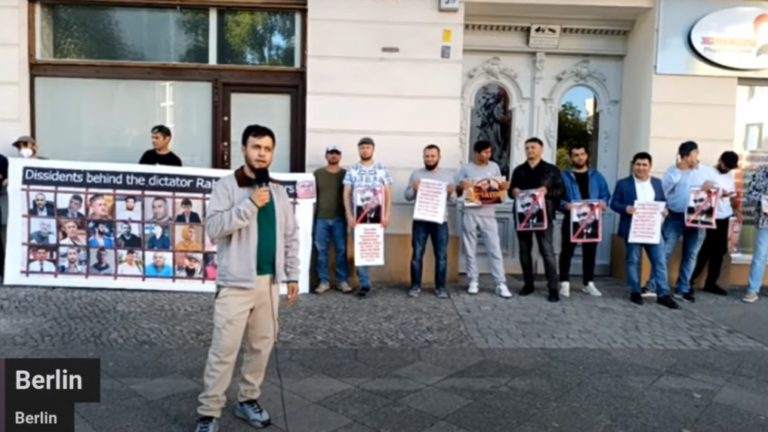
After the Tajik opposition organized protests in front of the Tajik Embassy in Germany and the residence of the President of Germany in Berlin on September 28 and 29, during which President Rahmon’s convoy was pelted with eggs, the law enforcement agencies of Tajikistan began to mass detain the relatives of opposition activists. They were detained and taken to an unknown location, and the fate of some remains unknown.
The authorities of Tajikistan have not yet officially explained these mass detentions. However, opposition activists claim that Rahmon wants to “take revenge” on their relatives, as he has never been attacked by the opposition during his foreign visits, unlike what happened during his visit to Germany.
According to the opposition members and activists themselves, the law enforcement agencies of the country, during the detention of their relatives, stated why they called the president a dictator and pelted his car with eggs, thus putting pressure on the relatives to ensure that the opposition members abroad return to the country, repent, and ask for forgiveness.